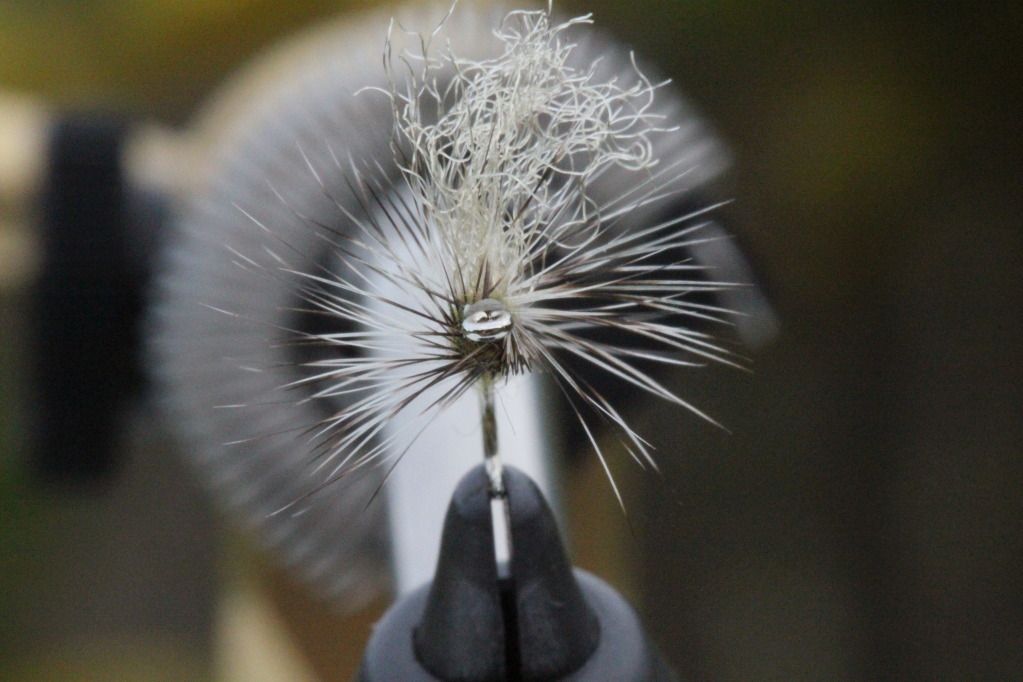
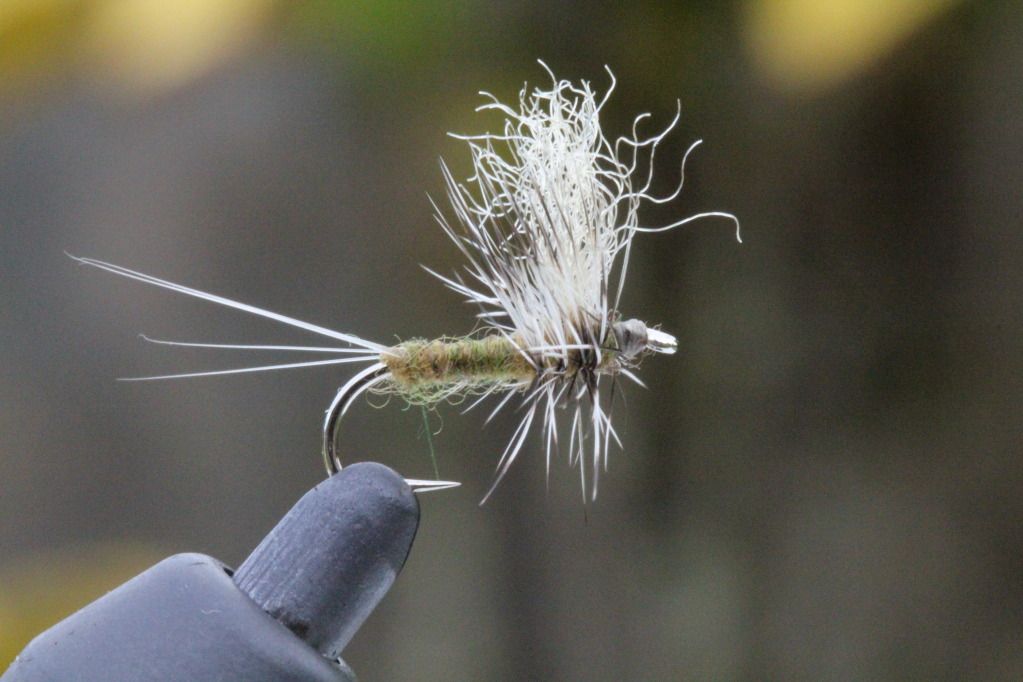
Joking here, but I am trying to select a fly pattern with a better footprint on the water. No one seemed to like the Water Walker style fly for this purpose. So, I’m focusing on a thorax style fly.
Which pattern do you think produces the better footprint?
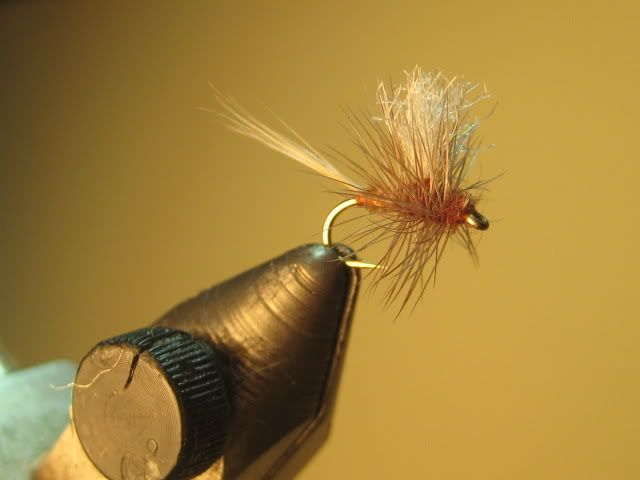
I don’t know about how good the “footprint” is but I have had times on the river when a fly dressed like the one in your photo caught but one tied using the exact same materials in parachute style didn’t. Probably only 1/16" in difference in the way it sits on the water made the fish reject the fly. I could see them come to the parachute and inspect it. They wouldn’t take it. Change back to the thorax and caught the same fish.
Cheers,
A.
Yes, Deeana (sp?) {Lady Fisher} reminded me of that one. Will see how it compares - in the bowl of water test against the clipped thorax style. If I get a good photo of the two of them on water, I will post it.
Byron
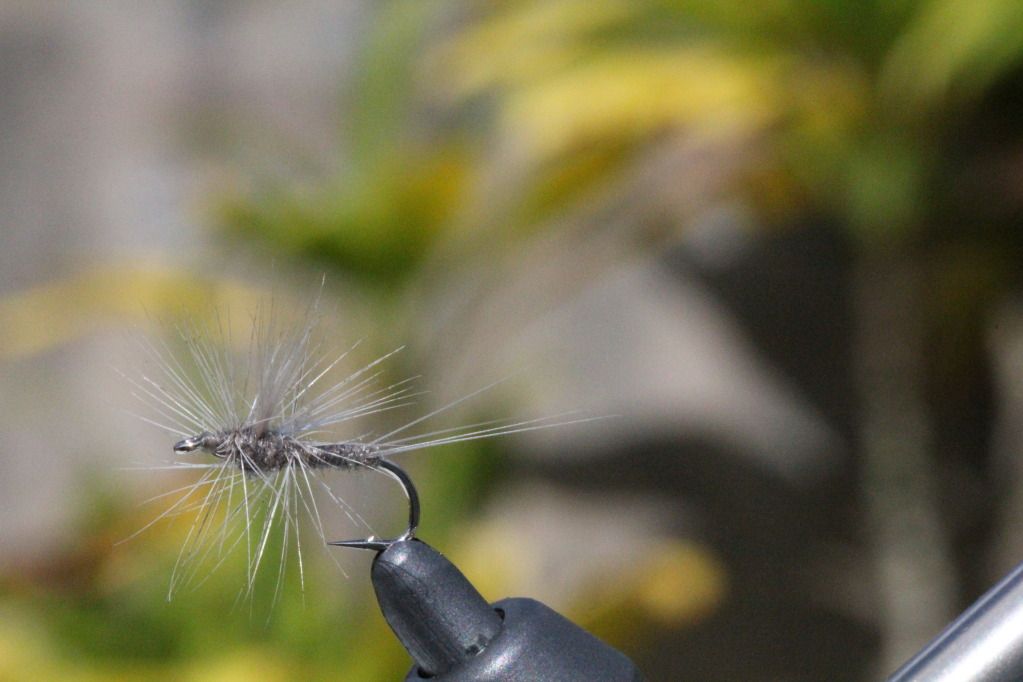
Don’t know if their footprint is better, but I do know the thorax style is a heck of a lot easier to tie and it catches fish for me. My favorite mayfly pattern is Barr’s viz-a-dun:
I usually tie with a biot body to speed things up even more.
Scott,
Tried a thorax style. Thought the hackle was to be sparse and X wrapped? I notice my “wing” fibers are too sparse and don’t stand out enough.
Anyway, would this work for a comparison of footprint on water in a plastic bowl?
Thanks,
Byron
I actually liked your other fly, but down this path lies madness, or the recreation of a mayfly with 6 legs touching the water, which is where sparse hackle and that thorax tie come in. As long as that big nasty steel hook hangs down there, and tippet hangs off the front and touches the water, the footprint is going to be less than perfect.
Been thinking about the premise of this thread.
The answer is obvious. Somewhat like the emperor’s new dry fly.
There is no perfect footprint. Or perhaps it’s more accurate to say there are many.
If you stand in the Spring Creek during a thick hatch–perhaps Pale Morning Duns in July, for instance at O’Hair’s south of Livingston, MT–and if you watch the fish, rather than fish, you will see the fish take any and all arriving dimples. Some are drowned and spent wing. Some have wings upright but are still half trapped in the shuck. Some are on their sides, struggling vigorously. Some have one wing up and the other crumpled stuck to the body. Some dimples are drifting nymphs with wing cases barely split. The fish take them all–all the real ones anyway. Sometimes two fish will race each other to next arriving dimple.
Any and all flies that are approximately the right size and color are as good as any other. If a fish refuses your Sparkle Dun. Switch to a no-hackle or an emerger or to a spent wing. Changing pattern (to any other pattern) as a response to a refusal is what any experienced spring creek guide will tell you to do. That’s what they told me when I first started working at the Yellowstone Angler. I heard that from everybody I worked with: Deanna’s nephew Tom, from John Green, Paul Rice, Rick Smith, Chuck Tuschmidt, Randy Berry, Rick Smith. Brandt Oswald. Bob Auger. George too for that matter. All of them. It doesn’t mean you can’t have a few favorite patterns. But you do have to be willing to give up on them periodically. A wide variety of simple patterns in your box is more powerful than a smaller number of complex ones.
Pitt:
I can see your point. Would tend to agree in some situations. However, I have been in situations where you really did have to “match the hatch” to be successful. The reason I enjoy fishing and fly tying is because it CAN be so challenging. I enjoy the challenge and strive to meet the challenge, where necessary. I have seen guys walk away from the river in frustration when the rising trout would take nothing he put on - and he must have tried 8-10 different flies. I don’t like walking away…
I’m not saying the fish aren’t selective, during a hatch. I’m stretching the morphological definition of match. A green drake pattern won’t do well during a pale morning dun hatch. But any (any) fly the size and color of a pale morning dun can be used effectively. Some might work better than others, but conditions change, from minute to minute. And spring creek fish are wary. They’ve all been pricked a thousand times. If you do get a refusal you have to change pattern. Else you scratch on the eight ball.
During the evening Sulfur hatches (late summer on the Paradise Valley spring creeks) it is virtually impossible to catch a fish on a dry fly. Unlike blue winged olives and pale morning duns, which ride the surface film for twenty feet or more before flying off, the sulfurs seem to catapult themselves out of the water the instant they reach the surface. There are no drifting naturals and the fish won’t take them. You have to fish nymphs or emergers. Or you won’t catch any fish. A wide variety of tiny sulfur-colored cylinders work just fine. Perhaps the term should be “match the behavior.”
Also, as to John’s points about presentation (posted below this one)…sure. Presentation is extremely important. But it isn’t the whole story. If you’re fishing your favorite sparkling water walker with trailing Zelon shuck and UV microlegs, or what ever, and if you get refused twice by the same regularly rising fish, two dozen perfect presentations after that are good money after bad. Change pattern and then make a good presentation, however, and boom. There you go. Fish on!
… if not likely, that the problem was not with the particular flies being offered, but with the angler’s presentation of them.
Of course, blaming it on the flies or the fish is easier than taking responsibility for the presentation.
Admittedly, I fish very few hatches ( except for the stoneflies and October caddis ) and run into very few “selective trout” and very rarely fish over trouts that have been in any way “pressured.” But fundamentals are fundamentals, and presentation is right up there at the top of the list on what it takes to catch the fishies.
I do agree with Sandy that having a good selection of simple flies probably confers a real advantage over having a good selection of flies designed to catch fishermen, or hobbyist fly tiers.
John
P.S. When I used to ask one of my mentors, Bruce Staples who is a Buzz Buszek award winner, about which fly to use, he would tell me it didn’t make much different - just present a good one properly.
Every July I fish Harriman Ranch on the Henry’s Fork. Mike Lawson, who has a shop there, says the trout on the Ranch “have their PHD’s”. They are very selective!!!
… with this observation. In my case, out of two dozen casts, I may get a couple “perfect” presentations, so I’ll likely hang in there a bit longer with the same fly.
The turn this thread has taken reminds me of a day on the Lochsa this past summer. For weeks, I had been doing quite well with a fly that doubles nicely as a hopper and golden stone, rarely changing to any other pattern. This particular day, I came across a couple good size fish regularly showing themselves as they took nymphs or emergers high in the water column and rarely breaking the surface. They were feeding just off the right side of a V formed by currents of differing speeds below a pocket of soft water behind a large boulder. Not a long cast, but a rather tricky presentation.
Thought the big hopper / golden stone might entice them. Nope. For about an hour, I changed patterns and presentation angles with no success. I lined them, I leadered them, I hit them with big flies, I hit them with little flies, all without changing their feeding pattern. Finally, I tied on a scraggly left over size 20 Griffith Gnat tied for the trico hatch the summer before.
Second or third cast - got one. An 18-19" Westslope Cutt. A few casts later - hooked the other one. After a couple really strong runs and a good tussle, got him in close enough to know he was a bit bigger than the first one, and then lost him when he took the tippet over some rocks just below my position.
Everyone knows that cutts are dumb, right? Reminds me of one I worked on the Gallatin up in YNP - showed itself taking some unidentified bug, I had been doing fairly well with a foam-backed Convertible so I tried that first (no luck), switched to a beetle (no luck), saw it swirl again on something I couldn’t see so I went real small with an ant, still no luck, CDC & Elk, the same. After about 20 minutes of this I sat on a midstream rock, had a drink of water and just watched; finally saw some small mayflies coming off (18’s), pmds???, tried a hairwing dun and nailed that 10 incher on the 2nd cast. Made my day.
 Reminds me of one I worked on the Gallatin up in YNP - showed itself taking some unidentified bug, I had been doing fairly well with a foam-backed Convertible so I tried that first (no luck), switched to a beetle (no luck), saw it swirl again on something I couldn’t see so I went real small with an ant, still no luck, CDC & Elk, the same. After about 20 minutes of this I sat on a midstream rock, had a drink of water and just watched; finally saw some small mayflies coming off (18’s), pmds???, tried a hairwing dun and nailed that 10 incher on the 2nd cast. Made my day.