While most fly fishermen consider the Catskills the birthplace of American
fly-fishing, the folks around Henryville, Pennsylvania might have a different
view of history. Located in the Pocono Mountains of Eastern Pennsylvania,
Henryville and the surrounding area just might have a justifiable claim
as birthplace of American Fly-fishing. The area has always been known for
the abundant trout producing streams. When Captain Daniel Brodhead purchased
his 1500 acres in 1737 the cold flowing waters had been known by the Indian
name of Analomik but it was not long before people started referring to
it as Brodheads Creek. The beginning of the angling tradition begins almost
a century later with a log cabin or Halfway House built by Arthur Henry
along the freight road between Easton and Scranton Pa. At first, Halfway
House was used primarily by the muleskinners and freighters with the occasional
trout angler. In 1836 the log cabin was expanded and became known as Henryville
House. The Brodhead was already developing a following of visiting anglers
with the help of glowing fish stories written by the visiting newspaper
columnist. A special section was devoted in the 1848 edition of “The
Complete Angler” of fly patterns specifically for the Brodhead and
surrounding streams. With the expansion of the railroads came the real
invasion of fly fishers into the area.
Around 1851, Thaddeus Norris noted fishing author was one of the early
Brodhead apostles whose signature is found in old registers at Henryville
House. That same year Norris experimented with a “dry fly method” as
he describes it in detail in his “American Angler’s Book” of
1865. His efforts were made with hardly more than a heavily hackle wet
fly that would land softly, float and be taken by a trout before it would
sink. This primitive dry fly method was practiced on the Brodhead almost
25 years before the innovations of Theodore Gordon on the Beaverkill. Joining
Norris at Henryville House was Samuel Phillippe the noted gunsmith and
violin maker from Easton Pa., who, working with Norris developed the modern
bamboo rod construction method. Mixed in among the fly fishermen the names
of noted celebrities from the world of sports, entertainment and politics
could be found on the pages of the register such as John L Sullivan and
Lily Lang-try. Presidential candidates Grover Cleveland and Benjamin Harrison
were registered at Henryville House simultaneously for a week of fishing
just before their campaign in 1880.
By 1890 the little river started its decline. Years of abuse from farming
and logging had ravaged the landscape leaving the water shed vulnerable
to the summer heat making the water too warm for the native Brook trout.
The opening week end of 1897 was an historic event in the history of Henryville
House for it marked the last time a group of wealthy fly fishermen known
as the Brooklyn Fly Fishers held their annual ritual at Henryville House.
They would move to the North to the Hardenburgh Farm on the Beaverkill
where these early Brodhead fishermen would play a major role in the development
and reputation of the Beaverkill and Catskills. Their departure marked
an end to an era; the Brodhead and Henryville House would never be the
same. Gone are the freight wagons and steam driven trains and native Brook
trout, today anglers drive into the Poconos from Philadelphia and New York
for a chance to land one of the stocked Brown or rainbow trout that have
since replaced the Brook trout. I supposed very few of these fishermen
know the importance these waters played in shaping the direction of our
sport.
I’m not really sure if it is safe to give all the credit or title of birth
place of fly fishing to just one place, either the Catskills or Henryville
. It is clear that the Catskills benefited from the progressive thinking
and fly fishing innovations resulting from the work by the early Brodhead
fishermen. But, the Catskills has produced innovations and contributed
to the sport also and has maintained the high quality of fishing longer.
Perhaps the Brodhead dropped the ball and lost the title when it allowed
it’s outstanding fishing resource to be reduced to that of only ordinary.
I hope that perhaps the most important lessons the Catskills or any other
fishery could learn for Henryville is to keep in mind just how important
it is to protect this valuable and treasured asset.
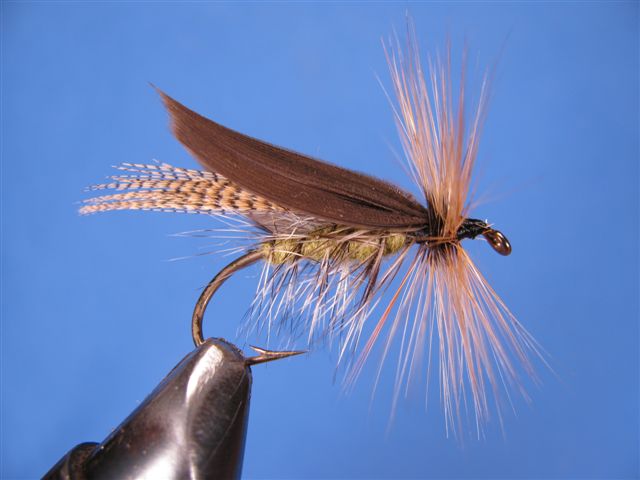
The fly known as the Henryville Special was first tied by Hiram Brobst,
an old-time Pocono fly tier from LeHighton Pa. The fly was developed to
be use for a caddis imitation on the fast boiling pocket water of the Pocono
Mountains. The influence of the popular sedge fly from Europe can be seen
in the laid back wings tied tent style. Countless other variations of the
fly has been developed and used around the world.
Henryville Special
- Thread: Olive or black
- Body: Olive dubbing
- Rib: Grizzly hackle with the barbs slightly shorter
than the hook gape- Wing: Woodduck flank used as an under wing, over
which are matched sections of natural dark goose wing quill tied
tent style- Hackle: Dark ginger
Credits: The Beaverkill by Ed Van Put; American
Trout Fishing by Theodore Gordon & a Company of Anglers; Homage
to Henryville by Ernest Schwiebert; Universal Fly
Tying Guide by Dick Stuart; ~ LB
Originally published November 2, 2009 on Fly Anglers Online by Larry Bordas, Pennsylvania.