I was under the weather for a couple of weeks and didn’t feel up to tying. So, I spent a lot of time viewing tying videos on Youtube and other media.
One of the tiers I enjoy watching and listening to is Kelly Galloup of Slide Inn on the Madison. He’s really a “down-to-earth” tier/fisher. In one of his videos, he talks about hackle. While discussing the various types (neck, saddles,dry,wet, etc.) he got off on a bit of an interesting tangent. He discussed that he feels present day tiers use hackle which is shorter than should be used. He even went so far as to say that he often uses at least one and sometimes 2 sizes larger hackle than is called for given current gauges and size proportions.
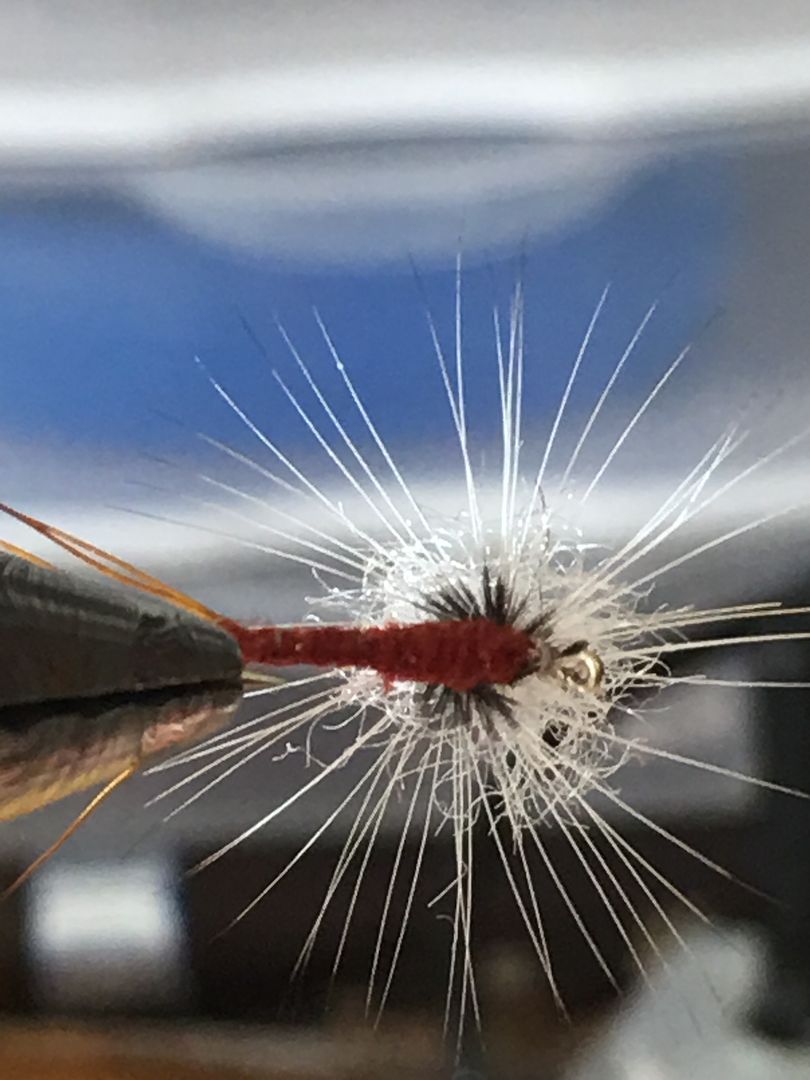
Anyway, he stressed that it is more important (to him, at least) in parachutes and spinner patterns. I find that another tier I really admire (Bob Jacklin of West Yellowstone) seems to do the same. I have had such great success with his para-spinner pattern which does have “oversized hackle”, that I had started doing the same thing even before watching Kelly Galloup’s video.
Wonder what other tiers think of this.
PS, Galloup even referred to the old “Variant” dry fly patterns which used over-sized hackle for classic tied dries.
Hope you’re feeling better now, Byron. Two ideas about “oversize” hackles on parachute flies. First- the legs of some duns are spread out rather far. Second and, to me, the most important reason: many parachutes are tied with dubbed bodies, that are then treated to be water repellant. This makes them sit up on, rather than in, the surface film (at least until a trout slimes it up!). This, along with the slight, but important weight of the wing and hackle on top of the body, causes the fly to be a bit top-heavy. Using larger hackles helps to stabilize the fly. Just my $0.02, but I’ve done tests in dishes of water to help pass the winter months (I don’t live in Hawaii!).
I don’t personally tie/use Catskill style or Variant style flies anymore, but here is an example of the “Variant” Kelly Galloup referred to. It is the Art Flick style Gray/Grey Fox Variant tied by someone (not sure whom):
I find that 2 sizes larger on spinners is about right. If you look at the BWO spinner post, you will see an example of a #18 shank hook, which is tied with #14 hackle… I tie and fish catskill variants quite a bit, and as posted by Byron, they are very efective. Commercially, i agree. They are tied too small.
In both variants and spinner patterns, the hackle represents wings as well as legs, so you want the hackle to be a bit longer.
I go back and forth about how long to make the hackle on parachutes where there are no wings (think ants) and haven’t come to a clear conclusion.
Most commercially tied Catskill style flies (and I’m not referring to variants) have hackle that’s considerably shorter than what was used “back in the day”. It’s my belief that they don’t fish as well because of it, but that may just be a confidence thing on my part. I like the longer hackle.
Agree Redietz. I should have clarified that on parachute patterns I was talking about mayfly/Stonefly patterns and not terrestrials. I do think Jacklin, Galloup, and many others make a valid point. When I look through the big bins at big fly shops with the nearly perfectly consistent imported parachute ties, I find the hackle to be shorter than I think provides an inviting outline when viewing from below the fly. Just my opinion as well. I found this comment by Charlie Craven, I believe, when discussing a parachute spinner tied by famous Rene Harrop:
“While conventional wisdom is that the hackle on a parachute pattern imitates the legs of a mayfly, Harrop’s fly instead uses the parachute hackle to imitate the long, spent wings of a mayfly spinner lying flush in the surface film, and therefore the hackle is purposely tied twice as long as normal to better match this identifiable trait.”
I think of parachutes as multi-stage representations – ie, they might imitate duns, emergers, cripples, or spinners. Not really sure what that suggests in terms of hackle length, but I prefer my parachute hackle oversized by one.
I agree with the notion that hackle on spinners represents the down wing and use a hackle to match wing length.
If you want to get picky, I’d note that some mayflies have relatively longer wings (compared to body length) than others. Maybe we should be adjusting spinner hackle length to the specific hatch? For example, Tricos, at least in my neighborhood, have relatively long (and wide) wings which I try to incorporate into my imitations.
 ](http://s1101.photobucket.com/user/byhaugh/media/Para Spinner_zpscbbqxahz.jpg.html)
