| Sysadmin Note |
|---|
Chapter 4: Midge Emerger (ascending pupa)
Midge (Diptera) undergo a complete metamorphosis like caddis. Hence the term emerger, which we often use for mayfly hatch stage, may not be appropriate in the scientific and taxonomical senses. However, for spring-creek anglers the term is commonly used. We mean:
- Pupae that are ascending to and reaching almost the water surface
- Midge adults that are leaving (or struggling to leave) their pupal shucks.
Trout will key on what’s available to them and the hatch stage in which insects are most vulnerable (the easiest stage for trout to capture them). Midge hatches and fishing during it may not be for everyone. I think it’s mostly because flies are small. Those are hard to see when fishing on the surface. Also anglers are forced to use finer tippets, which translate to careful hook-sets and skillful fish-fighting. Additionally the trout will care about size, shape, and color of even these tiny creatures. If we want to catch them with our flies we have to play by their rules.
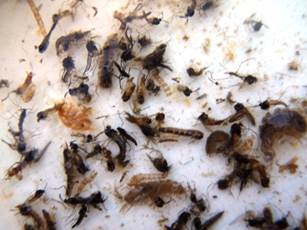
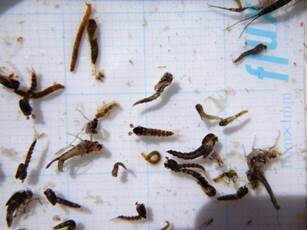
These stomach samples were taken from trout that were “rising”.
Seasonal Importance:
Midges are available for trout all through the year, and more specifically, I like to divide midge availability into two phases.
-
In a yearly cycle, midge hatches will cause trout rises in March (the end of March provides more predictable hatches). Then, after the fall Baetis hatches are over sometime in November, midge hatches can cause trout rises again in November and December (and January and February, if you are lucky). An important note is these are the periods when other insects are not active but only midges. Midges will hatch in the middle of summer and in the fall too.
-
So when midges hatch during the period when other insects are active, we have to figure out what trout are keying on. Often midges are causing rises before hatches of other prime insects occur. Then, once prime hatches are over midges still can bring trout up to the surface. Now we are talking about an hourly cycle of the day. The bottom-line is: be prepared for midge hatches any time at spring creeks!
Midge APE
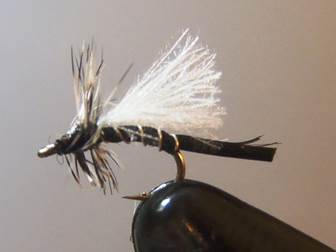
- Hook: Emerger #20, 22, 24
- Thread: Veevus 16/0 black
- Ribbing: Fine silver wire
- Shuck & Abdomen: Life Flex, black. Abdomen is NOT wrapped but just secured above thread under-body with the silver wire.
- Wing: White CDC
- Hackle: Grizzly, trimmed flat at the bottom
Note: APE stands for “Adult, Pupa, Emerger”. Dress ONLY CDC wing with CDC oil floatant.
Pupaerger
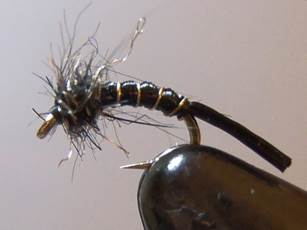
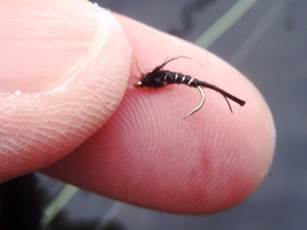
- Hook:Emerger #20, 22, 24
*I also use scud hooks and light-wire scud hooks in the same sizes to penetrate the surface a bit quicker than emerger hooks do. Besides scud hooks are stronger than emerger hooks. - Thread: Veevus 16/0 black
- Ribbing: Fine silver wire
- Shuck & Abdomen: Life Flex, black. Abdomen is wrapped around the shank.
- Thorax: Shaggy, with a bit of sparkle, black dubbing
Note: This pattern became the massive success instantly. I have caught many trout that were selectively feeding on ascending pupa/emerger (hence the name). Right photo attests the bruise caused by large individuals (and that’s why scud hooks can be used oftentimes).
How to Fish:
I almost always fish with a dry-fly and subsurface fly combination. Apparently those two above make the perfect combination. The top fly can be taken by itself and then it serves as an indicator for the emerger or ascending pupa patterns.
Midge Mania:
Whether on spring creeks or big rivers like the Yellowstone and Madison rivers, midge hatches provide some of the finest fishing experiences. Apparently I’m one of those “aficionados”. In my case, I try to fish every month of year so I usually experience the first and the last rises of the year with midges. On those days, any trout caught on my dry-flies are pleasures to me. Then when I encounter groups of trout feeding “exclusively” on midges and “selectively” on a certain hatch stage, my fishing sense is in the stage beyond description.
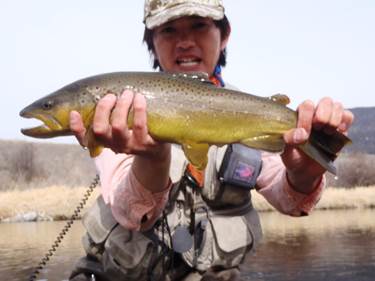
One of the most challenging and technical midge situations on DePuy Spring Creek. Once hooked, the fight was the toughest and the most careful one with a long leader which ended with 6X tippet. Fly was Pupaerger illustrated above.
Satoshi Yamamoto, https://leftyangler.blogspot.com, is a guide and a professional fly-tyer in Livingston, MT.
| Sysadmin Note |
|---|
| Sysadmin Note |
|---|
Chapter 5: Snails:
Snail (Animal Class: Gastropoda) is probably the most overlooked trout food for the majority of anglers. Whether on rivers, spring creeks, or lakes/ponds, snails are abundant and trout do feed on them. Especially on spring creeks, but you might say “Who cares?” Well, trout do. Some anglers simply don’t know it, others don’t have the right flies. Almost every time I catch trout 11 to 15 inches on spring creeks in my area, when I do stomach sampling, I have been collecting snails more often than other types of food. Of course, when I do kick-seining, I collect them. The idea to design a snail pattern began ticking in my head.
| Live sample from kick-seining | From a stomach sample, along with crustaceans. |
Seasonal Importance:
Same observation can be applied as stated for cranefly larvae and Golden Stone nymphs. Even though these are present and available all year long, trout may pass up when other food sources are more abundant. During the periods when mayfly and caddis are actively hatching, trout simply pay more attention to them.
Mummy Snail
Development:
I first thought about how to represent the segmentations and flash of spiral coiled shell. Wire and Scud-back were employed. My next and biggest concern was the shape. If I would create the wider part at the rear end of hook-shank and taper down to the hook-eye, that would have been easier. However that would narrow the hook-gap and potentially result in lost fish. On the contrary, if I would design the wider part at the front end of hook, how could I wrap up the fly? The answer was to incorporate a bead. I could whip-finish behind the bead, maintaining the wide shape. Besides, the bead adds extra weight and all-time fishiness. It may even look like a “foot” peeking out! Finally it was created and tested on DePuy Spring Creek. It was an immediate success!! Since then it’s been hauling in trout after trout. There are two reasons that I suspect for this great effectiveness:
- nobody uses them and trout has never see snail flies
- trout love them!!
| * Hook: MFC 7231 or Dai-Riki 280 size 16, 18, 20 * Bead: Gold 3/32" for size 16, 5/64" for sizes 18 & 20 (copper bead can be substituted.) * Thread: Brown 6/0 or 8/0 * Wire: Medium copper for size 16, small for sizes 18 & 20 * Wrap: Scud Back tan 1/8" * Dubbing: Whitlock’s SLF Blends #14 brown stone nymph *Match colors of Scud-back and dubbing according to what you find in waters you fish. In my case, brown dubbing with tan wrap was proven to be better than other colors. |
How to Fish:
Use under an indicator rig in moderate to fast riffles where snails are dislodged and washed away. Apply split-shot to achieve desired depth (speed to get down) and drift (the more weight, the slower to drift). It’s recommended to trail and fish together with other aquatic food imitations.
| Crunchy? | Crushed Mummy Snail……….. |
Bad Snail:
New Zealand Mud Snail (Potamopyrgus antipodarum) is what we DON’T want. Please refer here for detailed information (https://en.wikipedia.org/wiki/New_Zealand_mud_snail) so we can identify them and somehow get rid of them. These bad snails combat against other trout food (mayfly nymphs and caddis larvae) over habitats and they usually take over. Consequently mayfly and caddis population of the water will decrease. Trout actually feed on Mud Snails but cannot digest them. Unfortunately in my area, the Madison Drainage (including Firehole and Gibbon Rivers within Yellowstone Park) are classified as “invaded”. I once heard a very disgusting report from an angler who caught a brown trout for consumption from the Madison. As he gutted it he found a stomach full of tiny black snails…………
Fortunately, the Yellowstone River and its tributaries are invasion-free for now. So both local and visiting anglers are well-advised to wash wading boots and, if possible, own another pair and use one pair for each particular drainage.
Satoshi Yamamoto, https://leftyangler.blogspot.com, is a guide and a professional fly-tyer in Livingston, MT.
| Sysadmin Note |
|---|
| Sysadmin Note |
|---|
Ascending Mayfly Nymphs
Perhaps mayfly hatches are the most iconic and captivating images of spring creek fishing. Do you want to fish with dun and emerger dry-flies? Yes, you can and will enjoy. However what is the more effective fly/method to catch more numbers and even bigger trout during the hatch? It’s the nymphs that are ascending the water column to hatch. I’m positive some readers have just said “Ugh? What? Nymphs?” I know, I know. There are two-fold mistakes. The first one is the “lingo”, which I can explain with my words. When fly fishers mention “nymph”, often it implies to fish with any kinds of subsurface flies (often bright beads incorporated) deeply with indicators/bobbers. That’s not the kind of “nymph” I’m talking about. What I mean here is “mayfly nymph” as the creature. We fish with them either on the surface or slightly below the surface. If you still don’t get it, that’s the second mistake; mix of dry-fly snobbery and misunderstanding of trout/insect behaviors. To add more dignity and support to this chapter, I will quote from Dave Whitlock’s “Guide to Aquatic Trout Foods” (ISBN: 0-941130-64-9). “During the nymphal emergence and surface transformation, the mayfly is most attractive and vulnerable to the trout. Trout often follow the nymphs to the surface and suck them in out of the surface film just before or during the transformation to the free dun. Understanding and fishing nymphs is as much, if not more, sophisticated and complex a technique as the floating-fly techniques.”
| A stomach content of trout that was rising during BWO hatch. | A typical stomach sampling result during PMD hatch. |
Seasonal Importance:
There are two major mayfly hatches that deserve special attention. The Pale Morning Dun (Ephemerella inermis and infrequens) prime hatch is from late June to most part of July. There are still some insects that hatch into August. One can observe PMD hatches throughout the season, but normally not in sufficient numbers to be considered a hatch. Another major mayfly is the Blue Winged Olive (Baetis). Spring BWO are seen from late March to April. Fall BWO hatch through October and in November.
Winged Victory Nymph
| BWO | PMD |
| * Hook: Standard dry. #16 & 18 for PMD. #18, 20, & 22 for BWO * Thread: 12/0 to match naturals * Ribbing: Fine gold wire, counter-wrapped over abdomen * Tail & Abdomen: Pheasant tail (natural, olive, & yellow) * Wing-case, Eyes, & Wings: Medium rubber-legs * Thorax: Superfine Dub to match naturals |
FA Nymph
| * Hook: Straight-eye dry. #16 & 18 for PMD. #18, 20, & 22 for BWO * Thread: 12/0 or 16/0 to match naturals * Ribbing: Fine gold or copper wire, counter-wrapped over abdomen * Tail & Abdomen: Pheasant tail (natural, olive, & yellow) * Wing-case: Thin strip (1mm) of foam, black or gray * Thorax: Superfine Dub to match naturals |
How to Fish:
If you are a confident angler, who can cast accurately and who can detect takes (by feel and subtle movement of leaders), just tie on one of these patterns singlehandedly. Also if you can get really close to a visible trout that is feeding subsurface, you should be able to see this type of fly without an indicator or a dry-fly above. (yet one needs be a confident angler) Trailing this type of fly under dun imitations is always effective. Often trout will also take dun dry-flies too.
Satoshi Yamamoto, https://leftyangler.blogspot.com, is a guide and a professional fly-tyer in Livingston, MT.
| Sysadmin Note |
|---|
| Sysadmin Note |
|---|
Chapter 7: Caddis Larva
Caddis often seems to be forgotten or even ignored due to the popularity of mayflies on spring creeks. They will also hatch and cause trout to rise and will consist a certain part of the trout’s diet. Caddis hatches also take place during the warm months (spring to summer) but their larvae remain active and seem found throughout the season (my kick-seining and stomach samples). Knowing food sources and having fly patterns always get you one-step ahead of others. These caddis larva patterns are such examples.
| Free Living (Swimmer) | Portable Case Maker |
Seasonal Importance:
Either at moderate or fast riffles of spring creeks, caddis larvae are found all through the year. These would become important and be eaten more by trout during the period other insects are dormant.
Chewy Green Caddis Larva
| * Hook: 2XL curved hook #10 to 16 * Thread: 8/0 olive * Weight: .015 lead-wire under thorax. * Tail (pincers): Brown goose biots * Ribbing: Gold or copper wire. Small or medium, depending on sizes. * Over-body: Scud back olive * Under-body: Super-Floss or any other “stretchy” materials, wrapped around * Dubbing: Brown Ice dub in a dubbing loop |
L.L. Beads (black)
| * Hook: 2XL curved hook #16 * Thread: 8/0 black * Body: small black beads * Tag: Pearl Krystal Flash, whip-finished * Coating: Clear cement or nail paint Note: This is exactly the same pattern as shown in Chapter 1. However, I’d like to categorize this “black #16” separately from red & small ones. This one also imitates small leeches that I often observe. Indeed I came up this one first before red ones. Hence the name “L.L.”, which stands for “Leach & Larva”. |
How to Fish:
Use under an indicator rig at moderate to fast riffles, where caddis larvae are most common. They prefer oxygenated waters. Apply split-shot to achieve desired depth (speed to get down) and drift (the more weight, the slower to drift). I encourage anglers to use these patterns on two-nymph rigs, combining with other aquatic food sources.
Satoshi Yamamoto, https://leftyangler.blogspot.com, is a guide and a professional fly-tyer in Livingston, MT.
| Sysadmin Note |
|---|
| Sysadmin Note |
|---|
Sculpin:
Because spring creek waters are clear and rich in nutrition, sculpin and other types of minnows inhabit the stream in great numbers. Hence they are one of the more important food sources for trout in spring creeks. These are not the type of food that is consider standard spring creek fare, but using flies that imitate these small minnows will produce some surprising results.
| Top | Side |
| Belly – see why “gill” is often imitated red/orange in most fly patterns. | Found dead while kick-seining. No surprise if I find the same ones from stomach samplings. |
Seasonal Importance:
Sculpins and minnows are another constant year-long food source for trout on spring creeks. Hence streamer fishing can be effective any time of the day, any day of the month, and twelve months of the year. When trout migrate into creeks from Yellowstone River for spawning, those large and aggressive trout will take streamers viciously. Often I use streamers day-in and -out and when I don’t see any surface actions or somehow my nymphs are not producing.
ZAC Fry
| Natural | Olive-Black |
| * Hook: Dai-Riki 280 size 8 to 12 * Weight: .020 lead wire, 15 wraps on the front half of hook-shank * Thread: 210 denier or MFC Streamer Thread in misc. colors * Flash (optional): Krystal Flash in misc. colors under tail and both sides * Tail & Top: Pine squirrel zonker * Ribbing: Fine silver or gold wire * Body: Ice Dub in misc. colors * Collar: Webby portion of low grade saddle hackles: grizzly, olive-grizzly, tan-grizzly * Eye: Small 3D or stick-on in misc. colors of choice * Head: Built up with thread & coated with Sally Hansen Hard-as-Nail (clear). Note: ZAC stands for “Zonked And Chomped” as large predatory trout seem to find these small Zonker types just suitable for “one quick bite”. |
Egg Muddler Sculpin
| Natural | Olive-Natural |
| * Hook: Bent hook (Dai-Riki 700B, MFC7073) #4 & 6 * Thread: 6/0 colors of choice * Barbell-eye: colors of choices (silver, nickel, or gold) with 3D-eye, also colors of choices. * Tail: Marabou * Body: Dubbing and a clump of Ozzie Possum * Dubbing for gill: Pink * Legs: 3 pairs of barred rubber-legs * Collar: Deer hair, same color as the top of head * Head: Deer hair, dark color always on top half * Egg: Otter’s Egg 4mm (apricot, orange, etc.) stuck from the front of hook-eye over the red thread base and with super-glue. Note: Recommended color combinations are as follows. 1. Natural: natural deer hair = tan over white. 2. Olive over white. 3. Black over white. 4. Black over olive. This should help you choose colors for marabou tail, body dubbing, and possum hair. |
How to Fish:
A 5 or 6-weight rod with a regular floating line plus a 9 to 10-foot of leader will suffice. Leaders should end with 2X or heavier tippet. If necessary, apply split-shot on the leader in order to sink streamers. Dead-drifting with multiple mending and long and slow retrieve (1 foot of stripping) are two methods that I use the most. Often I encounter situations to sight-fish with streamers.
Satoshi Yamamoto, https://leftyangler.blogspot.com, is a guide and a professional fly-tyer in Livingston, MT.
| Sysadmin Note |
|---|
| Sysadmin Note |
|---|
Mahogany Duns
The hatch and presence of Mahogany (Genus Paraleptophlebia) is totally overshadowed by those of Pale Morning Dun as they share just about the same hatch period. The Mahogany duns surely are beautiful mayflies too. Trout may not particularly key only on them but I often find them in stomach samples. It doesn’t hurt to keep some of Mahogany patterns in your fly boxes to show something different to the trout.
| Late June at DePuy Spring Creek | From a stomach pump of trout caught during PMD hatch at Armstrong’s. Observe the mix of PMD and Mahogany duns. |
Seasonal Importance:
Mahogany Dun hatches are most common in late June to sometime into July, just like the prime hatches of PMD. The nymphs are classified as crawlers.
Pheasant Tail Mayfly Cripple – Mahogany
| * Hook: Standard dry #14, 16, 18 * Thread: 8/0 or smaller, brown or dark brown * Ribbing: Gold or copper fine wire * Tail & Abdomen: Natural or dyed brown pheasant tail * Wing: Dun or dark-dun CDC * Hackle: Brown * Thorax: Superfine dub, Mahogany brown |
Sawyer PT – Mahogany
| * Hook: Standard dry #14, 16, 18 * Thread: 8/0 or smaller, brown or dark brown * Ribbing: Copper fine wire * Tail & Abdomen & Wing-pad: Natural or dyed brown pheasant tail * Abdomen Hackle: Brown, trimmed * Thorax: Copper fine wire |
How to Fish:
Trailing these two is very effective, or use them by trailing and making combinations with PMD patterns.
Satoshi Yamamoto, https://leftyangler.blogspot.com, is a guide and a professional fly-tyer in Livingston, MT.
Originally published February 24, 2014 on Fly Anglers Online by Satoshi Yamamoto. Combined from 6 parts.