I’m Introducing a young fellow to tying for bass where my experience is in trout. What are the most popular hook sizes? I seem to note that #4 and #6 are commonly called for but I feel these are small for old bucket mouth. I also note that streamers for bass seem to be tied on much shorter hooks. Is this because bass simply gulp down the bait instead of nipping at a minnow’s tail and then turning the food around? I want to start him right. Thanks.
Ray,
4 and 6 are good starting points. It’s difficult to tie a fly too large for bass with most of our available materials, but what the angler can cast effectively is more of a concern.
Bass are engulf feeders and they always hit the head of their prey, thus the shorter hooks. You can tie most bass flies on a Mustad 3366.
Good Luck!
Buddy
Bass eat small things as well as big things and even small hooks will hold if they are sharp. I catch a lot of bass tied on size 10 and 8 hooks.
A lot depends on the types of patterns and sizes you will toe. I tie flies for LM bass on hooks from size 10 to 6/0 ( flies from 1.5 to 12 inches long).
But selecting hooks based on the manufacturers labeled size can be confusing as there is no standard. Two hooks that I use a lot that are about the same physical size are the Tiemco 8089 in size 10 and the Mustad 3407 in size 1. When selecting a hook for a pattern I select it based on its actual physical dimensions rather than the manufacturers size designation.
For streamers I prefer short shank or standard shank length wide gap hooks. My favorites are the Gamakatsu SC15 in sizes 4 through 2/0 and Tiemco 8089 in sizes 12 through 2. Short shank hooks are often preferred because they can be a bit more difficult for a leaping fish to throw. Bass engulf their prey too so short strikes are not usually an issue. Wide gap hooks are easier to fit snag guards to. I also use the 8089 for most of my surface bugs.
For bugger type patterns I sometimes use 1xl or 2xl standard nymph hooks in sizes 2 down to 8 such as the Tiemco 5262. These will hold even large bass fairly well if they stick in soft tissue.
I also use a lot of straight shank hooks intended for use with plastic worms. These hooks usually have a pretty good shank length to hook gap ratio. I tie lots of big bugger type flies on these types of hooks. Many local anglers who cross over from fishing plastic worms to flies often start tying on worm hooks because they already have them.
A great all around hook for bass patterns that is often available through fly shops is the Mustad 3366. It has a nice shank length and gap and can be used for buggers, streamers, and top water patterns. A selection in sizes 10 through 1/0 would be sufficient for many patterns appropriate for bass. A starter collection of the 3366 in size 6, 2, and 1/0 will provide pretty good coverage and allow you to create flies with a wide range of physical dimensions.
Ray,
What Buddy stated is spot on and I got a chuckle out of your one statement: " I seem to note that #4 and #6 are commonly called for but I feel these are small for old bucket mouth."
I feel that a #24 is small for browns over 20 inches but they work!! : )
Most of the bass I’ve hooked down here have been on #8-10 wooly buggers!
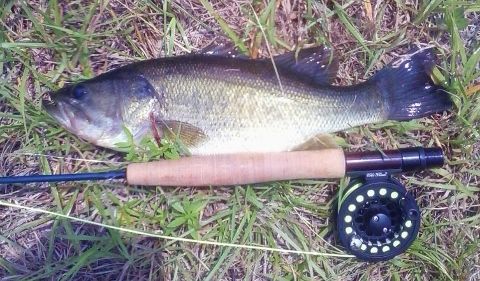
I don’t bass fish with a fly rod, but I warm water fish and catch some bass in the process. My largest bass was around 5 1/2 lbs. caught on a 1/132 oz. jig with a number 10 hook. I have caught a few 7 - 9 lb. catfish and a couple of 7+ lb. grass carp, all on number 8 Aberdeen hooks. Remember a lot of the large hooks you see advertised for bass fishing are going to have a 3/8" plastic worm or a pork chunck inside the gap.
What Buddy said I think is the most relevant. The thing with bass flys are that most of them are less aerodynamic and harder to cast. One of my favs is a muddler down to size #12. You’ll catch bass, bluegill, pretty much everything on that size fly, plus they’re easy to cast. The bigger the fly size the bigger the fish that can eat it. So by downsizing the hook you allow for more opportunities to catch fish.
I think that castability is the priority here.
Remember that for most spinning/casting tackle, a four inch bait or lure is considered a ‘finesse’ bait. Most bass plugs are three to five inches long, soft plastics are in the four to eight inch range, a spinnerbait is usually around five inches long and about three inches high.
Few of my bass flies approach those sizes.
I’ve caught ten inch bass on twelve inch plastic worms, and had three little six to eight inch fish hit the same 5 inch minnow bait (actually landed all three).
It’s unlikely that we can fish with a fly that is too big for ANY reasonable sized bass.
I catch most of my bass on subsurface flies that run in the two to three inch lengths. Usually leech or crawfish patterns. I try to keep Clousers at five inches or so, but decent length bucktail is getting harder and harder to find.
I use long tails on my topwater largemouth flies, looking for four to five inches. Sometimes I can’t get there with the materials I’m using.
I can cast most of these with six weight rods, which are my usual choice for bass. I try not to have to use heavier gear, but for some presentations, you need a nine weight and bigger flies.
Buddy
Amen, brother
Just another thought on fly sizes for bass that I thought would be worthly of posting. One should select their bass fly sizes based on what the bass are use to seeing and feeding on. By this I mean that the bass in Florida are use to seeing much larger prey than bass in the northern areas. I would think that you would want to present a fly that is close to the size the bass are use to seeing. I do not think you could present a fly that is to small but you could present a fly that is too big for the majority of the bass in your system. Yes, a larger fly may get the attention of the largest bass in the lake or pond, but, there will be a lot more smaller bass and catching a lot of 2 to 3 pound bass would be more fun for me than fishing all day and catching one bragging size bass. I guess it would depend on what your goal is when fishing for bass. If you are after the biggest bass for a possible line record or State record, then larger flies would be the norm, but, if you are just out for the fun of catching a lot of bass and not that worried about how big or small they are, then you should present a fly that is pretty close to what they are feeding on. Same goes for trout fishing. Some trout fishermen will spend the whole day flinging larger streamers and flies and they are only interested in catching the largest brown/rainbow in the river and do not want to be bothered with the smaller trout. If that is what they enjoy, then that is what they should do.
So, I guess what I am trying to say is that you should try to fish with bass flies that are the size of the prey that your area bass are use to feeding on and that size varies from State to State.
Just thoughts and nothing more…
Bass are aggressive opportunistic feeders. I say again, aggressive. Catch them in the right mood, and they will slam a popper on top and slam a clouser minnow stripped fast under the surface - regardless of size. With that said, I agree 100% with the statement “…castability is the priority…”. If you cannot affectively present the fly in the correct spot, size won’t matter.
I once caught a 4 1/2lb bass on a 4wt casting a #10 woolly bugger(ish) fly. Crawfish color, dragging it on the bottom, and bingo! Fish on!
Whatever you do, tie patterns that you can cast efficiently, effectively present, and have fun with.
Some great information here. I’ve got a lot to learn in my migration from trout to spiny rays.