A mixture of salt and freshwater settles over
miles of narrow, white sand flats blanketed by
a sea of grass. Nowhere in North America is
there a more diverse estuary than the Neuse River.
Experience the thrill of being an arms length
from heart stopping fly-fishing action. Mother
Nature has crowned this area one of
the most pristine and diverse ecosystems on the
continent, second in size only to Chesapeake Bay.

The seasons dictate the fish species you will catch.
In the late summer when there is no wind, you would
wish for a pocket full of clouds to raise a cooling
breeze. Understand this beautiful place and I’ll
take you on a journey to catch some unforgettable
memories. Let’s embark now on the first in this
series to explore the estuaries of the Neuse River
System.
The Neuse’s waters, river and creeks provide approximately
2,750 acres of prime nursery habitat, and 1,250 acres of
secondary nursery habitats. The upper reaches of the
Neuse provide an important habitat for such fish as
shad, herring, catfish, bass, and flounder. The Neuse
is also home to vital populations of blue crab (estimated
to top those in Chesapeake Bay) and oysters.
Of the 3.5 million acres in the Neuse Basin, 48,000
acres are state parks, 110,000 acres are game lands
held by the Wildlife Resources Commission, and 58,000
acres are National Forest. The Neuse River drains land
in 19 counties covering 6,192 square miles. More than
1,500,000 people (1/6 North Carolina’s population) live
in the basin. Many people come to visit each year.
There are million acres of plush marine habitat
including the widest variety of sea grasses from
Johnson’s, manatee, paddle, shoal, star, turtle,
eel and widegon grass. These grasses house the
majority of fishes and provide needed oxygen and
forage for their healthy survival.
Whether you fish, paddle, or just enjoy the environment,
take your camera for some breath-taking scenery. From
New Bern to Oriental and Lower Broad Creek and the Mouth
of the Bay River (the entrance to Pamlico Sound) you’ll
find many public access points for boating You can hirer
a fishing guide to take you to prime light tackle or
fly fishing, or eco-tours for sightseeing by pontoon
or kayak. There is a lot to do, and don’t forget your
sunscreen and polarized glasses.
The Neuse is one of only three rivers in North Carolina
whose boundaries are located entirely within the state.
It begins northwest of Durham, NC, in a 10-acre farm
pond, the headwater of the Eno. From there it feeds
into Falls of the Neuse Lake, located on the north
side of Raleigh, NC. Consequently, the Neuse starts
in the heart of one of the fastest growing areas in
the United States. From the Raleigh-Durham area, where
it is a freshwater river, it flows generally south and
east toward the Pamlico Sound, passing through many
cities, farms, and swamps. It becomes a shallow,
slow-moving, brackish estuary just upstream from
the city of New Bern, in western Craven County. It
is wider here at its upper estuary and is affected
by wind-driven currents, as well as by salt water
“wedges” that move upstream from Pamlico Sound. The
lower Neuse estuary begins in the area of Flanners
Beach and Minnesott Beach and continues until it
empties into Pamlico Sound. There, the mouth of the
Neuse is the widest river mouth in the continental
US. The Neuse River is one of three large rivers
that flow into the Albemarle and Pamlico Sounds.
This estuarine system is the second largest in
the United States.
At an estimated 2 million years, the Neuse is one of
the oldest rivers in the US. Archeological evidence
indicates the first humans settled around the Neuse
as early as 14,000 years ago. Early native American
settlers included the Tuscaroras, Coree, Secotan,
and Neusiok Indians. A struggle between early European
settlers and the Tuscaroras drastically reduced the
European population after the decisive “Tuscaroran War”
in 1714. As new settlers populated North Carolina
during the next 250 years, farming and forestry took
hold. Today, over 1.5 million people live in the
watershed from the sprawling suburbs of the Raleigh-Durham
Triangle area to the golf and sailing communities of
Oriental, the sailing capital of North Carolina.
The nearly 2 million year old Neuse River is a majestic,
flowing lady that has her beginnings above Durham, NC
where the Eno and Flat rivers converge. The Neuse River
is a vital part of the United States second largest
estuary, the Albermarle-Pamlico. The Neuse’s current
is fast moving for 150 miles from its source until
she reaches western Craven County and becomes a
slow-moving, brackish estuary that continues for
another 40 miles.
Combine this river system with the confluence, just
offshore of the Outer Banks, the two mighty systems,
the Gulf Stream and the Labrador Current, and you
have the makings for one of the most diverse
estuaries in continental North America. Feeding
the back of the Banks, along Core Sound and down
the Neuse meeting in Pamlico Sound. This is a
virtual nursery for every type of game fish known
including Tarpon, and one other elusive fish that
is Harry’s secret.
This series focuses on the fishery, the habitat,
types of flies and techniques used, and the seasons
of fishing in Eastern North Carolina. This fishery
is diverse as it changes from season to season
depending on Mother Nature, wind, salinity and food
sources. You’ll experience a pleasurable fly-fishing
adventure like the search for the loot from one of
Black beard’s galleons. Our journey starts in
Mid-January as we ready for stripers and shad
on the upper Neuse River in a place called Pitch Kettle.
~ Doug Sinclair
About Doug:
Capt. Doug Sinclair has relocated from New Smyrna Beach, Florida to
Grantsboro, NC. He specializes in fly-fishing and light tackle charters.
Doug charters the Coastal Carolina area of New Bern or Oriental.
Catch him on the web at
www.flyfishacademy.net or call him at (252) 745-3500.
Originally published c. 2004 on Fly Anglers Online by Doug Sinclair.
Part 2
We crossed the Neuse on route 43 just below Cow
Pen Landing and past Pine Tree Creek. The morning
was cool and refreshing. A bright sun pierced through
places in the broken puffy clouds. This was a
fabulous morning to be going fishing. In mid-January
there are no chiggers, mosquitos or deer flies. Ducks,
Canada geese and other fowl are the winter residents
in every field and waterway. They fly freely in this
lowland savanna called Vanceboro.
Fred, his son Hunter and I drove north, the boat and
trailer in tow. The road was flanked with high banks
and vast fields that were stopped at the edge of tall
pines. Once an endless forest of longleaf pine and
cypress trees, loggers and settlers cut the mighty
trees for ship masts and buildings. Their resins
were resistant to decay and so became an important
staple to the local economy. Forests were thick
with park-like floors of soft pine needles, cypress
and Spanish moss. These majestic trees have high
bowls (the distance between the forest floor and the
first branch being about 30 feet off the ground).
With polarized glasses you can see deep into the
timber and observe the light that flickers down from above.
I often wonder how many times I can visit here and
always enjoy it like it was the first time. I marvel
at this place called Pitch Kettle. There is a lot of
history and the fishing is tremendous. Understand
that the Neuse is one of those huge natural hatcheries
that attract lots of fish to its waters. The seasons and
salinity will dictate which fish are in various locations.
The salinity levels don’t seem to affect the striper
population — they travel where there is food. The striped
bass, or rock, can run 5 to 15 pounds and will easily play
your 7 or 8 weight rod to the gunnel. The trick is
keeping them from running down or out to the lowland
into roots and submerged stumps. Don’t be surprised
as you maneuver around these great trees to see remnants
from other anglers tied off to branches.
Many times I’ve been invited to fish the Roanoke for Shad
and Rock, only to prefer the great Neuse River and the
place called Pitch Kettle. Capt. Fred Slann, of New Bern,
first took me there. Call it “extreme fly-fishing.”
The wind howled out at 30 mph from the north and blew
tree limbs down and waves with such a fury that launching
his boat was difficult to say the least. It required
two lines running to shore, shared by Fred’s son Hunter
and myself, as each of us took a line from the bow and
stern, to hold the boat straight when launched from the
trailer.
Once on the river, though, wind blown, yet safe and secure,
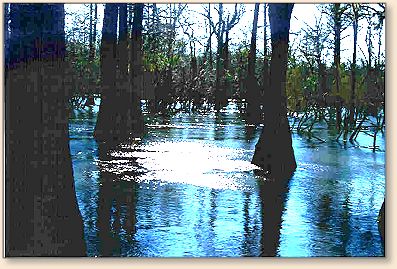
we ventured to the flooded cypress and pine forest, the winter
home of these marvelous fish. We traveled west and
north. The river makes a ninety-degree turn and we
went wide around the treacherous cross current.
Farther up a stream we veered off to the right and
into a creek spotted with tall cypress trees. The
water was about 10-15 feet deep in the lowlands.
The trunks of trees can exceed 12 feet in diameter.
Below is a rich bed of vegetation and aquatic life
that provides the nutrients for fish and other species.
The lowlands are also home to beaver (they can grow to
over 60 pounds), otter, raccoon, and other wild animals
including black bear. There are wild berries, fruit
trees, seeds and edibles for all kinds of wildlife.
Along the sandy bank we spotted the once a stately tree
trunks, where parts in the ground still hard and fragrant
from the pitch, a kind of embalming fluid for trees. Worn
smooth by weather and bleached by the sun, these arboreal
vertebrae are sometimes used as kindling and known in
rural North Carolina as “lighter wood,” “fat lighter,”
or “fat wood” because they burn furiously. Other carcasses
remain in the form of big turpentine stumps, trees that
had large box like areas hollowed out to collect resin,
hence the name Pitch Kettle and the name of the creek
where the pitch was collected.
Even the bark of longleaf strives for immortality and
is readily identified by persistent layers at the base
of stumps long ago burned deep into the soil. I counted
over 200 growth rings on one stump. No doubt when this
tree was cut, the pines were abundant. In the first half
of the 1800s, records show hundreds of barrels of naval
stores shipped from this area. Imagine the aroma of
the rich soil, compacted longleaf and cypress, the
crisp morning air and the inviting anticipation of
hickories invading the river on their spawning run.
Migrant hoards of baitfish move inland at this time
of the year. Escaping the cold lower basin they move
up the Neuse towards Kinston and Raleigh. Pitch
Kettle Creek joins the Neuse at a “T” in the river.
The currents and flow are interrupted by a ninety-degree
turn in the river forcing water in two directions. Bait
fish get confused or are forced head long into the creeks
on the bend in the river. In the Lowland areas they find
refuge in Pitch Kettle Creek, foraging in the grasses,
roots and submerged stumps. Here you will also find
stripers because they will eat the shad. Use a seven-weight
fly rod which will also be handy should you catch both
species on one hookup. The striper will follow your
shad and gobble it. You’ll have two fish for the hookup
of one. Use small flies. Fred prefers small white dart
type flies tied with white buck tail on a #6 saltwater hook.
This is a blind casting adventure. However, it is
evident to witness the ribbon of baitfish propelling
out of the water. The activity gets explosive as
he shad get ravenous. Your only worry is snagging
your cast on a tree trunk, or hooking up only to have
a shad swim under a root. Use #12 leaders, and have
plenty of spares when you are fishing shad. These
little guys will give you a good fight. Boat them
quickly and you will have a great time catching and
releasing to your heart’s content. Bound by the
beauty around you and basked by the aroma that is
reminiscent of being in a cedar closet, you’ll enjoy
this vast labyrinth of intertwining trunks.
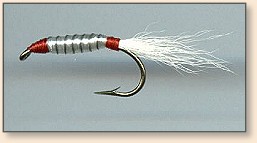
I prefer a Royal Dart tied on a #6 3407 Mustad hook.
Wrap the shank with 0.15 lead free wire prior to
building the fly. It is similar to Fred’s white
buck tail fly, except I use red and pearl mylar
windings. I have to admit that Fred’s flies always
work. Take at least 30 flies because some will get
lost in the limbs and roots. The hook set is simply
a matter of keeping the line tight and letting the
shad set himself. Figure on a good day you’ll hook
15 or more. On an off day you’ll do 4-8. You’ll
have a great time.
Next time you’re in New Bern, Raleigh or anywhere
else and you want to try your hand at Hickory Shad,
give a call and you’ll be in for a treat. Next
time we’ll start in downtown New Bern, the Capitol
of the Carolinas (established 1710), where the rock
and speckled trout fishing is out of this world.
We will stage down the river, just like the trout
and catch hundreds before April 1st. See
Cabin Fever
for 9-pound striper action in the same places. We
have stripers all year round, but we will get to
the big ones and large drum much later.
Please don’t teach your trash to swim. ~ Doug Sinclair
About Doug:
Capt. Doug Sinclair has relocated from New Smyrna Beach, Florida to
Grantsboro, NC. He specializes in fly-fishing and light tackle charters.
Doug charters the Coastal Carolina area of New Bern or Oriental.
Catch him on the web at
www.flyfishacademy.net or call him at (252) 745-3500.
Originally published c. 2004 on Fly Anglers Online by Doug Sinclair.