There is a free magazine available at your local fly shops.
Entirely supported by advertising (meaning free to you), Fly Fish
America produces magazines for six regions of the U.S. (We get
the Pacific edition.) One issue had a terrific article by Paul
Marriner, titled the “Magic Inch.” This magic inch is where insects
are just prior to emerging in the top one inch of the water.
Nymphs along with spent spinners, empty shucks, and cripples
who were not able to get out of their shucks all ride the current in
this one inch layer.
Below the surface, more activity takes place. Some anglers
claim 90% of the food trout eat is taken below the surface. That
generally means nymphs.
Mayfly nymphs fall into four groups. A knowledge of which
group is which will tell you which nymphs and adult mayflies you
have in specific locals. Each of the mayfly families require certain
environments.
Species which live in slow-water developed excellent swimming
characterists. Other species evolved to crawl along the river or
lake bottoms, cling to underwater rocks or structure in fast-moving
water, or others which burrow in stream or lakebed mud.
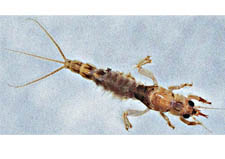
Brown Drake (Ephemera simulans)
Burrowing Nymphs
Burrowing nymphs construct protective burrows composed of
fine gravels, sands, muds, or silts in river beds or lake beds.
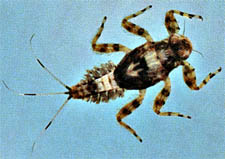
Flav (Drunella flavilinea)
Crawler Nymphs
Crawler nymphs inhabit diverse habitats. Species in faster waters
resemble clinger nymphs and species in slower waters resemble
swimming nymphs.
**Mayfly photographs by Jim Schollmeyer; from
Mayflies, An Anglers’ Study of Trout Water Ephemoroptra
by Malcolm Knopp and Robert Cormier. Published by Greycliff.**
Originally published c. 2000 on Fly Anglers Online by Deanna Lee Birkholm.