Fly Fishing 101, Part 12 Hide and Seek
Last time we were trying to
find the fish. This
excerpt from Clive Schaupmeyer’s The Essential Guide
to Fly-Fishing (see the book review in
“Are You A Flailer?”)
does an excellent job of explaining where the fish are
in specific areas on the stream. The numbers on the
illustration match the numbers in this list.
Favored Holding Spots of Trout in a Typical Section of River
**Trout often hold and feed in identifiable parts of a stream:
-
In riffles and shallows, especially during insect hatches.
-
In front of boulders, where the water speed in front is
slowed by the rock behind. This is a popular spot during heavy hatches. -
Along banks where the current is slower and terrestrial insects fall in.
-
Behind boulders that offer protection from the current.
-
In drop-offs between riffles and the heads of run that offer
protection from the current and a steady supply of food.**
**6. Behind submerged boulders or other protective pockets. -
In front of surface obstructions that can trap good insects.
-
Behind logs that offer protection and possible ants.
-
At the floor of runs where the water is slower and food is plentiful.
-
In quiet holding pockets between subsurface rock ledges.
-
In back eddies where the current is slower and where insects tend to collect.
-
In seams between slow and faster water where the current
isn’t too strong and food passes nearby. -
At the bottom of a deep pool.
-
In the shade of an overhanging streamside tree protected from view.
-
In and around weed beds that offer food and protection from the current.
-
In gravel bar shallows in late evening.
-
In the tail of a run where the current is slower.
-
Under or inside undercut banks.
```**
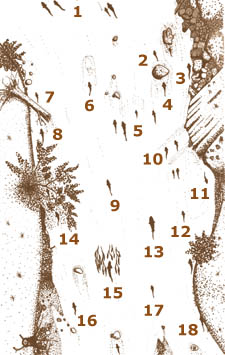
Looking at the illustration, you begin
to realize all the fish shown have one thing in common.
All the fish are facing the same direction. That direction
is upstream, or into the current. Fish that would face
downstream would all eventually end up all the way downstream.
As in the ocean.
Fish face upstream because that is
where their food comes from. Think of it as being in a
dining room, and the waitress bringing you a plate of
food but the food is hanging in the air above the plate.
That is what the fish have, a moving
dinner plate. The food comes to them floating on the surface
of the water and they have to make the decision to take that
food in a split second. Wait too long and it has floated past
them. And if the fly you offer doesn’t look like the food the
fish has been eating? You probably won’t get the fish to
take your fly.
Next time: what do they eat anyway?
Thanks to Clive Schaupmeyer for excerpt use
of his book The Essential Guide to Fly-Fishing, A
Comprehensive Guide for Beginner and Intermediate
Fly Anglers. Available in bookstores or directly
from Clive. Clive
lives in Brooks, Alberta. He is a member of the Outdoor
Writers of Canada. He fishes throughout Alberta and has
fished in the Northwest Territories, B.C., Saskatchewan,
New Brunswick and Montana.
Originally published c. 2000 on Fly Anglers Online by FAOL Staff.