| Fly Tying Terms |
The eddy is formed by the fast current blowing into the far side of the hole
and the curl of the bank toward the large boulder protruding into the lower
section of the hole. The fly settled on the soft water near the center of
the eddy and almost immediately, a shadow appeared and rose from the depths.
With a typical deliberate rise, the fifteen inch cutthroat came to the fly.
As he rose, I was counting …. 1, 2, 3…47, 48, 49…114,
115, 116… Well, not quite that long before he took the fly, but it
is one of the great sights of dry fly fishing to see a cutthroat come from
the bottom of a hole to take your offering, and it seems it is almost forever
before they get to it.
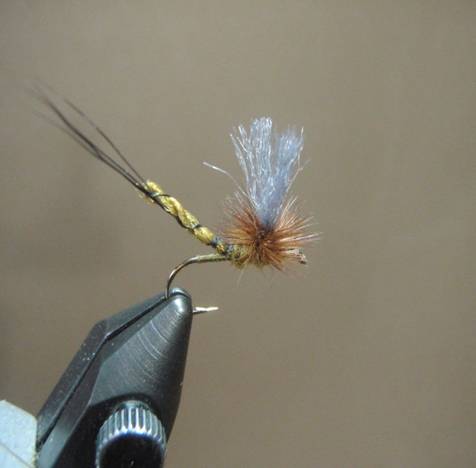
The fly was an FEB Drake. This was the first FEB fly I tied, in the late summer
of ’08. It did well last year, and proved itself again this past week
on the stream for which it was originally tied. Many, many cutthroat trout
on that stream have approved this pattern. I suspect that trout in other places
with hatches of large drakes or other good sized mayflies ( hexes come to
mind ) will also approve the pattern, given the opportunity.
Credit again to the FAOL Bulletin Board’s “Ducksterman” for
the impetus last year to try the “off the body” furling technique,
without which this fly would not have been possible.
Materials:
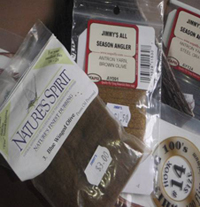
- Standard dry fly hook – size 12
- Olive dun 8/0 Uni Thread
- Olive brown antron yarn
- Black 6/0 Uni Thread
- Moose body hair
- Gray antron yarn
- Nature’s Spirit BWO superfine dubbing
- Brown dry fly hackle
Tying Sequence:
Start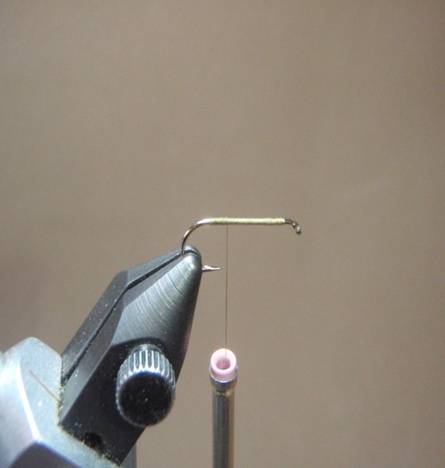
the tying thread and lay a thread base to the bend of the hook. Then wrap
the tying thread forward to just forward of the barb. Incorporate
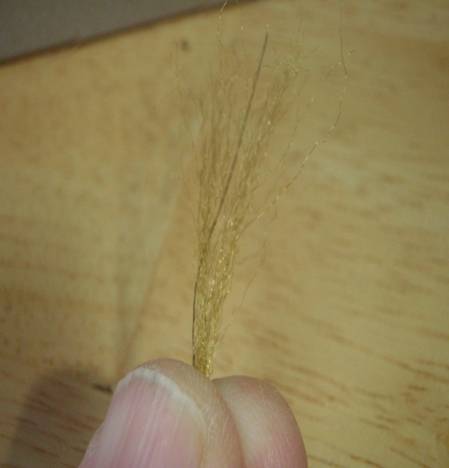
a piece of tying thread about 6” long in a strand of antron yarn. Comb
out the yarn and then comb in the thread so that it is surrounded by antron
fibers. Pull the end of the thread even with one end of the antron strand. Catch
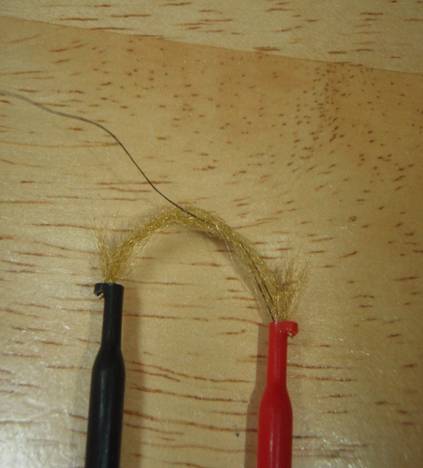
the antron strand with the incorporated tying thread in an electrician’s
clip. Catch the other end of the strand without the thread incorporated in
another electrician’s clip.
Position the piece of tying thread so that it comes out of the antron strand
at the midpoint between the clips.
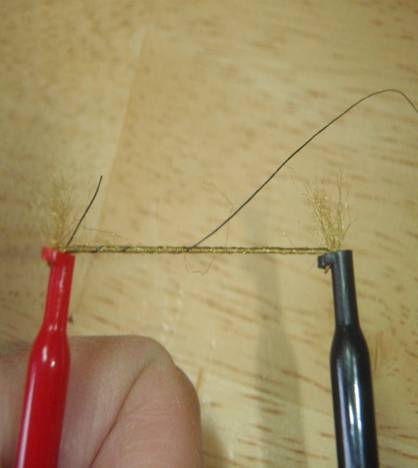
will take about six to eight twists. If the tying thread is properly
positioned at the midpoint of the antron strand, it will simply twirl out
away from the antron as the antron is twisted. When the antron is ready to furl, hold both clips in one hand, maintaining tension,
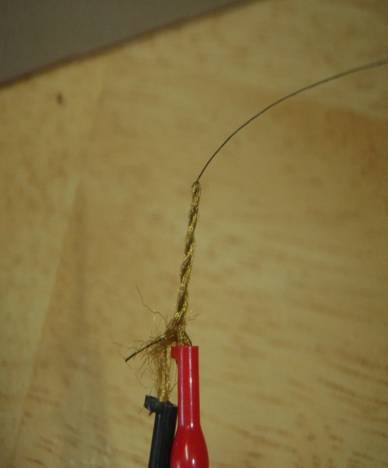
and then pull on the tying thread and relax tension on the clips.Remove the clips. Twist the furled extended body by hand in the direction it
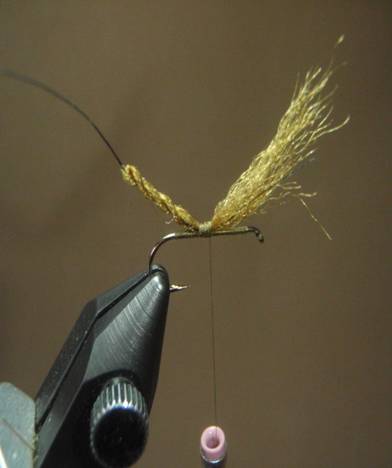
furled to tighten the furl. Place the FEB in position on the hook shank just
forward of the barb and tie in. Take several wraps over the FEB, then lift up
the tag ends and take a couple wraps in front of it, then a couple more over
just in front of the original tie in point. Trim the FEB and tie down the tag
ends of the fibers. Select several moose body hairs for the tail and stack them. Position the
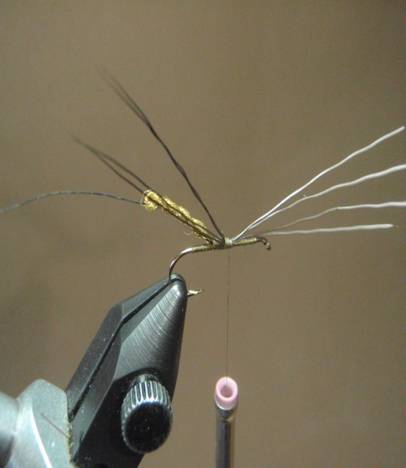
hairs on top of the shank so the tip ends extend beyond the FEB the length
of the desired tails. Tie the tails to the shank with the tying thread and
trim the butts. Grasp the end of the FEB and the tails with the thumb and forefinger of the
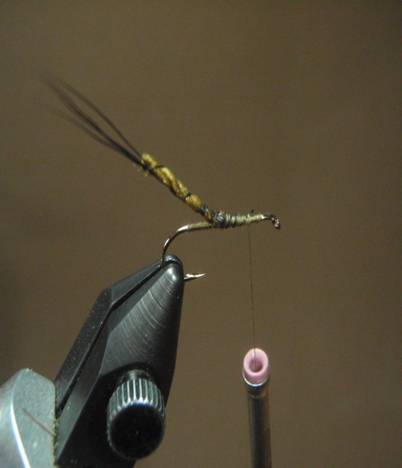
left hand. With the right hand, bring the incorporated thread around the FEB
and tails counterclockwise as far as possible. Then pass off the thread to
the fourth and little fingers of the left hand to complete a wrap around the
FEB and tails. Repeat this wrapping five or six times down the FEB to where
it meets the shank to secure the tails to the FEB. Then wrap the incorporated
thread forward several turns and tie it off with the tying thread. The rest of the fly is your basic parachute dry fly or thorax style dry. In
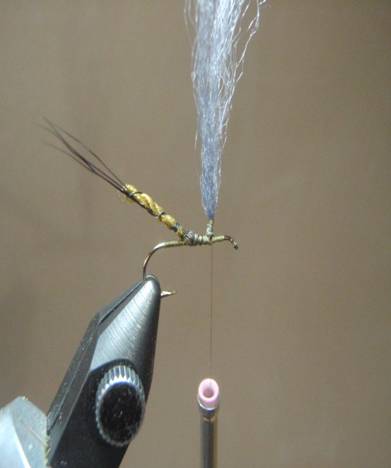
this demonstration, I’ll do the parachute version.
Tie in an antron wing. I like to double the antron strand over the tying thread
and take a wrap around the shank to position it, then a couple more wraps
to secure it to the hook. Post the wing.
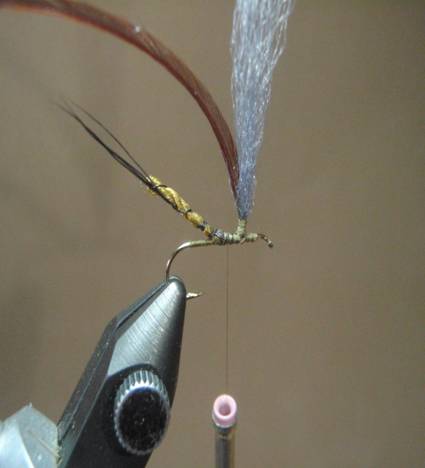
the wing, take one wrap around it directly behind the wing, and then wrap
up the stem of the hackle and the post, and back down. Wrap the tying thread back to where you trimmed the FEB. Apply dubbing and
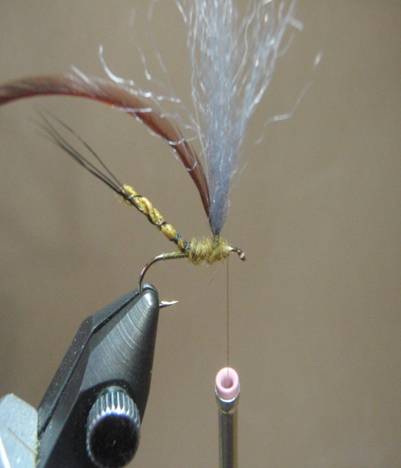
dub forward to behind the eye. Wrap the hackle counterclockwise and down the post as many turns as necessary
for the water you will be fishing. Tie off the hackle and finish with a couple
half hitches or whip finish. Head cement is optional at both the final tie
off and at the very point where the top turn of hackle meets the post.
The finished fly.
And from the fishies’ point of view.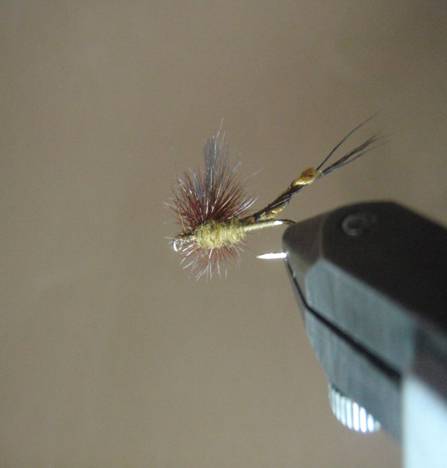
Two notes on this particular tie. The FEB is tied in a bit further forward
than usual. The hackle is a bit undersized for the fly. The competent fly
tiers out there will produce a much nicer fisherman’s fly, for sure.
For more great flies, check out: and
Originally published September 14, 2009 on Fly Anglers Online by John Scott, Rigby ID.