Dunc’s Floating Carey
"Angling friend . . . Duncan Laird is a champion of dragonfly nymphs.
We have had numerous discussions regarding the merits of these
meaty nymphs both as trout food and a source of inspiration
at the vise. Duncan has always been a fan of the simple lines
of the Carey Special. The Carey is a proven pattern that has
withstood the test of time. Careys not only make a great dragon
imitation but are equally versatile passing themselves off as caddis
pupae. About six years ago Duncan swapped the traditional Carey
body material for deer hair spun and clipped to shape.
What separates Duncan’s Floating Carey from other spun deer hair
flies is the unique method Duncan used to create his mottled
body. Spinning variegated deer-hair bodies is nothing new. Bass
tiers have been doing it for years. Duncan tried alternating
different stacks of deer hair but it still wasn’t what he was
looking for. The natural nymphs are a blend of many colors and
traditional deer hair methods didn’t duplicate this well. Taking
anywhere from 6 to 10 different colors of deer hair, Duncan blended
them by hand in a margarine container as though it was dubbing.
The goal was not to create a uniform color pattern. The individual
deer hair fibers mixed completely and when spun on the hook created
a natural mottled look. Duncan’s standard mixture begins with a base
of golden olive deer hair. From there Duncan adds 25% reddish brown,
30% natural, 25% olive, 25% yellow olive, and 25% dark olive. These
percentage figures are in comparison to the initial golden
olive base color. This formula is subject to change as dictated
by local conditions.
Materials
Hook: Tiemco 5263, #6 - #10.
Thread: Olive Monocord or 6/0 UNI-Thread.
Body: Deer-hair mix (spun and clipped).
Hackle: Blue phase pheasant rump.
Tying Steps:
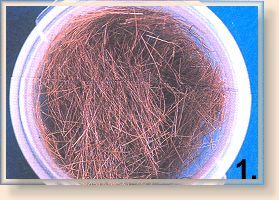
- Combine various colors of deer hair in a container
in the same manner as blending different colors of dubbing.
It is a good idea to make notes of successful color combinations
and to make enough for a number of patterns.
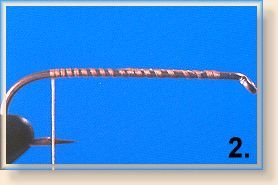
- Cover the hook shank with thread. Leave tying thread
hanging at the rear of the hook. Don’t build up too much
thread on the hook shank as this inhibits spinning the body.
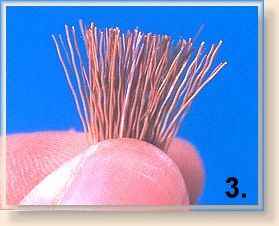
- Select a stack of pre-mixed deer hair. About the
diameter of a pencil is fine.
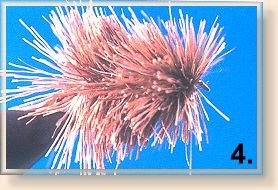
- Spin a body of deer hair all the way up to the hook
shank. Resist the urge to pack it. Remember to leave
room for the head.
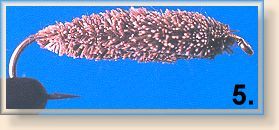
- Tie off the thread and remove the fly from the vise.
Trim the body to a cigar shape with a fat rear end and
sloping towards the eye. Keep the gap clear so as not
to impede the hooking ability of the fly.
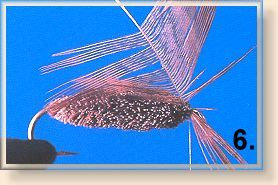
- Re-attach the tying thread at the eye. Select an
appropriate pheasant rump feather. The individual
fibers should be no longer than the body. Prepare the
feather by stripping away the flue. Tie in the hackle
feather by the tip with the shiny side of the feather
facing towards the tier, ensuring the fibers will sweep
back along the body.
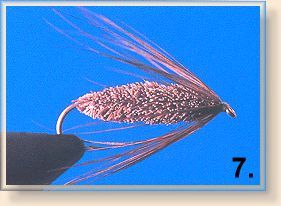
- Wind the hackle a maximum of 3 times. Tie off and
trim excess hackle. Build a neat head. Whip-finish and
apply head cement.
How to fish Dunc’s Floating Carey:
Fished just sub-surface, this modified fly proved
deadly when sedges [caddis] were active. Fish took
the fly confidently as it bobbed and sculled in the
surface film during the retrieve. . . when retrieved
the hackle pulses and breathes suggesting life.
~ Philip Rowley
Credits: From the terrific new book Fly Patterns for Stillwaters by Philip Rowley, published by
Frank Amato Publications. We greatly appreciate use permission.
For more great flies, check out: and Advanced
Fly Tying.
Originally published February 12, 2001 on Fly Anglers Online by Philip Rowley.