Am I correct assuming the Catskill dry fly has a straight (as opposed to split) tail? Is a split tail used for spinners only, or is it reasonable to imitate duns with them?
I ask because I’m finding that my dries with split tails tend to float more upright and seem more balanced; would they detract in some way from a dun imitation?
I realize this may sound like hairsplitting, but I’m learning to tie dries, and haven’t found this question addressed anywhere.
I know I can tie dries any which way I want, but I would appreciate any insight with respect to their tradition and thought behind it. Thanks in advance.
not to mention that the splayed tail looks more like the natural.
I always tie dryfly tails splayed because the land, float and look better (in my opinion), are more accurate in imitation, and finally because it looks right to me.
i think I’m in the minority on this one though…
mgj
I’m on Mikeytwoshoes side of the fence. Jax
What Mikey said.
-Jude
I learned an effective method of splitting tails from Al Beatty. When first attaching the thread to a bare hook, leave the tag end of the thread long and tie it down on the topside of the hook back to the bend, leaving it dangle out the back. Then tie the tail in as one clump. Now pull the tag end of the thread upwards thru the tail fibers, splitting them. Tie the tag end of the thread down on the topside of the hook. It is very easy and does a nice job of dividing tails.
Bob
For realistic, I side with Mikey. If you are tying impressionistic (the classics) then the tail is straight. I as a tyer have moved over to tying more of what appears natural on the water; even though I still find many classic patterns that still work.
J. Castwell, Please explain the 110 versus 180 degree comment. Thanks
[This message has been edited by Ray Kunz (edited 31 January 2006).]
I do a split tail on many of my dries, but use a bit different method. When dressing the shank, I leave a small thread bumb at the bend. I then take a hackle feather, pull an equal number of barbs downward from either side of the stem - leave the barbs attached to the stem - and tie in the barbs mid shank. I hold the barbs slightly to the near side of the shank and use thread tension to roll the barbs to the top of the shank while wrapping the thread toward the rear. When I get the thread back to the bend, the thread tension against the initial thread bump will tend to flare the barbs. Then, trim the feather and use again for the next fly. The result looks something like this"
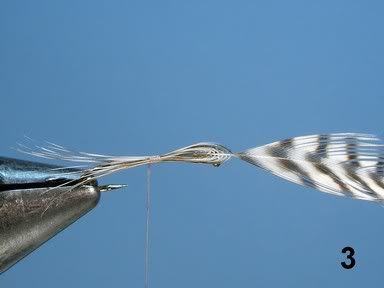
[This message has been edited by JMundinger (edited 31 January 2006).]
Split 'em.
The fly is more likely to land properly.
In addition, I buy the arguement that a clump tail actually looks like an extension of the body (therefore making the body look longer than desired) rather than a natural tail.
-Steven
Bob s.; COOL!, JMundinger; VERY COOL!I’ve got to try those two tricks and see which one best suits my fumble finger style of tying.