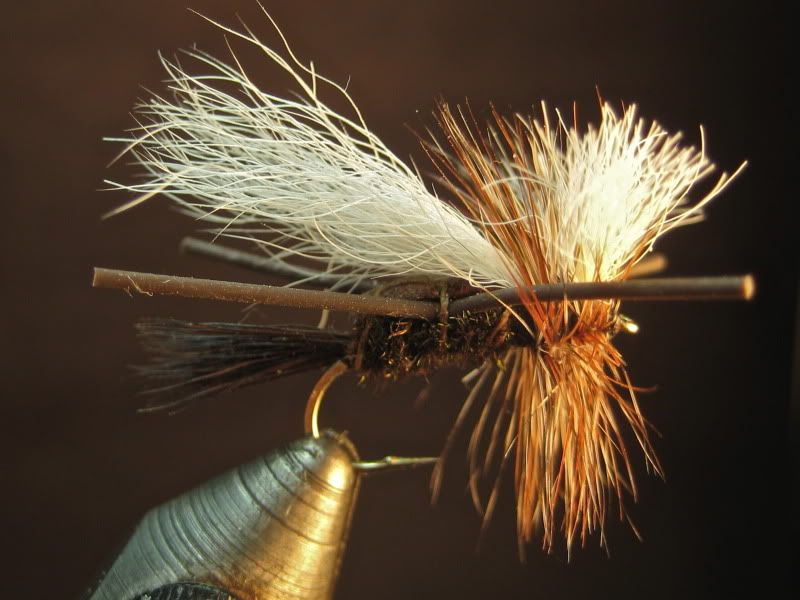
Okay, You’ve managed to find some extra money and you want to buy some dry fly hackle. You can buy a neck or a saddle(equal grade), no other option. Now, forget for a moment which offers the most feathers or possibility to tye more flies in a couple of given sizes, or that one has a greater range of sizes, or that one is easier to use than the other, etc. In other words, forget every positive thing about one or the other, and make your decision on this and this alone: Which one offers the best dry fly hackle feather and why?
One advantage saddles had was thinner quills which made winding the hackle easier and allowed for more wraps within a given space so denser and more floatable (???). I don’t have any capes in grades higher than Bronze/Pro/whatever but it seems chicken breeders have narrowed that gap (no pun intended), too. For tyers today, I don’t think there’s any wrong decision.
You asked about hackle feathers.
But it is interesting to note there are alternatives. I use fewer and fewer feathers every year–because the cost of good dry fly feathers makes me feel foolish somehow.
I prefer necks and own very few saddles. For me I tend to waste more saddle hackle when the saddles will tye two or more flies. As far as stem size and density of hackle I really don’t see much difference.
Given the fundamental nature of the two feather areas on the bird, and thus the feathers themselves, one would expect the cape feathers to have stiffer barbules than those on a saddle feather. May not be true with today’s genetic stuff. I have never compared them.
For strictly dry fly hackle quality?..necks. A top quality Saddle comes “close” to a good neck. But not quite.
For versatility?..necks.
The one item to consider is what you will be tying. If 80% of your tying is on #10-12 stimulators, then a Saddle that fits your slot is the better choice. It will tie far more flies for you in the size you seek. But if you will tie a little of everything that you find on your local trout waters?..a neck, hands down.
Especially with the prices getting flipped on us recently, its not necessarily cheaper for a top quality saddle over a neck these days.
In addition to the long, long saddle feathers, I find that their stems are better for hackling. The stems on neck hackle are generally stiffer and larger in diameter.
It seems to me that Whiting has concentrated a little more on their wonderful saddles in the last several years. Their saddle hackle today is much better than what it was even a few years ago. I could never go back to using necks - except for tail material or tying streamers.
You only get a solid 2 (with a smattering at best of a 3rd) hackle sizes in even a Whiting Silver. That means that I need at least 2 saddles, and in some colors 3 in order to tie what I use. Albeit the feathers are longer and all, it still comes down to economics.
Admittedly, that’s more of a problem with “me” than the saddles, since the reason for the problem is an unwillingness to cough up the money for 2 & 3 saddles for a given color.
With a quality neck, I find that I use up most sizes pretty evenly. So once it gets sparse one size I’m ready for a replacement anyway.
I don’t think it should be an either this or that choice. For example I use a lot of parachute adams in 14 and 16 so a Cree saddle in size 14/16 would be perfect or a coachman brown with a matching grizzly saddle in size 14/16 will tie hundreds of flies. But for other colors, a single neck might be better. The choice should be based on how many flies you tie using a particular size and color of hackle.
Okay, now that many of you have cited reasons why saddles may be better or easier to use, etc., or that other materials like hairs and foam add floatability or are better or less expensive than hackle, how about responding to the original question:
“make your decision on this and this alone: Which one (a saddle or a neck) offers the best dry fly hackle feather and why?”.
I think the stem is bigger diameter and stiffer on a neck feather, and thus they can be a bit more difficult to wrap. Also, the larger diameter means you can’t get as many hackle wraps in a given section of hackling location than you can with a saddle feather. Thus, you can get a thicker hackling job in a given length of fly shank. On the other hand, the barbules on a neck are a bit larger in diameter and a bit stiffer than those of saddle hackles, so I think flotation is a wash. Thus, I don’t think necks or saddles are favored against each other, as far as flotation is concerned.
Thicker stems do have one clear advantage. The stronger stem of the neck hackle, resist trout teeth better than do the weaker saddle feather stems. Thus, when it comes to individual flies having a long lifetime, I think neck hackle is better.
In the past barbule count was considered very important, however, the barbule count on the good new brands of hackle is so good, that I am not certain that it is even a factor any more.
For me, the saddle feathers are much easier to wrap, and that is a bigger factor for many othe factors. I can use my fingers, and that means better control and easire application.
When the Hoffman super saddles hit the market way back when (not really that long ago), they might have offered an advantage over the genetic necks available at the time. Today, I’d be hard pressed to find any noticeable difference in quality between the two feathers. I’d attribute any variance in floatability of a fly to the skill of the tyer. Some of you folks can tie a fly that dances on the tips of it’s hackle and skitters across the surface of the stream just like a real bug; I just always make sure I have a backup bottle of floatant in my vest as I try to keep my flies somewhere near the surface.
It is interesting to see the comments about the stem in neck hackle being stiffer than that in saddle feathers, which is a fact, and what I was referring to in my fist comment. It is even more interesting when I assume those of you who made this comment are referring to genetic hackle. If you think the stem in genetic neck hackle is stiff, you should try Chines or India necks, which is all that was available when I started tying. To add insult to injury, you about as often as not had to use at least two, and sometimes three, feathers to get a decent hackling on a dry fly! Those were the days; to coin a phrase.
Saddle. I hate hackle pliers, and with a saddle I have to use them less, only at the very end after tying a couple/few flies. More flies tied with the feather in my hands equals more fun tying.
In addition to having stiffer barbs, there is less cupping of the hackle so the hackle fibers are straighter. With saddles you need to be sure not to buy a saddle with severely cupped feathers. When you tie the hackle in as in parachutes you need to decide whether the barbs will bend in one direction or the other. With necks the barbs are not only stiffer but less bent to begin with.
If the question what will tie better flies, the answer is a neck. If you ask me what is easier to tie with, then that is an entirely different question.