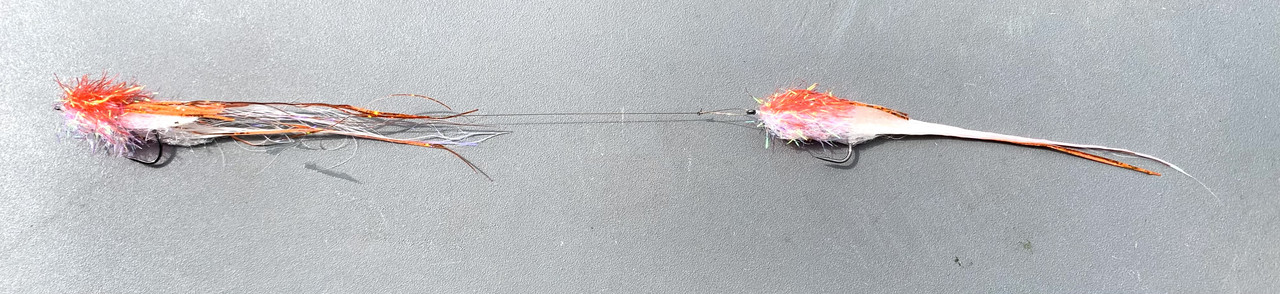
The flies themselves are nothing new, or particularly interesting, but how I have them set up may be.
What I’ve done is tie in a section of 25# single strand nickle-titanium tieable wire into the first fly rather than connecting the two flies via the normal method of tying the 2nd fly in off the bend in the hook of the 1st fly.
This effectively makes an extension of the tippet and makes it easier to cast.
It works well - I caught a small musky and a few smallies the first time I used it.
Interesting setup. I’ve often wondered about double rigging two streamers with a larger one following a smaller one. I’ve always thought that it would “hinge” on the cast causing them to tangle, but I’ll have to give your method a try. Thanks for sharing.
1 Like
I had that same idea of a bigger streamer following a smaller one, but decided to go with two the same size for the first try.
With that fairly “springy” 25# single strand wire lashed to the first hook all the way to the eye, it seems to continue the energy of the cast pretty well. My idea was to continue the leader with the same stiffness that was above the first fly, and it seems to work.
I’ve never liked casting double fly rigs of any sort with the 2nd fly tied in on the bend of the hook of the 1st fly…there’s a definite step down from the shank, and nothing to help transfer energy…so I decided to try it this way and am pleased with the results so far.
I very specifically didn’t open up my loop or change my cast when I first tried it to see how well the concept worked…It didn’t feel any different to me than casting any of the other bigger flies we use for bass, pike and musky to me.
Awesome. Reminds me of an articulated fly. I will have to try this. What size hook did you use?
1 Like
At 1/0, both of those are fairly large hooks with smallies, pike and muskies the intended targets.
What’s different between this and an articulated fly is that the wire is tied in long, and not in a loop to keep the back of the articulation tight to the body of the fly off the hook.