Comparadun Quill Gordon By Skip Morris
If the Comparadun is not the most popular style of dry fly
in America at ths writing, I’d be surprised. This fly has been
steadily growing in popularity since it was first revealed in 1972
by Al Caucci and Bob Nastasi through their book Comparahatch.
What makes the Comparadun significantly different from other flies
is its fan-shaped wing of deer hair. The best hair I have found
for this wing is coastal deer hair; most fly shops carry it.
The Comparadun Quill Gordon imitates the eastern quill-gordon
mayfly. It hatches as early as April, emerging in the afternoon
in quick water. More than just another productive mayfly hatch, the
emergence of the quill gordon signals the beginning of dry-fly fishing
to many eastern fly fishers; faith in the quill gordon hatch sends
anglers out to wade and cast in chill, rain, and even snow.
The Comparadun wing deserves a few pointers regarding its
construction. First there is the matter of getting the hair
wing firmly mounted; you may want to start with 3/0 thread so that
you can really bear down, or use use 3/0 throughout. Richard
Bunse wraps thread from the wing’s butts to the shank and back
repeatedly, using the shank wraps as an anchor. Another problem
is distributing the hair evenly; sometimes this wing ends up
heavy at its top and sparse at its edges. The best wing is
even throughout. Here is one solution: work the wing hairs
slightly down the sides of the hook as you tie in the wing
(rocking the wing as you work it down can help). Beyond this,
be aggressive in setting the wing upright - press it up sharply
with your thumbnail and secure the position with plenty of
tight turns of thread firmly up against the wing’s base.
The Sparkle Dun is shown at the end of the tying-sequence
photographs. It is a variation of the Comparadun and was created
by Craig Mathews of Blue Ribbon Flies [West Yellowstone, Mt.]
The Sparkle Dun is tied in exactly the same manner as the Comparadun
with the exception of the tail - a shank length tuft of sparkle
yarn is the Sparkle Dun’s tail. The tuft suggests the partially
discarded shuck of hatching mayfly. I’ve fished the Sparkle
Dun to great effect; try it.
Materials: Comparadun Quill Gordon
Hook: Standard dry fly, sizes 14 and 12 (the hook shown is
a Partridge GRS3A).Thread: Olive (or gray) 8/0 or 6/0 (you can also start
with 3/0, and switch, or simply continue with 3/0).Wing: Coastal deer hair of medium hue.
Tail: Two to four dark-gray Micro Fibetts (or hackle
fibers, especially on sizes 16 and under), split; olive brown
Z-lon or sparkle poly yarn for the Sparkle Dun’s shuck.Body: Light-gray dubbing with a dash of yellow (Caucci
and Nastasi prefer rabbit dubbing for all Comparaduns).
Tying Steps:
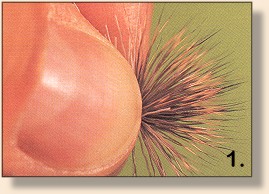
- Snip a bunch of coastal deer hair from its hide; comb, measure
(from eye to midbend as usual), and tie in the hair about
one-quarter of the shank’s length back from the eye using the
pinch. Stack the hair if you wish, but coastal deer is usually
well-stacked on the hide; careful handling will keep it that way.
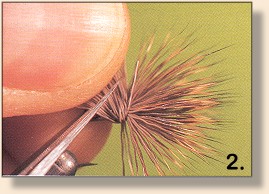
- Still holding the wing butts after the pinch, raise them
and snip them at an angle. Cover the trimmed butts with
thread. If you are using 3/0 thread, you now have the option
of switching to 8/0 or 6/0.
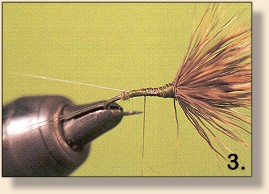
- Tie in the split tails.
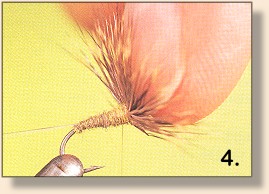
- Dub a tapered body to the rear of the wing. Set the wing
upright by slipping your thumbnail under it (and over the eye)
and right up against the base of the wing; them rotate your
thumbnail up and back to really crease the wing’s base. Repeat
this once on each side of the wing using either your thumbnail
or fingernail.
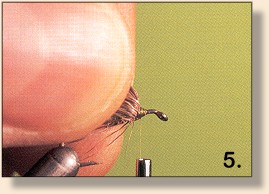
- Draw the wing firmly back and add tight turns of bare thread
right as its base for support.
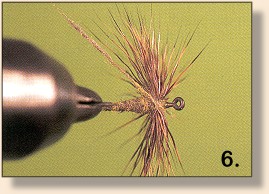
- (Bottom view.) Crisscross dubbed thread from the front of
the wing to the back and again to the front a few times to cover
the underside of the wing; then dub to just behind the eye
and complete the thread head as usual.
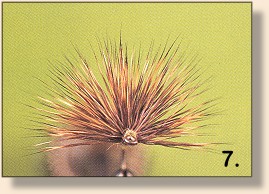
- The Comparadun wing: front view.
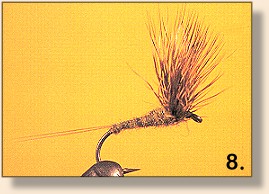
- Finished fly.
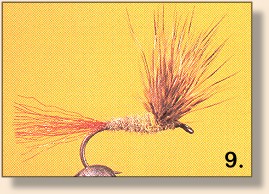
- The same fly fied in Sparkle Dun style - a shuck of
Z-lon or sparkle poly yarn replaces the split tails. ~ Skip Morris
Fishing Instructions:
For more information on Mayflies, and how to fish them,
click HERE.
~ DLB
Credits: From The Art of Tying the Dry Fly by Skip Morris,
published by Frank Amato Publications. We greatly appreciate use permission.
Originally published March 4, 2002 on Fly Anglers Online by Skip Morris.