New Year’s Eve. I was off from work for the day.
Temperatures, which had plummeted into the
mid-twenties over Christmas weekend were in the
low seventies again. The lake beckoned, and though
I knew what I’d find there, I had to go to it.
My friend, who goes by the moniker The Old Fella,
and I took to the boat just after noon. He was
armed with spin tackle and bait, myself with a
five-weight Redington. Neither of us held much
hope of catching a fish, but it really didn’t
matter. As The Old Fella put it, “Catching fish
is lagniappe.” In case you’re not familiar, that’s
a French-Acadian term, pronounced “lahn-yahp”
meaning something extra.
We trailered the boat down the Atchafalaya Basin
Protection Levee to Grande Avoille Cove, cok’tangi,
the ancient worship place of my people. Though Grande
Avoille is only a ten-minute ride by boat from the
reservation, I feared the air would be turning cooler
by the time we left the cove, so I wanted to shorten
the return trip.
Louisiana’s southern areas, particularly those
within the Atchafalaya River basin, are at the
mercy of wind, rain and flow. Months of high winds,
constantly shifting like restless spirits unsure
of the direction they wish to take beyond, would
fury from the north for a time, pushing basin water
levels out to the bay. Then the wind, like a hapless
vagabond, would shift south, and the onslaught of
tide would push into the basin again.
There was no clean water to be found in Grande
Avoille Cove, as I had expected. We rushed to
the back of Sawmill Bayou with the boat on plane,
because I knew the cove would be shallow. Though
it had averaged three or four feet in depth during
my youth, in the summer months I am lucky to find
two feet of water there now. There is only this
one place, where the forks of Sawmill Bayou converge,
that enough washout keeps a space, scarcely fifty
yards in length, deep enough to bring the boat back
on plane and get out.
Bits of twigs, leaves and sawgrass floated like
wayward souls across stained, brown water. The
Old Fella rigged up a bobber and worm, and I
fruitlessly cast a popper around the base of
cypress trees. The wind was picking up, blowing
from the southeast, straight down the mouth of
Sawmill Bayou, so we started the engine again
and idled over to the southern side of the cove,
to a place I call Sue-Sue’s Canal. It is so-named
by me, because it is my girlfriend’s favorite
place in all the basin, a lovely, shallow little
natural drainage basin for the surrounding swampland.
In the spring, big goggle-eye and shellcrackers gang
up here for the spawn.
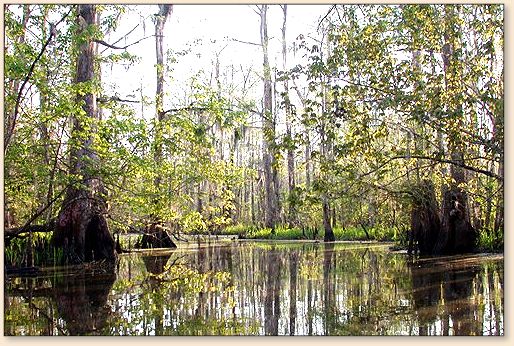
A slight current was moving out of the canal, but
we were blocked from the wind. Water lilies, that
Asian invader that has so plagued Louisiana waterways,
had been browned and withered by the Christmas freeze.
During the 1884 New Orlean’s World’s Fair, Japanese
exhibitors at the horticultural pavilion gave away
packages of water hyacinth seeds to all their visitors.
They were told to just throw them in ponds and waterways,
wait until they grew and bloomed beautiful, orchid-like
flowers.
They did, and the plant soon overtook most of the
Louisiana waterways. By 1897, the Corps of Engineers
was summoned for help. They enlisted hundreds of men
using pitchforks, who would throw the lilies out onto
the bank. There they would dry out and die. But as
more room was cleared for still-floating hyacinth,
they reproduced faster and more abundantly. In 1900,
a sternwheeler with a conveyor-rigged system would
scoop up the hyacinth, and grind it to a pulp. Later
dynamite was tried. Then flame-throwers. According
to an article by Buddy Stall in the Clarion Herald,
“A full cone of fire, hot enough to melt a block of
steel, was squirted on a hyacinth raft. When the fuel
was exhausted, a frog emerged from the blackened mat
and began sunning itself. The scientist using the
flame thrower was even more astounded later during
the next growing season. The burned plants were not
only the first to sprout, but also averaged nine
inches taller than surrounding plants. The next
attempt was in the form of arsenic. Some of this
got into the food of the workers at the site and
resulted in the death of one man and critical
illness to thirteen others. The hyacinths grew on.”
But winter will help keep the water hyacinth at
bay, and I was glad to see it’s weathered,
scarred condition. In the 1940s, the nutria
was introduced as a control measure for water
hyacinth, having already escaped captivity due
to a hurricane earlier in the decade. The nutria
however eats more than water hyacinth, and has
become a dangerous pest in its own right in
Louisiana.
We received a few half-hearted strikes down
Sue-Sue’s Canal, but the water was still cold.
I had abandoned the fly rod for a bobber and
worm, I am loathe to admit, but to no avail.
Twice the boat got stuck on logs or stumps and
required considerable maneuvering with the
trolling motor set on high to free us. We snacked
on raisin oatmeal cookies, The Old Fella and I,
talked about many a thing unimportant to any
but ourselves. We spied two huge beaver nests,
mound-shaped domes of gathered limbs and vegetation.
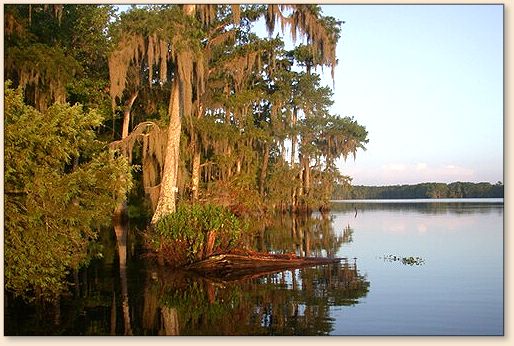
To the south, the white-shell remnants of cok’tangi
peek from crisp, dead cypress needles. The entire
Chitimacha nation would gather here annually, for
cok’tangi means literally “pond lily worship
place” after the flat-topped lilies which still
grow here. The Spaniards called that lily grande
avoille. A century ago, the clamshell mound extended
out thirty yards into Grande Avoille Cove, but
in the 1930s it had been dredged by commercial
interests for the shell, which is valuable for
laying roadbeds and driveways. The dredges
disturbed graves millennia old, and skeletons
tumbled out, to be gathered up by workers and
tossed out into the cove, where they would sink
into the soft silt bottom to vanish to a watery
unintended grave. These were nata, chiefs,
as well as medicine men and honored members of
the Chitimacha nation. Tossed into the mud like
so much discarded refuse. Sometimes when I am
drifting along the scarred, ravaged banks of
cok’tangi, broils of small bubbles reach
the surface of the water and burst there, and
I fear these are the breaths of ancestors, gasping
for air down deep in the silty mud. When the water
is clear and the sun strikes it at an angle and
plane of refraction, shadows below the surface
seem like fingers, spindly and crooked, reaching
out for me in pleading.
The fishing is a failure, but as The Old Fella
and I pack up our gear, he remarks to me, “You
don’t know how much this has done for me. If I
live to a hundred now, you understand, it’s
going to be all your fault.”
I tell him that’s a burden I’ll gladly bear as
we don our life jackets and I start the engine.
We idle back to Sawmill Bayou, turn the boat
around at the precipice of the deep hole where
the bayou forks. For a moment I am reluctant to
throttle the boat up, to race the engine, hear
it thunder, and break the solitude of Grande
Avoille Cove. Cypress stand tall and silent,
half-naked with winter’s coming. They twist and
churn in the southern wind, and at their trunks,
water laps relentlessly. And I realize that I,
like The Old Fella, have been recharged. Food
of the soul, this old worship place is. In the
shredded, rent remnants of it, there is still
power flowing in the wind, along the flow of
canals, and through the spirits of two late-December
visitors.
The engine roars, and the boat lifts her nose
high. We leap out of Grande Avoille Cove,
throwing churning mud behind us, and back
into a world of dreamlessness, but know where
we can find the dreams again when we need them.
We will be back. ~ Roger
Originally published January 10, 2005 on Fly Anglers Online by Roger Rohrbeck.