
**### Bamboo Chat- Host RON KUSSE - Thurs. 5-8 p.m. PST (8-11 EST)
—**
My Rod Shop
By Ron Kusse, Master Rod Maker
My name is Ron Kusse, I am a ‘Maker,’ a cane rod maker.
I have lived cane rod making. I am cane rod making.
I learned the craft early on and we grew up together. It
is what I think about when I get up, during the day and
the last thing when I go to sleep. I grew with it and it
grew with me. Most from that era are now gone, yet I
remain to carry on the tradition as best I can.
And now, in 2003, even I am moving, leaving the cradle
of the cane world as it has become known and spending my
retirement days building my final rod shop in upstate
New York. This is my story.
I have gathered here some pictures of my equipment. In
these I hope you will find some insight of what my world is
about, the world of the bamboo fly rod. This is not about
‘How to make a cane rod,’ but rather about what it takes
to make one. I feel that all, yes, all of this is necessary
if one is to really consider himself a true cane rod maker.
It is, of course, not necessary for the hobbyist making
only a few rods a month.
My shop is a production rod shop, my methods are those of
a production rod maker. This is my avocation and a life achievement.
I have worked under, alongside of, and carried on with, the
masters of the craft. A craft which can be often learned but
only rarely, if ever, mastered.
I have been making split cane fly rods for more than a half
a century. During this time I have owned three shops, the
first two were in Rochester, New York and the current shop
is in Washingtonville, New York. I have been working from
this shop for over 31 years, in the foothills of the Catskill
mountains, about six miles from Central Valley, New York,
where the H. L Leonard Rod company was located.
I was honored to be Vice President of the H. L Leonard Rod
Company for over ten years. The Payne Rod Company was located
a mile down the road in Highland Mills, New York and I visited
the shop often over those great years.
I have recently bought a new home and shop in Cape Vincent, a
small town on the bank of the St. Lawrence River in the
Thousand Island Area of New York State. I have visited
and fished many parts of the world and some were wonderful
places, but as a teenager I visited Cape Vincent and the
Saint Lawrence River area, fell in love with it and
have wanted to live there ever since. Now it seems my
dream has come true, better late than never.
I am a little sad to be leaving this area, because of the
wonderful rod makers and rod shops that were located here.
This region holds claim to over 100 years of great split
cane rod making heritage. The towns of Central Valley
and Highland Mills have not changed a whole lot and you
can still talk to old timers who remember that the craftsmen
from the Leonard Shop and the Payne Shop had formed a band
and would give concerts on Saturday night in the Band Stand
in the park at Highland Mills.
Employees like Ethel Frowcin, who came to Leonard Rod as
a young girl at the time of World War I, worked there as
a rod winder until about 1980. Tom Bailey worked for
Leonard Rod for a number of years, then worked for the
Payne shop for almost another 40 years. Then after Jim
Payne died, Tom worked for the Leonard Rod Company for
an additional 15 years until Leonard Rod Company was
closed by the Internal Revenue Service in 1984 for non-payment
of the excise tax. Craftsmen who worked at the Leonard
Rod company generally stayed a long time.
Maybe you will be interested in the physical layout of
the shops. All three were pretty much the same. To
really document the history of these shops in the last
40 to 50 years is way too much to try to do it here.
Perhaps someday there will be a book that will go in
more depth.
Of the two shops, H.L. Leonard was considerably older
and larger. Leonard started in 1862 and lasted until 1984.
Through much of that time the Leonard Rod Company had 20
or 30 employees. The Payne Shop started early in the
1900’s when Ed Payne left Leonard. Jim Payne, his son,
worked with him and eventually took over and operated his
shop until he died in 1968. The Payne Shop had
approximately seven employees.
It’s a sad thing to note that Hiran Leonard had sold his
complete interest in the Leonard Rod Company to William
Mills and Son, a New York City sporting goods store which
continued to use the H. L. Leonard Rod Company name. In
the case of the Payne Rod Company, Jim Payne, even though
his name was on the shop, had long ceased to be an owner.
Jim died in 1968 and after a succession of owners other
than Jim, the company was owned by the Gladding Corporation.
Of the two shops, even though older, the Leonard Rod Company
was much more modern. I attribute this to the fact that the
H. L. Leonard Rod Company burned down in 1964, so they built
a new shop out of cement blocks so it couldn’t burn and the
tools and equipment were all new and modern.
However, I found the Payne shop both interesting and intriguing.
Instead of having individually powered lathes, bevelers, grinders
and drill presses, all these tools were powered by a couple
of very large electric motors that ran these tools by way of
four-inch wide leather belts, some 10-15 feet long. Some motors
were mounted overhead and one was floor mounted, it kind of
gave me the impression of a spider web. Each motor was powering
more than one machine.
One thing all of these shops had in common, including mine,
was not having enough room. That is the reasons you did not
see much cane in the shop, it just took up too much space.
In the case of Leonard, we would store it in the cane shed
across the street. Jim Payne had a ‘cane closet’ and I have
a ‘cane shed’ in my back yard. A large amount of cane takes
up a lot of space.
When I was at Leonard, being a larger company, we were
splitting cane every week. The two cane room employees
would carry what they needed in from the cane shed. At
Payne they would cut cane about once a month or two, I
cut a year or so of cane at a time, then work on cane for
about a month and spend the rest of the year finishing rods.
In fact, my shop is very small and the miller takes up 13
feet, so when not actually cutting cane during that month,
it is taken apart in three large pieces and stored to give
me more working space.
In the past years, in cane shops, secrecy was the word;
in the Payne shop the beveler was behind locked doors.
There is an interesting story that Tom Bailey told me
about the H. L Leonard Company beveler, it was’ hidden’
in the beveler room. There were just two employees who
worked in the ‘beveler room.’ Tom said, "If you wanted
to ask someone a question in the beveler room you would
have to knock on the locked door, a voice would say, “what
do you want.” You would say, I have a question, or something
to tell you. There was a two inch hole cut in the center
of the door. Inside the door was a piece of wood tacked
in place with a nail over the hole. The board was pushed
aside and someone would stand in front of the hole so you
couldn’t see the beveler. You would have your conversation
through the hole in the door and then the piece of wood
would swing back into place so you couldn’t see it any more.
Everyone in the rest of the shop called this the ‘beveler
room peaky hole.’
To say that things were secretive and a little tighter in
those days is an understatement. In the years I knew Jim
Payne I never called him Jim. He was Mr. Payne and I was
Ron.
Here are some pictures and a bit of information about each, enjoy.
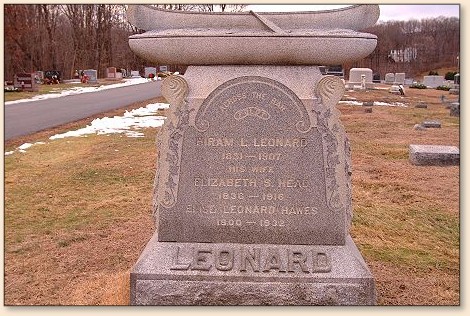
This is the grave stone of H.L. Leonard
who was the founder and owner of the H.L. Leonard rod
Company for many years. He is buried in the Highland
Mills cemetery, Highland Mills, New York, about two miles
from the H.L. Leonard rod Company.

This was the former home of H.L. Leonard rod Company as it
appeared in December 2002. This cement block building was
built after the fire that leveled H.L. Leonard rod Company
in 1964. The original shop was located about 100 feet to
the left of this building and consisted of a three story
frame building. After the fire this cement building was
constructed. At that time is was painted a cane color and
not the blue that you see here. The building consisted of
four major areas; winding and varnish room, rod mounting room,
cane room and office. Numbers of employees fluctuated from a
low of about fifteen to a high of nearly thirty. Leonard was
closed by the I.R.S. in 1984 for non-payment of federal excise
taxes. This is now a fuel oil company.

This home at one time was Ed Payne’s and a few years later
Jim Payne’s rod Shop, located in Highland Mills, New York,
about a mile or so from the H.L. Leonard rod Company. As a
rod shop it looked somewhat different. On the left side of
the picture it had a center main door with a little roof
and a stoop. There were no doors in the sides of the
building; however, there was a back door and the building
was a cane color. It was of wood construction. It contained
four rooms; varnish room, large center shop, cane room where
beveling was done and a small office. During it’s heyday it
had as many as seven employees. Jim Payne died in 1968 and
at that time the Gladding company in Syracuse owned it. They
tried unsuccessfully to run it. The name and building was
later sold to other owners. Eventually it was sold to a family
who converted it to a home, as it appears in December of 2002.
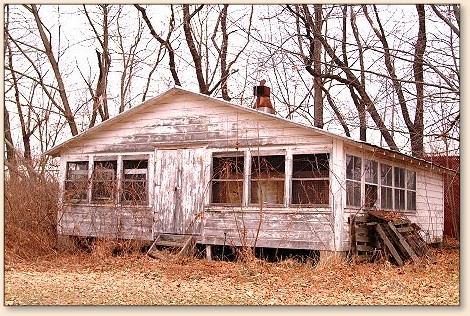
This is the cane shed located across the road from the H.L.
Leonard Rod Company. Here is where the cane was stored. At
times there were forty to seventy bundles of cane poles,
each twelve feet long. For a hundred years or more cane
was called simply poles by all rod makers. Demerest
Company was the major importer of cane from china for
many decades and they called cane simply poles. During
the 1970’s in some kind of strained quest for glamour
the newer rod makers started calling them culms.
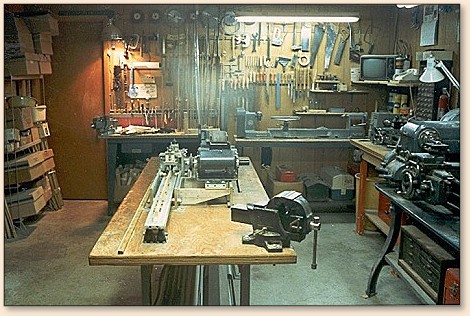
Older photo of my shop when miller #2 was still on the
center work-bench inconveniently getting in the way.
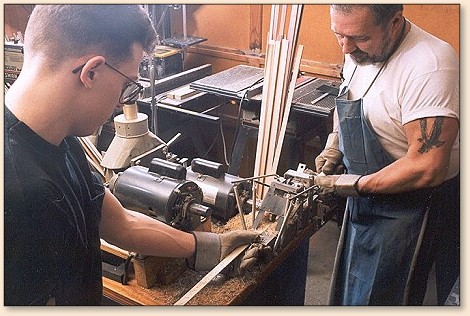
My son Eric and me running a strip through the thickness
planner. This machine will hold tolerances of 1,000 of
an inch. I generally plain them to 10,000 over so that
when I run it through the 60 degree miller I don’t have
as much cane to mill so it makes a much more accurate cut.
This is a push-pull machine and requires two people to operate.
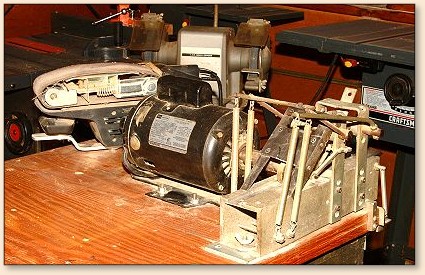
This small but powerful four inch belt sander is very
useful for a variety of tasks. The other machine is a
thickness planer, easy to build and will save you time
and will improve the cutting of strips. After the cane
is split, straightened and the nods dealt with, you put
it through the thickness planer and you can take it down
to the depth you need plus .010 over so when you put cane
through a 60 degree angle miller you have less cane to mill
off because it is .010 thicker than the strip you are making.
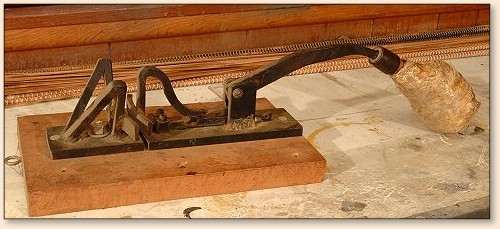
This is a node presser. Jim Payne gave me this back in
the mid 60’s as he had made a new one and I have used
it ever since. It is mounted on a maple board over an
inch thick. When the node presser is in use it is
bolted to a heavy work bench.
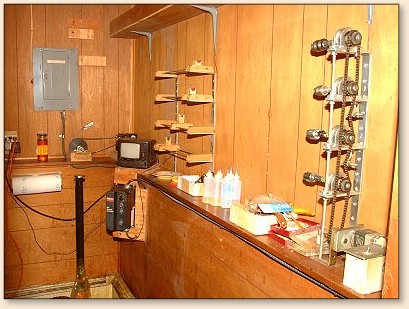
My varnish room is nine feet long by six and a half
feet wide. It has it’s own environment. It has it’s
own temperature, humidity controls and has an ionizer
for dust control. The walls have number of chain
driven turners for the drying of the varnish on
winds. It also has a rather sophisticated dipping
apparatus. This walk-in room is capable of hanging
thirty joints at a time.
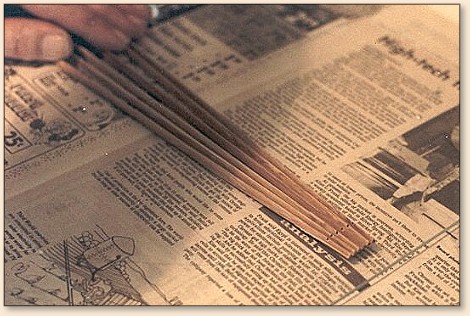
After the strips have been tempered and put in their
proper sequence, masking tape has been wound around
the thicker end and with a razor blade you slice
between two strips and the joint can be fanned open
with the masking tape holding them in their proper
sequence.
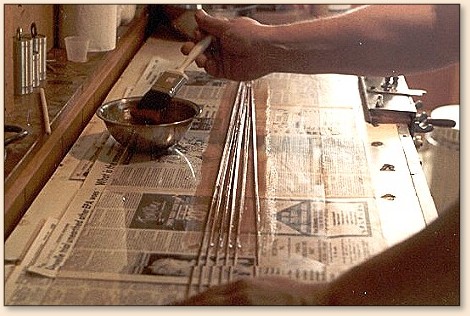
The strips have been fanned open and Urac-185 is
liberally applied to the cut side of all six strips
with a three inch brush.

The strip has been closed up into a hex shape and is
now run through the binding glueing machine. After
one pass it is then passed through again with the
string going in the opposite direction. This is done
with various amounts of weight depending on the size
of the strip to be glued. They are then hung in the
varnish room to cure.
This machine has two purposes. After the strips have
been milled and put in the proper order to make a joint
they are wound dry with string before tempering. After
the strips are tempered the string is pulled off. Then
a razor blade is inserted between one of the six strips
so it can be fanned open but remain in the proper sequence.
Glue (Urac 185) is painted on the inside of the strips
generously. The strip is then put back through the machine
and now the machine will be used for gluing. The cane is
put in the machine, string attached, and it is wound through.
The tension on the string forces the excess glue out. A few
half-hitches and then it is passed through the machine in
the opposite direction, checked for straightness, excess
glue wiped off with a damp sponge and hung in the drying
room to dry. I generally glue enough joints at one time
to make at least twelve rods. I use a different amount
of weights between butts and tips as the tension on the
string is not the same for both.
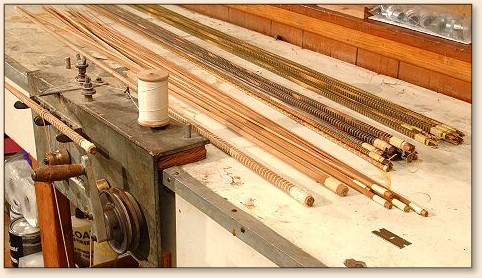
Overall view of the glueing table and binding, glueing
machine attached.

This is the 60 degree miller. It puts the 60 degree
angle on the strip, no taper.

Cane milling machine #2. This view shows the carriage
and pattern going under the cutting head.
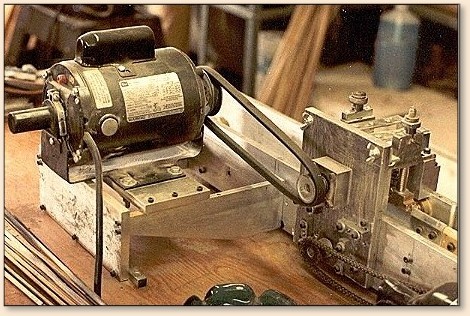
Just a different view of the cane milling machine #2.
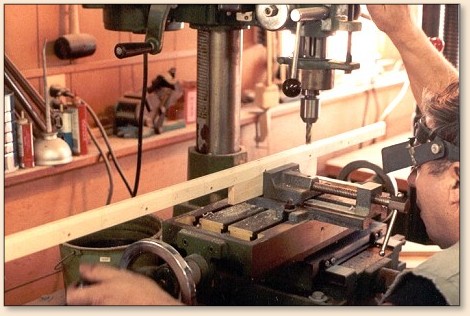
Here I am at the metal milling machine cutting a taper
into the maple pattern for the cane milling machine.
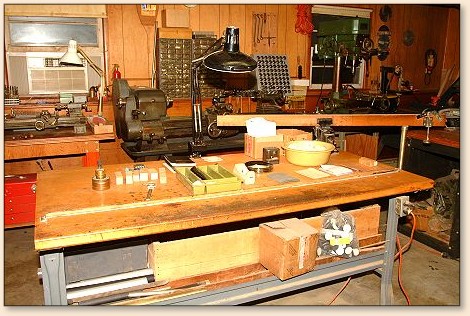
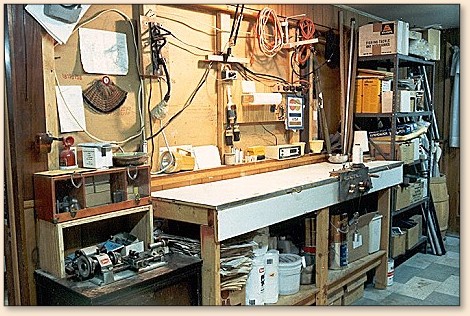
This workbench is the main workbench in the shop. I
try to keep it clean so I have a large area to work.
Miller #2 sat on a similar table for fifteen years.
Because of the way I cut my cane, the miller is only
used for about a month out of the year, a year’s worth
of cane can be milled at one time. The other eleven months
it got in my way. It needed thirteen feet of operating
room and encumbered my work space. Now miller #3, a new
version, is only used when I cut cane and is put away
for the rest of the year.

Drill press and motorized wet stone. Small drill press
for light drilling and motorized wet stone. The only
way to make tools sharp.

Pictured here are two tools. One is used often and one
is not. The 3/4 horse buffer is used often. The scroll
saw is used infrequently but there are times when it
is needed.
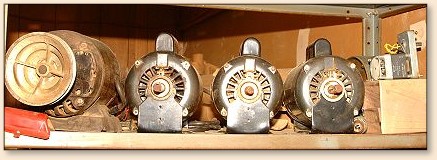
This is a shelf I store most of my extra motors on.
There is an extra motor for every tool in the shop.
In the event a motor should fail I can install a spare
and be back in business within twenty minutes. The
failed motor then could be repaired at my leisure.
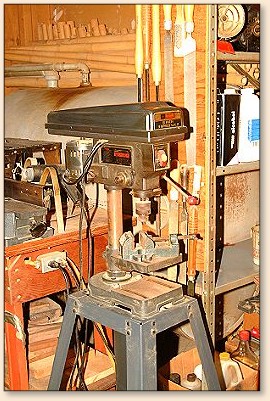
Medium drill press, not a very impressive tool, but
when you need it, you need it.

This small metal lathe was sold through Sears & Roebuck.
It is quite old but will last forever as it is all cast
iron and steel construction. This six inch lathe was made
by Atlas Clausing Company. This is the same company that
made the Everitt Garrison famous lathe. I use the mostly
to make ferrules and other small parts.
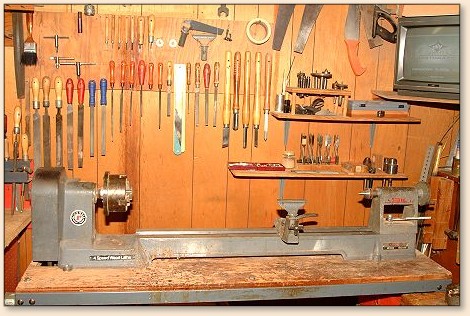
This is one of two identical Rockwell wood lathes in the shop.
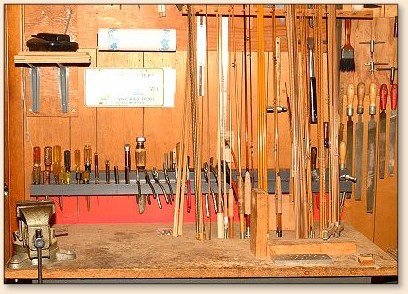
A workbench at the front of my shop with a vise and
a rod rack where work in progress and some repairs
are stored. There are also some small hand tools
hung on a rack on the wall.

A Logan metal lathe is my workhorse lathe. I do more
things with this dealing with metal than all of the
other metal working tools combined. I have almost
every conceivable option for this table. My collet
set numbers 105 in all, both inner and outer.

This eight inch table saw is fine for most cutting
I do in my shop and I like this one very much. When
heavy-duty cutting is needed I use the ten inch table
saw. An indispensable tool is the 48 X 6" heavy-duty
belt sander.

Shown in this picture is a 1 X 42 inch belt sander, a
ten inch band saw, a 3/4 horse power grinder and a ten
inch table saw. These tools are not used everyday, but
these tools are necessary to have a complete rod shop.
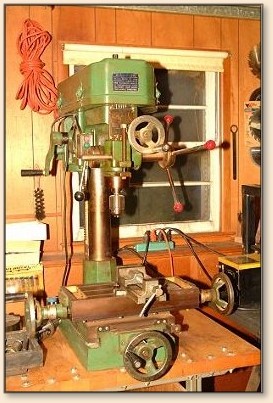
This machine is a great machine for making parts for
other machines and cutting patterns for milling the
milling machine. I could not do without it in my shop.
Also, it makes a fantastic heavy-duty drill press. It
weights over eleven hundred pounds.
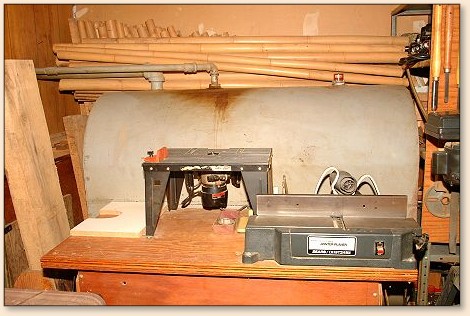
On the left is a heavy-duty router and table. On the right
is a jointer planer. Just behind that is a heat gun. Behind
the oil tank are almost seventy, six foot, pre-embargo cane
poles. These were purchased from Minei Hull, a very good rod
maker who lived in Buffalo, NY. I bought them in about 1963.
There are some 2 - 21/2," 21/2 - 3," and some 3 - 31/2" poles.
The power fiber in these cane poles is very deep . They are
very clean with very tiny nodes. I have only used 3 or 4 of
them in forty years. One of these days…
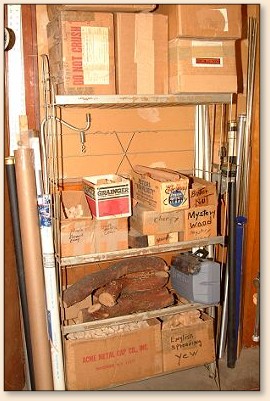
This rack has boxes of cork, maybe 4,000 - 6,000 corks.
Some of this cork is older cork that I got from Jim Payne
and from Leonard. This is plain, untreated cork from
Portugal and is stamped on each and every cork. Also
many kinds of wood are represented here for reel seats.
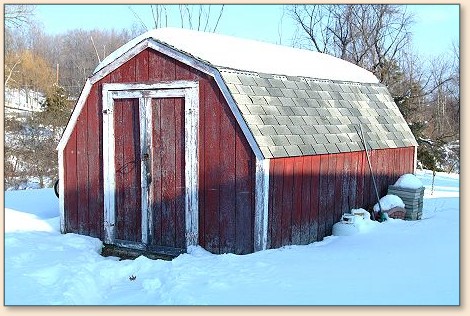
This is my cane shed. It holds many bundles of cut and
uncut cane. The most important thing about any cane shed
is that is must remain dry at all times. Three outboard
motors, two lawn mowers and lawn tools share the space
with the the cane.
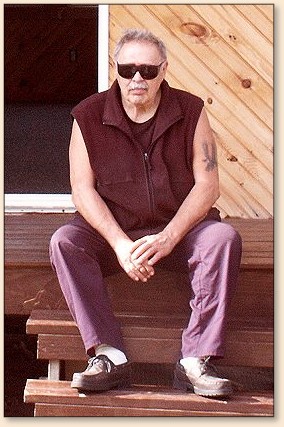
This is me, on the small back porch of my new home. This
was taken shortly after my eye surgery, hence the dark
glasses. My new shop is 28 by 34 feet with ten foot ceilings, oil heat,
100m amp electric, water and all 2 X 6 construction. What
more could a rod maker want?
~ RK
Originally published February 16, 2003 on Fly Anglers Online by Ron Kusse.