PART 2: SUDDEN CHANGES & ANALYSING SITUTATION
As reported in PART 1, afternoon of October 25th was one of the most memorable dry-fly fishing experience in my life. October 26th, in spite of sunny and windy afternoon, BWO hatch was good (at where I call “Windbreak” spot). I fished the same way with happy results. On October 27th, weather turned out to be very suitable not only for BWO hatch but for streamers and large soft-hackles. I had very good actions with large soft-hackles in the morning. Then BWO hatch started just as I expected at 1pm. Lots of trout did rise again at the “Bend”. Day couldn’t have been better than that. However, little did I know it was only a beginning of conundrum, actually a trap eventually paranoia.
TROUT BEHAVIORAL CHANGE: As trout started rising at 1 p m on October 27th, I started fishing just the same way as I had been doing at “Bend”, hoping another huge run-up trout would take my flies. I rigged up two dry-flies (combination of duns, spent, emergers, cripples, parachutes, and more) or one dry-fly plus nymph imitations (fished in various depth). For next two hours, my flies were totally ignored by rising trout. Changing flies more than I could recall and using more than several feet of 4X, 5X, and 6X tippets, I couldn’t even get trout attention at all.
I can describe this now because I kept my daily journal entries. Trout were rising to feed on something without breaking the surface film (this first observation was the key till the end). I was simply thinking “feeding on something under the surface, so try dry-dropper nymph, and have them target on nymphs”. I even tried soft-hackle swings. Nothing really happened. I actually had one strike on my dry-fly. That was the only one action when one particular trout broke the surface and fed above it. By then, I had changed too many flies and pieces of tippets, so one of knots might have been weak. It broke away my tippet, hence I couldn’t do stomach sampling. I didn’t take the situation too seriously in that afternoon. I said “Hey it’s just a tough day”.
| BWO HAPPY HOURS (part 2) |
HOW ABOUT BWO? : BWO were definitely on the water and in the air. However, considering rise forms of trout, I also thought about trout might have been taking midges. As frustration and nothingness accumulated, I walked to downstream, enough distance away from rising trout, and used my seine (always kept in my vest). What I collected was just like these.
| BWO HAPPY HOURS (part 2) | BWO HAPPY HOURS (part 2) |
My seine must have been covering from the surface to 4 or 5 inches below the surface film. All I got was these duns. Drowned or just fallen in? I did not collect any emerging/ascending nymphs or midges (unless counting a few of size 32 midges). Trout had to be feeding and rising for BWO then.
OTHER POTENTIAL PROBLEMS: I caught up with Tom at the creek. I explained situation and problems I had faced. As always, he pointed out potential problems and what I could do.
- Probably my fly patterns were limited. This was true and I accepted the fact as I wanted to add more variations eventually. Besides patterns in PART 1, what I had on that day were:
| BWO HAPPY HOURS (part 2) | BWO HAPPY HOURS (part 2) | BWO HAPPY HOURS (part 2) | BWO HAPPY HOURS (part 2) |
| CDC Sparkle Dun Hook: Standard dry or emerger # 18, 20, 22 Thread: Olive dun, rusty dun Tail: Sparse amount of dark dun Zelon Abdomen: Tying thread Wing: White or light dun CDC fibers Thorax: Superfine dub, BWO or gray | Pheasant Tail Mayfly Parachute – Yamamoto’s Hook: Standard dry # 18, 20, 22 Thread: Olive dun, rusty dun Tail & Abdomen: Pheasant tail Ribbing: Fine gold wire Parachute: White Widow’s Web or EP Fibers Thorax: Superfine dub, BWO or gray Hackle: Light or medium dun | Double CDC Emerger – Yamamoto’s Hook: Emerger # 18, 20, 22 Thread: Olive dun, Tail: Sparse amount of dark dun Zelon Abdomen: Brown goose biots Thorax: Olive Henry’s Folk Hackle – Montana Fly Company Wing: Dark dun CDC fibers | Pheasant Puff BWO – Yamamoto’s Hook: Standard dry # 18, 20, 22 Thread: Olive dun, rusty dun Tail: Sparse amount of dark dun Zelon Abdomen: Turkey biots – BWO, gray, PMD Wing: Gray fluffy fibers of any Ringneck pheasant feathers Head: Superfine dub, BWO or gray |
These were another good bunch. But also I was fishing the same spot of the same creek. Although I was confident of my casting and presentation, through my guiding experience I should have known that trout eventually would get used to same fly patterns.
- As of October 25th, I hadn’t seen any redds at “Bend”. That was why I could move around to find right angles of presentations so easily. However, just in a day or two, lots of redds were developed. Probably I should have simply left the spot but I was targeting rising trout along the far-bank and I was sure that I wasn’t stepping on redds. Instead I had to be either a bit too far or a bit too close to rising trout. Yet I still presented my flies without dragging. Over all, it still sounded like “Hey it’s just a tough day.” Even well-known fly-fishermen can face “Waterloo” every now and then. After those tough experiences, serious anglers conquer problems and grow up into further better anglers. I can relate to that situation myself too.
To be continued in PART 3, see if I could fix the situation………..
Satoshi Yamamoto, https://leftyangler.blogspot.com, brought his passion for fly-fishing & fly-tying from Japan to Montana and became the first ever Japanese guide in Livingston, MT. He guides and fishes big rivers like Madison & Yellowstone, spring creeks in Paradise Valley, and various waters in Yellowstone Park. Hence, with his Regal Vise at the bench, his fly tying interests vary from tiny midges to 5-inch streamers and anything in between. Once his ideas are combined he goes out for experiments at those near-by waters. Satoshi submits his innovative patterns to Montana Fly Company (www.montanafly.com).
His own innovative original patterns can be purchased from his fly-shop, https://leftytyer.blogspot.com.
PART 3: MORE ATTEMPTS
& MORE PARANOIA
Tying at Eva’ Hut along DePuy’s Spring Creek…..
Duration and intensity of Fall BWO hatch and trout rises vary day by day. Both are affected by daily weather. It’s hard to predict what would happen on that day or set up routines during fall fishing around Livingston. One day hatches and rises would last over two hours (longest one can expect), then next day, they could be as short as 30 minutes, if not none. Next good hatch and full two-hour rising actions I encountered were in the afternoon of October 31st. I added more patterns, learning from Tom Travis. Then I conducted following methods with better understanding.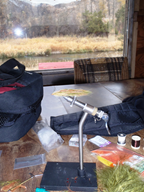
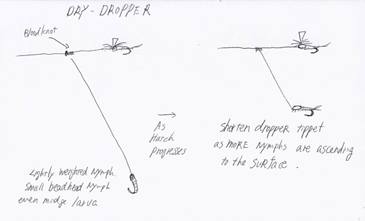
DRY-DROPPER REVIEW:
So I tied up following patterns. When I didn’t have time in my house or when things were slow at the creek, I tied some at one of resting huts of DePuy’s, bringing my travel tying kit.
| Paraloop Emerger/Cripple Hook: Emerger hook #18, 20, 22 Thread: Olive dun, rusty dun 8/0 Tail: Dark dun Zelon fibers or medium dun hackle fibers Abdomen: Turkey biots dyed BWO, PMD, or gray Thorax: Superfine BWO, PMD, gray Hackle: dun feather wrapped around monofilament and finished in Paraloop style | Foam Post Parachute – BWO Hook: Standard dry or emerger #18, 20, 22 Thread: Olive dun, rusty dun 8/0 Tail: Dark dun Zelon fibers or medium dun hackle fibers Abdomen: Turkey biots dyed BWO, PMD, or gray Thorax: Superfine BWO, PMD, gray Post: foam, color of your choice Hackle: dun feather wrapped around foam post | Sawyer PT with Dubbing Hook: Standard dry #18, 20, 22 Thread: dark brown 8/0 Tail/Abdomen: Pheasant tail Ribbing: Copper or brown wire, medium fine for #18 & fine for #20 & 22 Thorax: dubbed fuzzy, olive or gray Wing-case: Pheasant tail fibers | Turkey Biot Nymph Hook: Standard dry #18, 20, 22 Thread: dark brown 8/0 Tail: Pheasant tail Abdomen: Turkey biots BWO, PMD, gray Thorax: dubbed fuzzy, olive or gray Wing-case: Pheasant tail fibers |
Here’s how to use.
SWING SOFT-HACKLES:
I often apply this method when dead-drifting dry-flies is not producing or simply hard to see during BWO and midge hatches (of course soft-hackles can be fished dry and dead-drifted but that has to be discussed in different articles).
| Nick’s Soft Hackle Hook: Standard dry #18, 20, 22 Thread: Red 8/0 Tail: Dun hackle or mallard flank fibers Body: Superfine BWO, PMD, gray Hackle: Dun hen cape or partridge | Tom’s Simple Soft Hackle – BWO Hook: Emerger hooks to fish the film, scud hooks to fish below the film #18, 20, 22 Thread: Olive dun, rusty dun Abdomen: Turkey biots BWO, PMD, gray Thorax: Superfine BWO, PMD, gray Hackle: Dun hen cape, partridge, Coq de Leon hen cape | Flymph – Tom’s Version Hook: dry hooks to fish the film, nymph hooks to fish below the film #18, 20, 22 Thread: Olive dun, rusty dun Tail: Dun hackle or mallard flank fibers Abdomen: Turkey biots BWO, PMD, gray Thorax: Superfine BWO, PMD, gray Hackle: Dun hen cape, partridge, coq de leon hen cape |
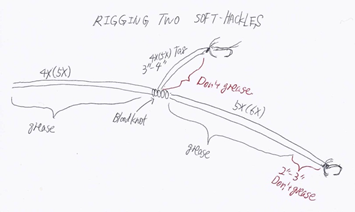
I rig up these soft-hackles as depicted below and fish in classic methods: cast down & cross, mend upstream to slow down, then let current take my line and flies. Trout can’t resist, follow soft-hackles, and set hooks automatically by themselves at typically corners of their mouths.
Some of you would expect pictures of fish and me doing “grip-&-grin” here………WRONG!! This afternoon was more shocking than the afternoon of 27th. At “Bend”, three trout locked in each position and kept rising again without breaking the surface film. Each of them barely moved one-foot to left, right, up, or down from its original position. So there must have been something good and big amount of food there. I again considered midge (pupae, emergers, or adults) might be present. However my seine kept collecting only BWO. Two techniques mixed with various flies (all good ones!!) didn’t work at all. My flies were totally ignored as if I were casting from Mars. Trout kept feeding for two hours and I was struggling for two hours. I had to admit my “Waterloo”.
Another concern I had: BWO hatch and trout rises seemed weaker than this time of year before (2011). It could call for the year any time soon. Time was limited………
To be continued to PART 4.
Satoshi Yamamoto, https://leftyangler.blogspot.com, brought his passion for fly-fishing & fly-tying from Japan to Montana and became the first ever Japanese guide in Livingston, MT. He guides and fishes big rivers like Madison & Yellowstone, spring creeks in Paradise Valley, and various waters in Yellowstone Park. Hence, with his Regal Vise at the bench, his fly tying interests vary from tiny midges to 5-inch streamers and anything in between. Once his ideas are combined he goes out for experiments at those near-by waters. Satoshi submits his innovative patterns to Montana Fly Company (www.montanafly.com).
His own innovative original patterns can be purchased from his fly-shop, https://leftytyer.blogspot.com.
Originally published Dec 3, 2012 on Fly Anglers Online by Satoshi Yamamoto. Combined from 2 parts.