Bunny Baitfish Text and photos by Alberto Jimeno
One of my favorite ways to fish for river
smallmouths is by using streamer patterns on a
sink tip line. This streamer is one of my go-to
patterns. It is quick to tie and can be tied in
many different colors.
In my opinion, tube fly streamers offer several
advantages over conventional streamer patterns.
Since the pattern is tied on a tube, and the hook
itself is separate from the fly, you only need to
carry a few hooks to rig up all of your flies.
Another advantage comes after you have hooked a
fish. After the hook is set, it tends to detach
from the fly. This not only protects your fly from
the teeth and thrashing of the fish, but also lets
you play the fish on a stout, short-shanked hook.
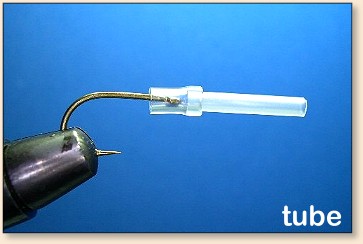
The picture above shows one of the generic ways
to setup a tube fly. In this case, the tube is
made of plastic. To make heavier flies, tubes
made of copper and aluminum can also be used. The
short piece of soft tubing is used to keep the hook
attached to the tube during fishing. It is called
the junction tube. Finally there is the hook. I like
to use the TMC105, shown here in a size 4 (for comparison
purposes, the plastic tube is " long). To rig this fly,
thread the leader through the tube and tie it onto the
hook. Then pull on the leader to snug the hook into the
junction tube.
Although you can buy special vises for tying only
tube flies, most fly shops and catalogs will sell
tube fly adaptors for your vise. These adaptors
will fit most vises and will not put a dent in
your wallet.
Materials for the Bunny Baitfish
Thread: Olive flat waxed nylon.
Tube: 1/7" diameter plastic tube, 3/4" in length.
Junction Tube: 1/8" soft tubing, 3/8" in length.
Tail and Wing: Olive rabbit zonker strip.
Body: White cross-cut rabbit strip.
Head: Tying thread, finish with stick-on eyes and epoxy.
Instructions for the Bunny Baitfish:
Originally published February 23, 2004 on Fly Anglers Online by Alberto Jimeno.