To be honest, I was not only stricken with the “winter
has been too dadgum long and if I don’t get out and catch
copious numbers of fish soon I’m going to turn into a
quivering bowl of guacamole-flavored Jello” syndrome,
but I also had a hankering for a canoe.
Yes, I said a canoe. First person that holds up their
hand palm first and says, “How, Chief Bayouwater” or
something equally cute gets slapped with a lawsuit,
understand?
Not a pirogue, mind you. A pirogue is something that we,
as Louisianians in general and Louisiana Indians in particular,
have somehow been bred out of. I mean, the pirogue gains its
origins from the dugout, which my ancestors made by felling a
good tree then hollowing it out to form a canoe using fire and
mud to control the burn. I kid you not, that’s absolute truth.
The Cajuns came along and started making dugouts out of cypress
planks, then later plywood.
But somewhere along the line, we have evolved away from the
use of the pirogue. Our ancestors just a hundred or two years
ago could stand in a pirogue about the width of a two-by-four
and use a push pole for propulsion. These flying trapeze artists
obviously possessed some gene for this ability, which has not
been passed along to their descendants.
Back many years ago, my fishing buddy and I decided we wanted
to fish some of the ponds we couldn’t get to with the boat and
trailer, so we loaded dad’s homemade pirogue into the truck and
went and dropped it into an appealing pond.
I’ve told this story before, but it bears repeating, I think.
Entering a pirogue is the first step in a series of harrowing
experiences. The first person has to board and make their way
to the far seat, crawling in this vessel which, despite the fact
that you know it is 14 feet long and 28 inches across, has just
taken on all the characteristics of a rabid alligator in a river.
It rolls and bucks, threatening to plunge you into the pond,
until all you can do is drop on your face and pray for your
life, which amazingly, stabilizes the pirogue so you crawl
to the back seat as carefully as you can.
Then the second person has to enter, but now your weight in the
stern has further destabilized the pirogue and watching him get
to the front seat, turn around and sit down is rather like
watching someone in slow-motion. At last you’re all settled
in, and you realize you left the tackle box on the bank, and
have to decide whether to go back for it or just fish with
whatever tackle is already on the rod.
We decided to use what we had. However, the beer had made its
way to the middle of the pirogue. It’s important to note that
my friend remembered the beer, but forgot the tackle box. Go
figure. A man’s gotta have his priorities. I do not drink beer
if I am boating, but I don’t preach at those who do, if they
remain responsible. But whoever said, “Beer and boating don’t
mix,” undoubtedly had a nightmarish experience with a pirogue.
It wasn’t so much the drinking of the beer that caused the
problems, it was the reaching back to the middle of the vessel
to open the ice chest, retrieve a beer, close the ice chest and
return to a semi-upright position without causing a major
maritime disaster.
The first cast was mine. I reared back and pitched my lure (I
wasn’t a regular fly fisherman yet) as I normally would, which
sent the pirogue into spasms of rolling and lurching so much
that water spilled in over the side, ruining the ham sandwiches
and chips. My pal’s cast was a little better, having learned
from my misfortune. So along we fished, and finally, my friend’s
cork suddenly shot off across the surface of the water.
He looked at me. I looked at him.
“What should I do?” he asked.
“I dunno,” I admitted.
“Should I jerk?”
“Don’t you dare,” I warned. Just talking about it was making
the pirogue start to roll.
“But we’re here to fish,” he protested.
“I know that, but if you jerk, what’s gonna happen?”
He jerked anyway, and the pirogue rolled, water slopped in,
and my shoes were soaked.
“I thought you weren’t going to jerk?” I yelled.
“It’s okay,” he said. “I missed him, anyway.”
“Jerk,” I said, but he thought I was still complaining about
his fishing-in-a-pirogue technique. “You ready to go home?”
“Yeah.”
“I got some fish in the freezer,” I noted.
“Sounds good to me.”
That’s pretty much the last time I tried to use a pirogue,
and even though I still have that old vessel of Dad’s, it’s
not the boat I want. I wanted a canoe.
See I’ve gotten tired of spending all that money on gas for
boats, all the maintenance costs, all the rest of it. If I
had a good canoe I could put into some ponds or hidden canals
that few people if anybody get to, man, I just know I could
mop up on the fish. The grass, you see, isn’t the only thing
that’s always greener.
I think my southern Indian ancestors, who invented the dugout
that eventually became the pirogue, were hampered by the fact
that water here is usually still. Whereas my northern Indian
ancestor kin, who made birchbark and deer hide canoes that were
wide and beamy and more stable, had it going on in fast-moving
water. The modern pirogue is a manifestation of one, the modern
canoe a result of the other. We’ve lost the genes for operating
a pirogue with six-inch-high sides, but a canoe is wider and
the sides 12 inches or more.
It’s kinda like thumbing my nose at the man, at big oil companies,
OPEC and Osama bin Laden all at once. All I gotta do is drive to
a place in the truck, which gets far better gas mileage than my
big ugly bassboat, and put my canoe over for a relaxing day of
fishing with the fly rod.
First I started looking for a canoe online, and the money involved
put me off. Canoe sticker shock is a dreadful thing. There is a
line where sticking it to the man is meaningless if you’re going
to pay all that money to do it. Like setting up $50,000 worth of
solar cells to quit paying the power company, you see?
Since I could not decide whether I wanted to buy or build, I
decided I’d try to build. What the hey, I figured, I got two boats
under my belt and another started, I can do a canoe. I wanted to do
a cross-breed, though. A hybrid, so to speak, of the canoe and the
pirogue. I decided I would call this a pinou, pronounced “pee-noo”
since it is a little of both.
So I gave it a whirl one weekend, and remember, I’m designing this
as I go: Short and wide. Sorta like myself, right? No problemo,
although I suppose it can be argued that while I am short and
wide, I’m not very stable.
I broke the first pinou under construction Saturday and one on
Sunday, each when bending the bottom chines or, as we say in
Looziana, the “stringers.” I’ve bent stringers for three boats
so far with no problems. Okay, I broke one side of the first one
I ever did, on my runabout, but that was it. A little marine
epoxy will cure many ills. The pirogue is built narrow, and I
think I was pushing my luck widening it more like a canoe. Either
that or I’m just a klutz.
Every boatshop must be fitted with an essential item: the Moaning
Chair. This is the place you sit and moan when you have done
something really stupid in your construction project. So after
I spent all day on the second peenou and broke the chine, I went
inside and got me a beer, went back outside and sat in my Moaning
Chair and moaned for a good half hour. Then I tore the whole thing
down and threw it away.
I was telling my finacee this, and bemoaning that I might have
to actually break down and get a set of plans to build a water
craft of this type, and she said, “Oh, well, God forbid that you
should tap into the collective wisdom of dozens of generations
of boatbuilders who make that sort of craft and have perfected
the art.” Not a bad point, really, but it woulda been cooler to
say, “Yup. This here’s me pinou. I designed and built it myself.”
Now, instead, I have to say, “Yup, this is my canoe. I bought a
set of plans from some outfit in New York and built it myself.”
It’s just not quite as satisfying, somehow.
But I broke down and ordered a set of plans for a plywood canoe.
As it turns out, the plans were just not to my liking at all. So
much for collective wisdom and I stuck them in a corner with the
rest of the plans. I have lots of boat plans I acquired and never
built: “Elly,” a Norwegian kosterbat some 150 years old, and “Marsh
Cat” a 15-foot sailing catboat and a Riva “Aquarama” runabout. If
I do build it, then I can only assume folks in New York know a lot
about pirogues - I mean, canoes. I think “Last of the Mohicans” had
canoes in it, and that was around New York, wasn’t it? It’ll be okay.
~ Roger

Do you have your copy yet? It’s out! And available now! Get your
copy of Roger’s book. Native Waters: A Few Moments in a Small Wooden Boat
Order it now from
www.iuniverse.com, Amazon.com,
or Barnes & Noble.com.
Originally published May 22nd, 2006 on Fly Anglers Online by Roger Stouff.
Part 2
Though I don’t plan on going exclusively canoe, if I
indeed find that I can fish out-of-the-way, previously
inaccessible waters around these parts in the absence
of the big ugly bass boat crowd, not have to pay $2.80
a gallon to put gasoline in my own big ugly bass boat,
well, that’s all the better. I still got my little boat
that my dad built, and I’ll finish my 16-foot skiff for
when I got a fishing partner with me. Heck, I might just
go native. Wait, I mean go…uhm…well, native, yeah,
that’s it!
The culprit in all this is satellite imagery readily
available via the Internet. There are places on public
property to fish that are only visible by satellite and
only accessible by a small, easily carried vessel like
a pinou. Canoe. Whatever.
I guess a lot of it boils down to the fact that a guy
who wrote a book called Native Waters: A Few Moments
In A Small Wooden Boat just has to accept the lot
given to him and spend his days in wooden boats, not
plastic ones. I don’t mind. I feel most tranquil and
at peace in a wooden boat with a bamboo fly rod floating
along black-water canals like generations of ancestors
before me. For me, anyway, that’s about as close to
heaven as you can get.
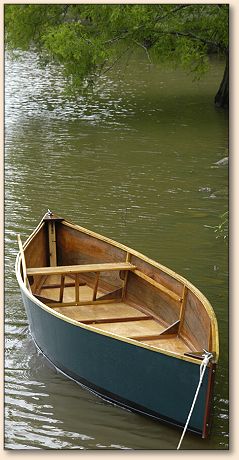
I finally got it going without breaking anything. It turned
out bigger than I intended. I wanted something in the 13-foot
range, but I made the silly mistake of measuring out that at
the bottom, forgetting that when I put the stems on each end,
the forward and aft rake would be significant enough to make
it just a hair under 15 feet long. It is about 35 inches across
the bottom, and both these measurements are within the realm
of the manufactured fishing or hunting canoes I have studied
on the market today.
I think I’m actually going to be classy and paint the name
on the bow: The Pinou. Problem is, with a double-ended vessel,
pointed on both ends, which is the bow? I guess it’s pretty
arbitrary, but such arbitrary things make me nervous. What
if I’m wrong, and shame my ancestors and myself by paddling
my pinou around backwards for the rest of my life? The cypress
trees would shrink away in embarrassment, the finches chirp
hysterically at my folly. I really need to make sure I get
it right.
The notion of a canoe or a pirogue is kinda romantic, too. I
was inquiring with a duck hunter the other day whether anyone
still hunts out of a pirogue or canoe, and he said yes, but
it’s becoming a lost art. Sounds right up my alley, doesn’t
it? Wooden boats, bamboo fly rods and lost arts. What more
can a relic like myself ask for?
I’m only 41 years old and already an eccentric old curmudgeon.
Can you imagine how I’ll be in 20 years?
I finally launched it May 14, not quite done but as far as
I wished to go without knowing if I would be happy with it.
I was. Oh, I have to get used to it, I’m not very experienced
with such vessels. But I didn’t tip it over and I got in and
out without having a coronary, so that’s a good sign. I like
the way it paddles, and I think that will improve with some
ballast. I was so uncertain I would like I didn’t build the
forward seat until later.
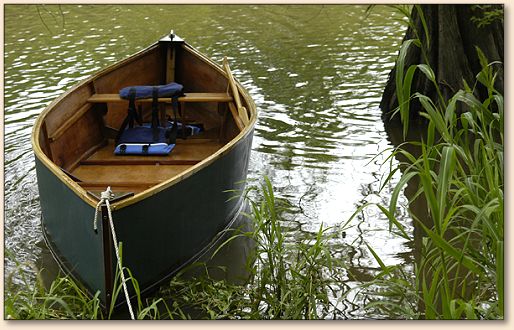
It’s heavy, yes, but not unwieldly. I can manage it without
too much sweating or swearing. Next I have to get or build
a rack for the truck. For now, I’m happy though.
Yes, I like the notion of paddling through the swamp or down
a small bayou, away from all the big ugly bass boats, just me
and the gators and the belly-busting-with-laughter finches
watching me paddle my pinou backwards. When I was a teenager
great bright flocks of them use to be on Lake Fausse Pointe.
Once, my fishing pal and I were in my little bateau down
Peach Coulee, and dozens of those little yellow finches
with the black masks circled the boat for a couple of minutes
or more, a spectacular maelstrom. Then, as if saying goodbye,
they shot off over the trees and to this day, I’ve not seen
a single one again. There’s many such things. There used to be,
now and then, a whacking, pounding sound in the cypress and
tupelo stands, usually when I am alone but, now and then, with
the brother of my soul in the boat. As if something enormous
were coming through the trees, crashing through the saplings,
trampling irises and reeds and deadfalls underfoot and then,
just before it seemed we’d see it emerge, just as we just
knew it was going to leap out of the woods, it would fall
silent. Neka sama my father’s people called it. An ancient
spirit, a nefarious soul that sometimes came out of the fire
to snatch young children from the hearth.
Ah, but there I go, rambling again. A relic and an eccentric,
eh? I guess part of what appeals to me about a pinou is that
I suspect the last surviving vestiges of my father’s people’s
legacy shrinks away from roaring outboards and noxious two-cycle
smoke. Yellow finches and Neka sama. Peach Coulee and dancing
lights in the still of the night. What a teeming, magical
place the swamps and lakes and bayous must have been when
there were only pirogues and dugouts, bateaus and small
skiffs. Before the putt-putt even of the old one-lungers,
the wonder and awe must have been…humbling.
I know I’ll never be able to recapture that completely.
But maybe, from behind the shadow of an old cypress tree,
perhaps from under the shallows of a clear, green-black
cove, there’s still a hint of it out there. That’s what
I really go for. Fish are nice, fish are great, catching
is always preferable to being skunked. But a glimpse of
a world gone by, untouched by combustion fuels and
rainbow-tinted slicks of petroleum, untainted by noise
and churning props…that’s the true rewards of an
outdoor life, at least for me. ~ Roger
Do you have your copy yet? It’s out! And available now! Get your
copy of Roger’s book. Native Waters: A Few Moments in a Small Wooden Boat
Order it now from
www.iuniverse.com, Amazon.com,
or Barnes & Noble.com.
Originally published May 29th, 2005 on Fly Anglers Online by Roger Stouff.
Part 3
I made my first fishing trip in my pinou this week.
In case you’re like me and can’t remember what you had
for lunch yesterdayéor sometimes by 4 p.m. the same day…
a “pinou” is the 15-foot long and 35-inch wide boat I
built as a hybrid between a pirogue and a canoe. I built
it from no plans, right outta my head and had a short
experience launching it behind my house in Bayou Teche
a couple weeks ago.
Transporting a 15-foot long vessel without a trailer is
a challenge. I didn’t want to spend a lot of money, mainly
because I ain’t got it. I also didn’t want to burden my
truck with a canoe rack until I’m sure I like this whole
paddlecraft thing. So I did some investigating and found
a thing called a truck bed extender. It fits into the trailer
hitch receiver already on my truck, extends an iron bar
about three feet, then comes straight up with a T-shaped
set of iron bars which can be adjusted for height. I used
this to support the pinou, tied down securely and with an
orange warning flag.
The choice of where to go was difficult. I am not a paddler,
yet. I had one harrowing experi-ence with a traditional
pirogue and gave it up for 25 years. So I wanted a place
with no boat traffic to make a wake and tip me over. I
settled on a secluded pond away from traffic and the public
eye.
The pinou hauled very well with the truck bed extender,
hardly wobbling or anything. I packed in a personal
flotation device, or as we used to call 'em, life vest,
ice chest with a bag of ice and two Diet Cokes, my tackle
bag and one fly rod, two paddles and a net. Not thinking
wisely I unloaded it from the truck with all this inside
and dragged it to the water the same way before kicking
myself in the behind. Reminder to me: Put all the stuff
in after you get it to the water, it’s a lot easier!
It looked awful pretty there in the water, just the forward
third of it on the bank, all hunter green with a black
waterline and varnished wood inside. I actually had to
sit and admire it for a minute, pardon my swelled head,
and I thought about my dad in that minute. I remember
being about 12, 13 maybe, and my parents got me a stereo
system for Christmas, one of those all-in-one jobs that
used to be so abundant with the turntable on top and the
smoked plastic lid. I had no convenient place to put it
so I begged dad for an additional twenty-five bucks to
get a little pressboard stereo rack from the department
store.
“Say, I’ve got some pretty nice plywood in the shop,”
he said. “We could build you something from that.”
My adolescent mind conceived this as the most ridiculous
thing I had ever heard. Why on earth would anyone spend
a day or two in the shop making something like a stereo
rack when they had plenty of them right down the road at
the department store. He ended up giving me the money -
it was never about the money, of course - but the lesson
appeared to have gone unlearned.
Shaking off that memory, tasting its bitterness of shame,
I got into the pinou and pushed away from the bank. I was
surprised again at the ease with which it paddled and while
I still need a lot of practice learning paddling, it took
virtually no effort to get the boat going at a good clip
until I found a likely spot to fish. Casting my eight-foot
fly rod was not hard at all from a sitting position and
while I didn’t exactly mop up on 'em, I caught two nice
bream and lost two flies to two monsters of the deep that
I never got a glimpse of but nearly gave me heart attacks
when they struck.
My biggest problem is drift, and I’m unsure what to do about
it. A one-mile-per-hour wind, just the merest exhalation of
a babe, and peeey-awwww! That flat-bottomed girl is heading
down the bayou tout suite. I like to fish quick at first until
I locate some fish then slow down and fish every inch of a
likely spot, but the breeze from aft kept me going when I
didn’t want to. I’m working with my paddling buddies on the
'Net on how to correct this.
Just to be sure I could, I stood in it to stretch my back
a few times, and even fished from a standing position for
a little while and yes, the boat is a little tippy, but at
no time did I fear it was going over, just sloshed from
side to side a bit. I walked from my aft seat to the ice
chest secured to the front seat with bungee cords to get
a Diet Coke and back to my seat again with-out incident.
I cast a boa yarn leech my friend Rick Zieger in Iowa sent
me and got several strikes. One of the two fish that nearly
gave me heart failure was on Rick’s white boa yarn leech,
the other on a red and black Jitterbee of my own tying. I
imagine if I had been able to spend more time paying
attention to my line and less paddling I would have done
better. I may consider a small electric trolling motor
eventually, but the sweetness of paddling along a quiet
pond was really wonderful.
Not wanting to be on the road after dark on my initial
maiden test fishing trip, I loaded the pinou back up
with ample time to get home before dusk. But I took a
little time, as has be-come a tradition with me, to
spend a moment in quiet. Though I quit my two-pack-a-day
cigarette habit a year ago, I do still enjoy a smoke on
the water now and then, and keep a pack of short cigars
in my pack. I lit one of these and stood near the pond,
watching the sun throw lances of dragon fire over the
cypress and willow trees to the west. Golden hour, and
everything was am-ber or auburn or brilliant green and
red and black. A long shadow stretched from my feet,
narrow and skewed, with a fedora and a cigar and for a
moment when I glanced at it I thought it might have been
my dad’s shadow as I had seen it so many times at the end
of so many days, but of course, it was my own. Odd how
they seem to look so much alike now.
Fish were rising to scuds or small insects I couldn’t
even see but I didn’t reach for my rod. I stood there,
smoke drifting around my head and thought of my father
again. I wondered…no, scratch that. I was thankful
that I did learn his lesson, after all, and I am sure
he knows it.
Now and then, as the sun moved closer to the horizon,
it would center in the space between tree limbs and
cast a spot of radiance like heaven’s gates opening
to earth. I’d watch them glow and then fade slowly as
the day continued to shorten. Microcosms of life, I
thought. Emergence, swelling to glowing brilliance,
fading, then gone. That little pressboard stereo rack
didn’t last a year before it sagged and delaminated and
went to the trash, but the wooden bateau my father built
two years before I was born still carries me safely to
the lake and back when I ask it to. My little
pirogue-canoe hybrid shows promise of being just as faithful.
There are lessons in all of it. I’ve said many times that
the most important of them I learned growing up between the
gunwales of a small wooden boat. Not so much has changed.
Not so much, after all. ~ Roger
Do you have your copy yet? It’s out! And available now! Get your
copy of Roger’s book. Native Waters: A Few Moments in a Small Wooden Boat
Order it now from
www.iuniverse.com, Amazon.com,
or Barnes & Noble.com.
Originally published June 12th, 2006 on Fly Anglers Online by Roger Stouff.