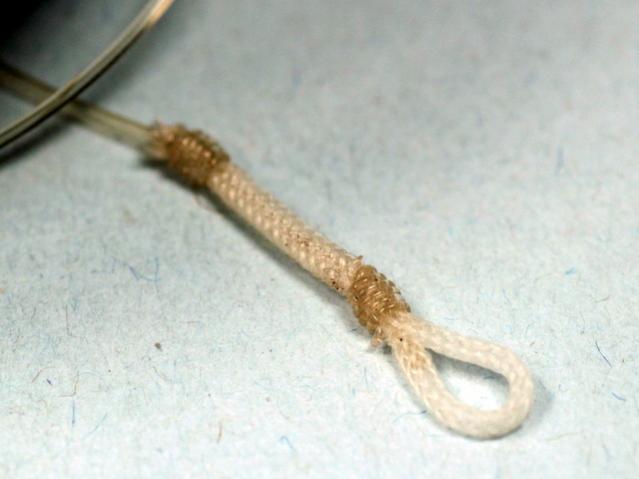
Not wanting to Hi-Jack okflyfishers thread, I thought I would post a new one. His question about line to leader connectors reminded me of my experiences with the braided line to leader connectors. About 16 years ago I was getting ready to go salmon fishing up in Canada and I went to the local fly shop to get a new line. They asked me if I wanted a braided leader to line connector installed. I figured, why not, so they put one on.
When I was up fishing and catching lots of salmon, I had just brought in and released a Coho and checked the leader near the fly and noticed the salmons teeth had damaged it, so I decided to put on another leader/fly that I had already rigged up. I cut off the fly and started to undo the loops from the line to the leader when the braided line connector simply fell off in my hand.
That ended my trusting those things and I immediately went back to the short heavy leader/loop combination that I nail knotted to the line (actually for large fish I wrap two nail knots to the line rather than just one, but for trout I just do one nail knot).
Then last year I was trout fishing with a buddy in Montana and he had gotten his leader caught on something on the drift boat and cut it up a bit so I just suggested he swing the line over to me and I would put on a new leader. That is when I noticed he had the braided line to leader connector on his line. I started telling him about my experience up in Canada when his braided line to leader connector simply fell off in my hand. I couldn’t have timed that better even if I had tried.
So, he now has a nail knotted short butt section on his line.
I know some people use the braided connectors and are very happy with them but I just can not have any faith in them anymore.
Sounds like these loops were not installed properly. There is an excellent article on Dan Blanton’s website on how to install braided loops that will not fail. http://www.danblanton.com/blog/getting-looped/
I have been using Dan’s method for about 15 years now and have never had a failure.
I have always preferred using a short leader butt of heavy monofilament with a perfection loop, nail-knotted to the fly line for the line-to-leader connection, but in the past, when I built my own steelhead lines, I used braided monofilament loops to connect different types of lines. I always finished the loop installation with a couple of nail knots over the butt of the loop and the fly line. I never felt it was necessary to use any kind of adhesive. The connection was stout enough that the line itself would break before the loop would fail.
I was in the process of putting braided loops on all of my flylines as they needed new butt sections in the early eighties when I was fishing one of them on the little south branch of the Pere Marquette river early one spring. I was working my way downstream with a weighted wet fly when I felt a strong tug and then the line went slack like one of my knots had failed. The entire leader was gone. I got home and tested the leader connection on another line and it too pulled off as the heat shrink wrap failed. I took them off of my other rods and haven’t used one since
I’ve been using the braided loops for many years and never have had one come lose. The ones I use, I think they’re Orvis, have a small piece of orange tubing on the stem just below the loop. I clip the fly line to a point. Thread it up the stem till it touches the loop. Then I use a very light coat of Goop or a clear flexible cement on the portion where the braid and fly line are in contact, slide the small piece of tubing down to the end of the braid. Let it set and dry.
The heat shrink tubing is a weak point. If you use a nail knot at the end of the braid, with a bit of pliobond on it to secure it, you should never have this problem. Don’t put a nail knot at the loop end as this will negate the “chinese finger trap” function of the braid on the fly line.
As I said above, I’ve never felt it was necessary to use any kind of adhesive (Pliobond, Aquaseal Shoe Goo, etc.). I would never rely on the “Chinese finger trap function”; try it some time without any adhesive. In short, it doesn’t work.
The “Chinese finger trap” does work. Try putting about 6 inches of braid over the end of a fly line. Grip it lightly at the end of the braid, 6 inches from the end of the fly line, then try to pull the braid off the fly line. By gripping it lightly at the end, you make the braid compress around the fly line and grip it tightly along the entire length. This is the purpose of the nail knot at that end. If you put a nail knot at the other end, near the end of the fly line, you are really only gripping the fly line with that nail knot. The only adhesive that I recommend is on the nail knot at the end of the braid to make sure that the knot stays put.
Heat shrink tubes are useless. Nail knot on the fly line end ONLY (not the looped end) of the braided loop and apply a drop of super glue. Also, clean the fly line end thoroughly before attaching the braided loop and super glue. Should have no problems. Best of luck
Odd as it sounds, this is exactly what is supposed to happen, sagefisher. The nail knot merely secures the braided loop and it is the ‘Chinese-finger-puzzle’ effect that keeps it on, and like a puzzle, it is easy to take off in the right manner.
While I most just use heavy, stiff, mono in a butt section with loop-to-loop connections, I use the braided loop for shooting heads and large game situations and the system works just fine. Dan Blanton’s site, that someone else cited, describes precisely how it is best done.
If I have to nail knot the darned stuff on to keep it on I might just as well nail knot the leader in the first place and dispense with the braided junk. And yes, I do know how to install the braided loops properly. They are not for me.
I don’t like the braided loops because of a few failures. I use the Castwell knot on six wt and smaller and an albright on anything larger. I do have some lines with the welded loops and have not had problems with those… yet.
I braided loop all my saltwater lines together (shooting head, running line and backing) ala Blanton style. Never had a problem in 4 years. Caught anything between a 6" perch to a 3 foot shark. Ok, maybe it was a 3" perch. Never liked the heat shrink tubing. Not only does it not hold but it clicks as it goes through the guides.
For those who nail knot a butt section to fly line, this works for some applications.
I was on a fly fishing charter targeting yellowfin tuna many years ago. Several of the other anglers on the trip insisted their nail knot connections were sufficient. This was their first Bluewater experience. Every single one of those anglers had the same experience. Those connections stripped right off the end if the line leaving some of the exposed core.
I have been using the same connections described on Dan Blanton’s site, and the similar connection described on Trey Combs Bluewater Fly Fishing book for 20 years now and never had a failure of a braided loop that I made myself. I have replaced a couple that were damaged by coral, or barnacles also caused complete
Failure of the leader, but the damaged braid still held.
The loops are secured to the flyline with a trap nail knot at the end of the braid where the line enters and the knot then coated with a bit of pliobond. This coating only serves to protect the knot a it and help it go through the guides. I have had fly lines break before the loop. The glued single catch loops available from most commercial sources are prone to failure in the glued sections which do not flex well. The use of tubing is problematic too - a line under tension stretches and when it does its cross section decreases - so the tubing may loosen.
Many of today’s flylines have excellent strong loops built into the line but I still use braided loops when I need to replace these.