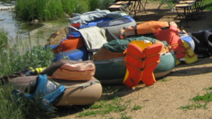
a bunch of our relatives floating around in float tubes; basically an inner
tube covered with a fancy cover. For many of my readers this is not an uncommon
sight, and for many it is the normal method of fishing. However, as an ‘old
school’ trout fisher, the idea of fishing for trout except by wading around
in the stream wearing rubber pants is a relatively new concept.
Back when I was cutting my angling teeth you fished for bass, bluegills, and
similar finned creatures from a row boat, usually with a bobber and some type
of live bait. Trout fishing was done while wading or walking along the bank
of a stream. The only exception would be trolling streamers for brook trout
on a lake in Maine, or casting a Skunk [a type of fly] to pockets among the
cedars from the seat of an Au Sable River Boat.
My first exposure to float tubes as a means of fishing for trout came during
my first visit to Montana 38 years ago when I saw a crude float tube hanging
in a fly shop in West Yellowstone, Montana. When I inquired about its use
I was told that an angler would put it around their middle, don a pair of
swim fins, sit down on the canvas seat, and paddle around casting to trout
on one of the many local lakes. WOW, sounded like a dumb idea to me.
It was the following year that I saw the value of fishing from a float tube.
Back in Montana again I watched several anglers catching some respectable
trout floating around in a device loving called ‘a belly boat.’ The fish that
they were catching were unreachable from the bank, other floating devices
set too high in the water to be really effective, and the angler was very
mobile allowing them to maneuver quickly from place to place. The pockets
that were incorporated in the cover allowed the angler to carry boxes of flies,
extra leaders, and tippets; in short everything that was necessary. WOW, what
a great idea. The next question was where can I get one?
My first belly boat was a gray canvas cover with a small zippered pocket on
each side and a larger pocket across the back. You bought the cover and the
tube separately. The tube was simply a large truck tire inner tube, and most
fly shops did not have the tubes so you had to go to a tire shop to find one.
Over time the tubes would develop dry rot and you hoped that you discovered
it before you were floating halfway across some deep lake. The most dreaded
noise that a belly boat angler can hear is a hissing sound!
Today the covers are made of nylon, they have several pockets, an inflatable
backrest, and the tubes are made of vinyl and they are called bladders. Some
are shaped like a U with an open front, and some have a point on the back
like the prow of a boat. While some people use them on moving water this is
risky and not a recommended practice.
In the traditional belly boat getting into the tube with fins strapped to
your feet can lead to some interesting new dance steps especially as our bodies
get a bit older. Walking in fins requires that you lift your feet REALLY HIGH
to avoid tripping, and the safest way to walk wearing fins and waders is backwards.
This is especially true when entering the water. Falling forward with an inflated
tube around your middle while carrying an expensive fly rod is not only truly
embarrassing, but can be expensive and even dangerous. Fins used for belly
boating should either float or be tethered to your leg. Losing a fin makes
getting back to shore a true challenge. I always wear a floatation vest when
tubing. This only makes sense to me, and in some states it is required as
a matter of law.
While it is possible to cover considerable distances in a belly boat ideally
they are a short range craft. Most of us are not accustomed to propelling
ourselves using fins and kicking with our legs. Finding yourself on the far
side of a large lake when the wind suddenly decides to stir things up, and
your only option is to kick back across against the wind or wait until the
wind goes down will convince you of the wisdom of both watching the weather
and limiting the distance you travel.
Generally belly boats are allowed wherever other types of floating devices
are permitted, but I get a bit nervous when bobbing around in an area where
high speed thrill seekers are pushing their high powered speed boats or jet
boats at break-neck speed across the lake surface while trying to impress
members of the fairer sex. Throw in a bit of alcohol and I feel like a target
in a shooting gallery.
Since those days of yore I have spent many hours bobbing around in a belly
boat. I have toted them into mountain lakes, farm ponds, and paddled around
the bays and backwaters of large lakes. They are a great fly fishing platform,
and open up angling opportunities which would be off limits without them.
If you haven’t tried one you should give it a try. Who knows, I might even
bump into you someday bobbing around on some trout lake. If you do I hope
you wave.
Originally published July 20, 2009 on Fly Anglers Online by By Neil M. Travis.