hey guys
I spend more money on expensive flys than i do buying a new rod or reel. Do you guys know how good the Gander Mtn. beginner fly tying kit.
thx a lot,
Dmark
hey guys
I spend more money on expensive flys than i do buying a new rod or reel. Do you guys know how good the Gander Mtn. beginner fly tying kit.
thx a lot,
Dmark
I couldn’t find a fly tying kit on the website but generally beginner kits are not very good or they are very expensive. Go to to the FAOL home page and click on fly tying in the menu on the left. Go to beginner fly tying lessons for AL Campbell’s suggestions as to what a good kit should consist of and read over the first couple of lessons to see if this is something you want to do. If at all possible get an experienced tyer to go with you when you buy tools and materials. If you can’t do that it would be worth the extra money to go to a fly shop rather than a big box store. You will pay more but you won’t end up with a bunch of trash. The best tyers cannot salvage bad materials and cheap tools need replacing very quickly. If you manage to save money by tying your own flys please post and tell us how. It just doesn’t seem to work that way though you will have more and more varied flies.
Dmark
One thing rainbowchaser left out, there is nothing like the feeling you get when it a fly you have tyed caught the fish. It is wroth the all the money and fustration of learning to tye your own flys.
Ghost
dmark, Welcome to FAOL. I don’t know about Gander Mountain kits. I started with a Bass Pro Lefty Kreh beginner’s kit once upon a time. Came with a DVD and enough hooks and materials to get me hooked (pun intended). I think it was around $50.00. I’ve never regretted it. Like GrayGhost said, once you catch your first fishie on a fly you tyed, it makes it all worth while. I don’t know where you are at, but if you can go to a FF club meeting or a store where they have tying classes, you can get a feeling for what you need. My penny’s worth. Jim
In my experience Kits are full of tying materials you don’t need and wont use, and its in the wrong colors.
I started with a Cabela’s kit and with in weeks was looking to upgrade, don’t buy a kit buy a good beginners vise, (danvise, Griffin 1a or 2a etc) and a few other tools and learn to tie, follow the advise of Rainbowchaser and save your self the frustration of the kit game.
Eric
GrayGhost I’m beginning to forget what that feels like after getting skunked two days in row. At this rate they might as well call me back to work.
i recommend buy tying tools and materials separately, not in a fly tying kit. as others have said, the materials are somewhat useless.
a good bet would be one of these tool kits from dr slick
One of the problems with a generic kit, aside from low quality, is that the materials are not suited for tying local patterns. What are you going to do with large saltwater feathers if you need to tie mayflies ?
The quality of your tools and materials make a huge difference. I thought I couldn’t spin deer hair until a fellow tier showed me it was the deer hair not my skill that was the problem. While a really skilled tier might be able to use sub-standard material, the beginner will be frustrated to the point of quitting.
One of my local shops puts together a ‘starter kit’, a reasonably priced set of basic tools with enough material to tie a few flies that will be useful in my area.
You don’t need all the tools in the world to start out. You need a good vice, a good scissors, a thread bobbin, some hackle pliers and some thread. The rest you can make or probaly have at home. Add more tools as you need them. Buy your materials and tools with a particular pattern in mind.
FOAL has a great ‘basic tool kit’ article here…
/flytying/kit/
Charlie’s web site has has some of the best tutorials you are ever going to find…
http://www.charliesflyboxinc.com/flybox/index.cfm
Look for local clubs and organizations, such as Trout Unlimited. They often have fly tying get togethers and are a great sorce of hands on info.
Get to know the local shops, many of them keep a vice and tying table in the corner so the guys can tie a few when buisness is slow. They are often more than happy to sit down and show how something is done, especially if you are buying materials.
Check out the local library, they probaly have a fine selection of fly tying books. If not they can get anybook from nearly any library in the world through the inter-libray loan system. (I have even ordered books from France! all for free)
As far as saving money, I think most tyers will admit to spending a significant amount on materials. It becomes an obsession. If I am honest I have way more invested in my ‘fly tying hobby’ than I ever would have spent on flies. Yes, I can certainly produce a fly for less than the retail purchase cost, but any savings went into more materials and then some. I also have a lifetimes worth of stuff.
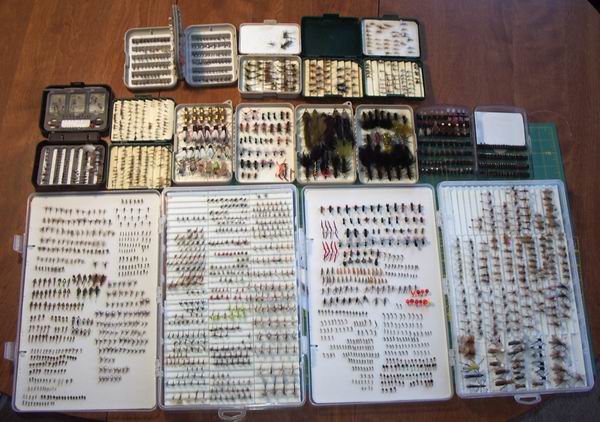
The difference for me is that I have a hobby that I enjoy almost as much as the fishing. I have a lot of flies. Before I tied I might have owned 100 flies in two or three small boxes, now I have at least 2000 flies in some big fly boxes I keep in the car. I’m kind of a rolling fly shop - this lets me re-stock stream side and I give a lot of flies to my friends. I can produce them cheaply enough that I don’t think anything of giving away a dozen bugs to some poor struggling angler I meet stream side. I keep a vice setup in the TV room, I tie up a few whenever the wife and I watch a movie, if I tie only a dozen per week I end up with over 500 per year, I’ve been tying for over a decade. That’s how you end up with several thousand flies in the back of the car…
It’s only a hobby - not an obcession, I can stop anytime I want…really
I was looking through some of the materials I still have from a kit I purchased back in the 70’s - probably okay for some of the gaudy wet flies that were popular back in the days of sepia photos of guys in bowler hats with 75 trout hanging by their gills on sticks. I’m sure the newer ones are better, but still not worth the money. As mentioned by others put your money towards some decent tools and basic supplies. I buy a lot of my stuff on-line and you can get some great deals on Ebay, especially for things like hooks, bobbins, scissors, a vise; might be a good idea to look at some vises before you purchase - each one has different features thay you may or may not find appealing and since it’s the single most expensive item you need for tying, you should get what you want. If your not sure that you need a rotary vise right now, look at a good, used Thompson Model A - they’re out there for under $20.00 and are pretty much bullet-proof. If you have a fly shop near by spend some time (and money) with them; if they’re halfway decent folks they’ll want to invest in you as a customer and will get you off on the right foot.
Regards,
Scott
after you buy the tools and some materials for specific flies good in your region from your local fly shop, visit
their kits are excellent. they include everything you need to tie a particular pattern, and the quality of the ingredients is far above any other.
You can by kits with all of the materials to tie 12 flies of a single pattern for $15 to $20. Other than that, in my experience the Kits with tools and materials rarely have either good tools or good materials.
If you decide to tie flies to save money your making a huge mistake. It will cost you money, a lot more then buying flies. If you want to tie to have patterns exactly tailored to your fishing needs then your doing it for the right reason. With that being said a kit is a huge waste of money.
Disagree. If you stick to the patterns you’ll tie and use, and go through, tying your own can certainly save you money. Its when you drop a few bucks a week on “neat” materials, or stuff for flies you’ll tie up a dozen of and never ouch again.
If you want to tie to have patterns exactly tailored to your fishing needs then your doing it for the right reason.
Agreed. Tying solely because it will save you money will never work, as it can be a serious pain in the butt to do all that tying. You need a reason other than the bottom line to get into and stick with tying. The custom fit flies work as a reason for some…I find that its a creative, artistic outlet for me, a guy that, in most artistic pursuits, has all the artistic talent of a cowpie.
With that being said a kit is a huge waste of money.
Also agreed. Most kits DO cover all the essentials, but also supply you with low end materials that will cause you more frustration than enjoyment and may hinder your learning process. Also, many kits include materials you’ll never use and possibly even tools you’ll never use. Use the same amount of money for the kit to get a decent vise, bobbin, bodkin, and whip finisher. You should have plenty left over for thread, marabou, chenille, and a cheap chinese neck for tying buggers. By the time you run out of a material (probably the chenille), you’ll have a far better understanding of what tools you want, as well as ideas for a new pattern you’d like to tie. Master one at a time, and soon you’ll have a solid base of patterns you know.
Another recommendation: instead of branching out to radically different patterns, figure out a new pattern you could learn that might only require one or two additional materials.
Another strong suggestion: whatever you decide to tie, tie at least 5 or 6 at a clip. I find I do the most real learning somewhere around flies 4-6.
Agree 100%…stay away from kits. Personally, the best way to go about it in the beginning, is to get a solid set of "basic tools. Then look at the top 12 patterns you fish consistently…and purchase the materials that you will need for them only. Grow from there.
That’s easy to say however…reality is, if you catch the tying bug, you will become a material junkie in short order 
I agree about materials kits, but the Dr. slick tool kit previously mentioned is a great bargain. High quality tools and darn near everything you are going to want for tools. Not mentioned in the catalogs, the handles of two of the tools serve as half hitch tools and, if you take out the foam it came packed in, you’ll find yourself with a nice fly box.
Al Campbell, a marvelous guy who passed away a few years ago, left behind some outstanding tying tutorials on this site. Use them in combination with the ones previously mentioned by Charlie Craven. Tie for a few months, then sign up for some lessons if you can. You will get a ton more out of the lessons if you go into them already knowing where you are having problems.
I don’t tie to save money, but because I enjoy it. But you will save money if you stick to simple flies and buying only the materials you need for the flies you use a lot. I’m still at the stage where I buy the flies that are really hard to tie or that require fairly exotic materials.
Does anyone here have an opinion of the fly tying kits you get from cabela’s?