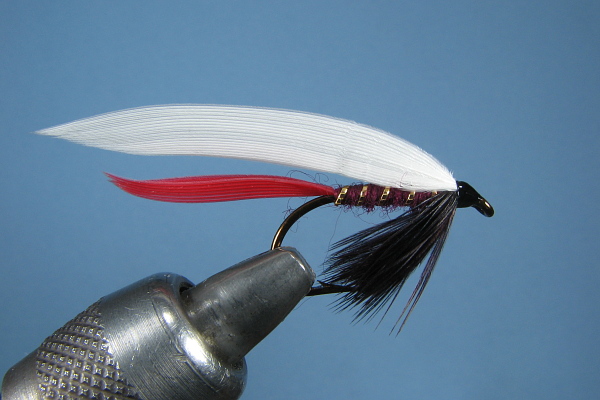
Ashdown Green Streamer
Eric Austin, Ohio - October 11, 2009
I found this interesting little fly in Joe Bates’ book on streamers, Streamer
Fly Tying and Fishing. It is difficult to tell from the
illustration in the book, but it appears to be tied on a wet fly hook,
as were many of the early streamers. I can’t say definitively, but when
I tied this on a 4X streamer hook it just didn’t look like the one in
the book at all. This one is much more representative.
This fly could be mistaken for a wet fly were it not for some differences
in proportion. Many of the early featherwing streamers had overly long wings,
wings that stuck out way beyond the hook in back. More modern day streamers
don’t generally go more than about a quarter of a shank length beyond the
hook, as fouling can result, but the early ones did. There is a Spruce fly
depicted in the book, tied by Dan Bailey, that has wings that are twice the
length of the entire hook.
Many of the early streamers were simply elongated wet flies. In fact, there
are streamers listed in the book that were just that, flies like the Grizzly
King Streamer, Colonel Fuller, Alexandra, Parmachene Belle, and even a McGinty.
I’m having trouble picturing a McGinty streamer, a giant bumblebee I guess.
Many of the flies I’ll call “composite wet-streamer flies” were
dressed for Bates’ book by the Gulline Brothers of Fin, Fur and Feather, Ltd.,
in Montreal, Canada. This was undoubtedly a jumping off place for those heading
out to fish the Provinces back in the 20s, 30s and 40s. They tied beautiful
streamers, with very long wings, and were responsible for developing the Trout
Fin series of flies. I’ll expand on this in a future article.
The Ashdown Green was actually developed in Canada on the other coast, by
Mr. Ashdown H. Green, an ichthyologist from British Columbia. It was originally
a wet fly, and H. L. Gulline, used the fly as a trout fly as early as 1889
on the Cowichan River. It was later adapted as a streamer by the Gulline brothers,
hence its “hybrid” nature, somewhere between a wet and a streamer
fly. It became quite popular in the Maritime Provinces as a result.
I was surprised not to see this fly listed in Fly Patterns of
British Columbia, which has many old wet flies depicted
therein. However, there is a nearly identical fly shown called the Cowichan
Coachman, which is the very same fly minus the tail, with floss instead
of wool for the body. At first I thought it was the Ashdown Green wet
fly, but not quite. Regardless, here’s the recipe for this week’s fly,
and if you want to make a Cowichan Coachman, change the wool to floss
and leave off the tail. Oh, and tie it like a wet, with a shorter wing.
The Ashdown Green Streamer
Tail: A section of red duck or goose wing feather, rather
long and thin
Rib: Narrow oval gold tinsel (the one in the book is
dressed with medium oval gold tinsel)
Body: Maroon wool, dressed medium heavy and picked
out slightly
Throat: A maroon saddle hackle, tied on as a collar
and then tied downward. The hackle is rather long and enough turns are
made to make it fairly heavy
Wing: Two matched sections of white goose or swan wing
feathers, extending slightly beyond the tail
Credits: Streamer Fly Tying and Fishing by Joseph D.
Bates, Jr.; Fly Patterns of British Columbia by Arthur
James Lingren; ~ EA
Originally published October 26, 2009 on Fly Anglers Online by Eric Austin, Ohio.