I have a book called Simplified Fly Fishing by S.R. Slaymaker. It was written in 1969, but it’s still the best beginner’s guide I’ve ever seen. The subtitle on the cover says, “It gets you on the water and fishing with flies in half an hour.” Everything a beginner needs to know is in the eleven pages of chapter one.
The Curtis Creek Manifesto is another great little animated book for beginners.
That is pretty funny Steve for sure.
What I learned is that for beginners to do a roll cast, I need to emphasize that they “punch” the wall to get the line to lift off of the water.
That is pretty funny Steve for sure.
What I learned is that for beginners to do a roll cast, I need to emphasize that they “punch” the wall to get the line to lift off of the water.
I taught one of my pastors who’s bucket list included fly fishing to cast in one day and then we went fishing where he caught his first trout. Basic fly fishing is not that hard.
Fly fishing has levels of difficulty. If I can use an analogy, it is a lot like learning to fly an airplane. Taking off and landing a single engine prop plane in good weather is not that difficult. But ramp that up to multiple engines, then commercial jet engines, then jet fighters, then jet fighters on an air craft carriers at night, and you have something akin to comparing basic fly fishing to highly technical fly fishing.
In my view, it is not really fair to compare the discussions about the technical fly fishing as prototypical of basic fly fishing. In my view we are not making fly fishing more difficult at all. What we are doing is exploring all the skill levels of fly fishing, from the simplest to the highly technical.
For what it’s worth, I agree with Warren completely. My first fly fishing trip was with Jack on the Duck river a few years ago. I caught my first trout on a nymph. I have tried dry flies some and I really enjoy trying to cast and present the fly correctly. However, I have still not caught many fish on a dry fly and if I had started with that I’m sure my interest would not have lasted very long. Great article Warren, thanks for sharing.
Jason
It’s all about funnels.
When you’re talking about attracting new people to fly fishing or introducing new anglers to the sport in general, the KISS principle is extremely valuable. The simpler and easier you (the teacher, salesperson, guide, spokesperson) can make it, the bigger the end of the funnel gets. The bigger that end of the funnel is, the more people it will hold. Once folks enter the funnel they can find how deeply into the cone they want to descend for themselves. We don’t need to make that decision for them. We only need to make the knowledge and training and equipment accessible to everyone.
If you flip the funnel upside down by making it seem difficult, expensive, and time consuming catch fish on a fly, then you won’t find many people in the funnel. How many people are looking for the most difficult, time consuming, and expensive way to relax and have fun? Exactly. LOL But folks with a propensity for things like Jason Borger’s discourses on the physics of fly casting and those cute graphics from the Sage Casting Analyzer will find their way to the pointy end of the funnel once they’re in it. And we will “catch” more of them with a bigger wide end on our funnel.
The Jason Borgers and Rajeff brothers of the sport are great for narrowing and lengthening the spout on the fly fishing funnel, which makes it more useful as a funnel too. After all, the purpose of a funnel is to put stuff from a big source into a container with a small opening. These types push the technical envelope of the sport, improving tackle, techniques, etc. in a similar way to how auto racing translates into improvements to your pickup truck or mini-van. Guys like Silver or I come in really handy when you are trying to expand your fly fishing capabilities and run into a “hiccup” you can’t figure out how to get rid of that is keeping you from doing what you want to do. Our technical knowledge and ability to dissect and rebuild fly fishing skills should enable us to work with you to solve your problem.
But whether you’re a Borger, a Silver, or a WarrenP, when you’re staring at that beginner holding a fly rod for the very first time, you have to lay down somewhere between 99% and 90% of everything you know about fly fishing and leave it for another day. You gotta change your mindset from what you want to teach and put yourself in their waders and ask yourself (with the benefit of all your hindsight) what you really wish you had been taught on day one. You know how much you can absorb and retain in a day. Nobody else is gonna be a whole lot different.
And above all, we need to get back in touch with this concept: nobody takes up fly fishing to tie knots, tie flies, wear waders, cast, etc. Everyone who takes up fly fishing…everyone…does so to catch a fish on a fly rod. Our #2 goal (after keep them safe) with a newcomer should be to help them do exactly that: catch a fish on a fly. Get them “hooked” on fly fishing first. Then they might get hooked on tying, casting, rod-building, or whatever. They may become the next Rajeff, Borger, or Kreh. They may be a WarrenP. Maybe they’ll be another Silver. But nobody will ever know if they never catch that first fish. You can take that to the bank.
Yes, we make it too hard.
Though I do love all the technical ins and outs of flies, leaders, lines, rods, reels, waders,vests, charts, graphs, and boats, it has to be overwhelming for a beginner.
I think in order to come close to answering the initial question, someone has to answer the question of:
Who are the ‘WE’ in the question? Is it the fly fishermen(women)? The guides? The magazine/book publishers? The authors of books/magazine articles? The equipment/supply manufacturers? The fly fishing schools? The destination fly shops? The big box stores? The catalogs? The internet sites? Did I leave any potential influences out?
Personally, I try to keep it simple.
Allan
If you can afford $375.00 - $450.00 bucks a day for a guided float trip you can be a “Fly Fisher”! Your guide will tie all the knots, select the leaders and tippet as well as the fly. All you have to do is “Fling it out there”! This became evident on a recent float down the the Clark Fork by Kaboom1 and I during our month long trip. We were about 2 - 3 hours into it when our guide admitted that it was not often that he had clients that could “Cast past the oars!!” (he guides 80 days a year)! Sad statment for flyfishing.
Float trips are not my cup of tea but if you can afford them it sure makes Fly Fishing easy!! Absoultly no guesswork involved!!
It also helps if you wear a bright yellow full length raincoat and do the 2 handed “Fly Fling” over gin clear water! Another story!
Jason (hungNtree) was what all new flyfishers should be, a good listener! I for sure had more fun then him on that first outing for trout on the Duck. But we fished it the way I knew he would catch trout, dry fly’s are for another day.
I think that we forget how simple fishing need be. Most fish are caught within 30 feet of the fisherman. That equals a little bit more than a rod length, a leader length and the same amount of line. I teach people the roll cast then use the forward part of a roll cast in reverse for the back cast then put it together for a full cast. Takes no more than 20 minutes to get someone able to cast 30 to 40 feet. Using nymphs usually works well as they don’t need a clean presentation and most fish will consider a nymph. I love the pond with a million blue gills. They are great first fish and not real fussy.
Learn to Fly Fish in 24 Hours by Bob Sousa is a good book with simple step by step instructions.
jed
The last outfitter float I witnessed out West was really embarrassing. I was fishing with another very experienced angler and our guide was very good. He was loving it. But we were part of a 6 boat party and 4 boats had inexperienced anglers in them. Those guides put balloons on extremely long, heavily weighted leaders with multiple nymphs and heavy rods and had them just lower them over the side of the drift boat. On this 3-day “fly fishing trip,” NO attempt was ever made to teach these “anglers” to cast. In fact, ZERO education took place at all. So…yeah…that was pretty easy.
I never thought of fly fishing as a funnel but it is a perfect description. I wish I had thought of it. Kudos to you.
Everyone starts a the same place, as a beginner. But I think your experience BEFORE you started fly fishing matters. In my case, I had fished ever since I was 7 years old. My father bought me the first Mitchell spinning reel before there was the Mitchell 300. After I took my first fly fishing course, it took me a full year to catch my first trout. That first year was frustrating, and it was difficult to stay committed to fly fishing when I could take my spinning outfit and catch trout at will. So my expectation of catching fish met the reality of knowing how to cast but not how to fly fish effectively. I needed a reason to change from spin fishing to fly fishing.
It was during my second year of fly fishing that I caught my first trout. It was a wild 16" brown trout from the Firehole River in Yellowstone Park right off the Midway Geyser Basin parking lot. I caught it with a fly I had tied and a fly rod I had built. It was an epiphany. My reason to change was not how many fish I caught, but how I caught them. That sealed the deal.
That single fish meant more to me than the the fish I had caught earlier that year with a spinning rod. I decided to put the spinning outfit away and commit myself to fly fishing.
I decided that if I was to commit myself to fly fishing I had better become a lot better than I was. There was no internet but there was the library. That winter, I read every fly fishing book in our local library. Books I did not have I bought and even those that the library had, I bought if I thought they were knowledge worthy. I was a better fly fisher the next spring. For example, I knew what insects hatched in Wisconsin and I knew what flies to use. That alone was huge.
Gary Borger had made his first video and he had been my fly fishing instructor so I got to know him. He became my mentor and my friend. Natural curiosity, a desire to learn, and access to personal coach has smoothed my journey. Not everyone can have a personal mentor, but now there is the internet which makes it a lot easier to take the first step than when I began.
So my answer is that I don’t think that we are making fly fishing harder. I took a fly fishing class from Gary because I could not teach myself to cast. I tried it in Utah and I failed. Now there are many more places to learn how to fly cast. Our TU chapter does it for free for a youth outdoor sports gathering and for Women of The Outdoors.
I wish I had those resources. The basic casting skills are not difficult. It is harder to learn how to ski or to play tennis than it is to fly cast BUT the depth of knowledge that comes later is far greater in fly fishing. Fly fishing success demands more knowledge than physical skill compared to either downhill skiing or tennis, both sports that I did quite a lot of in my earlier years.
So I would say that compared to the 1970’s when I learned to fly fish, it is easier now than then. The fly rod and fly lines are better. There were a lot of crappy fly rods in those days, and I made my own Fenwick HMG because it was so much better than the the Shakespeare rods. Now you can get a fly rod far better than the HMG for about $100.00
Access to knowledge, affordable quality equipment, and good instruction are three legs of fly fishing success. I would argue that all three are far more readily available now.
You’re welcome.
My introduction to fly fishing was completely different, and worthy of recounting here if only for that reason.
I was 13 years old, and it was the end of 1979. I had just moved to Texas. Fishing a 120 acre spring-fed lake almost daily after school for bass and pan fish, I would sometimes see an elderly man in a wooden row boat and straw hat with a bamboo fly rod catching a bream on almost every cast from near the banks. It was graceful, peaceful, artful, and obviously VERY effective. I finally worked up the courage to approach him in my small peddle-boat, say hello, and watch from a closer vantage point. He asked if I wanted to try it. Not knowing that I was supposed to think it was difficult, I said sure! We pulled alongside one another and I climbed aboard his wooden jon boat. He gave me about a five minute fly casting lesson…if that long…and told me to cast as close to the bank as I could. I did. It worked out OK. I caught a Red Ear. We repeated this procedure about a dozen more times that evening before going to our respective homes for dinner.
I met the old fly fisherman on Lake Brenda a few more times and fly fished with his rod from his boat that year, and then I never saw him again. I fly fished a few more times over the next few years for trout in Colorado, but mostly I fished a LOT with conventional tackle. Catching fish never was a problem for me no matter what tackle I used: trot-lines, jug-lines, limb-lines, yo-yo’s, cast nets, traps, hand-lines, gigs, conventional tackle, or fly tackle. I just never thought of one type of gear being more of an obstacle than another type once you got past seines, electricity, and dynamite.
Then, in 1998, I moved to Branson, Missouri. I immediately marched into the local fly shop and bought a $100 rod/reel combo. The fly shop owner had a rule: no rod went out the door of his shop with a first-time buyer without a free casting lesson. He didn’t care about my story about the old man on Lake Brenda 20-some-odd years before. (I don’t blame him) We spent about 15 minutes in the parking lot, and he said, “Go fishing tomorrow even if it is only for an hour.” So I did. I was able to go for about half the day. I didn’t know a lot about trout, bugs, or fly fishing techniques back then. I could roll cast and single-haul about 35-40 feet with my new rod. Honestly, I had cast the old man’s bamboo rod much better than I did that stiff new Redington RedFly. But I caught over a dozen Rainbows in a few hours that day totally on my own in unfamiliar water.
The moral of the story is NOT that I am a great fisherman! The moral of this story is that my grandpa, the old fly fisherman on Lake Brenda, and the fly shop owner in Branson were all great teachers who kept it very simple and all about catching fish for a beginner fisherman, a beginner fly fisherman, and re-beginner fly fisherman. And I have found my way down the funnel a little ways.
The path is a bit different for each of us.
please see signature for one person’s opinion. 
Well, based on the number of emails I get from people who tried fly fishing and gave up because it was too complicated, I’d have to say yes, we are making fly fishing too difficult for beginners. I’m not sure who the “we” is (probably plenty of blame to go around) but there is definitely a perception among beginners that they have to know all about the bugs, have to buy lots of very expensive equipment and definitely have to take casting lessons. Even several people on this thread who say it doesn’t have to be too difficult do say they should take casting lessons.
I would suggest starting beginners with a tenkara rod. It just doesn’t get any simpler. Most people seem to pick it up within about half an hour on their own with minimal (if any) instruction. Beyond the ease of casting, there is no emphasis on matching the hatch and no emphasis on expensive equipment. The emphasis is almost entirely on presenting the fly (traditionally a wet fly) to the fish in a way that (A) doesn’t scare the fish, and (B) makes the fly look like it is alive and therefore food. Not everyone catches fish their first outing, but many do. In addition to being very easy to learn, tenkara is also extremely effective.
The negative comments about tenkara on a number of forums (including FAOL, but thankfully not for some time now) suggest that some of the “we” seem to be pretty threatened by a method of fly fishing that really isn’t difficult to learn.
“How many people are looking for the most difficult, time consuming, and expensive way to relax and have fun?”
How many people hunt mountain goats in remote locations at great expense when there is much more tender less expensive meat grazing in the field next door? But wouldn’t you rather read about stalking game in the mountains than read about cutting cows out of the local herd? If I want to make a living as an outdoors author, which subject should I write about?
Once you start thinking about it, how many questions like this can you come up with?
I guess my point is that fly fishing fulfills different needs for different people. An article here a while ago pointed out that fly fishers fell into three broad categories-recreational, commercial, and competitive. There is overlap between categories also-a classic 3 Set Venn Diagram.
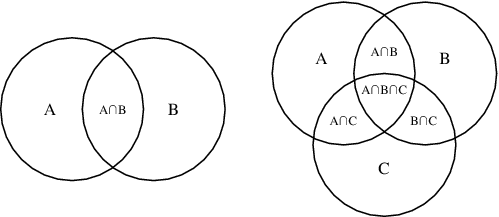
I have to think that beginners fall into the same three buckets. So the real trick is figuring out what kind of beginner we are looking at. Are we making it too complicated or too simple?
… and this comment from Chris reminds me of an exchange I witnessed in a local fly shop last spring. A potential newcomer was asking the owner of the shop how to get started in fly fishing.
The owner, in the course of the conversation, mentioned spending around $1500 on equipment and lessons in the first year, a lot of it up front. I just shook my head when I head that comment.
John
P.S. I guess I should mention that the owner of the shop was in the process of selling off his inventory as he was going out of business. Now why on earth did he have to go and do that ??
Fly fishing is like most hobbies and interest people have, you must have the desire to do it. For many people there are other less consuming ways to fish. However I still see new people getting into fly fishing all of the time. And even in a difficult economy beginners are still buying equipment. I feel the real question should be: will there be enough good fishing water for all of us anglers.
I took up fly fishing because bait fishing wasn’t a challenge anymore. I wanted more of a challenge but didn’t want to spend a fortune on it. No matter how many years go by I am still learning and aquiring new equipment and experience. It hasn’t cost me a fortune and I’m no novice. I do prefer dry flies and always say I’ll try nymphs but it hasn’t happened yet. Maybe next summer…
That being said, there is always the possibility that I will be talked down to in fly shops or at expo’s. That’s maybe because I’m a woman but maybe that’s just how it is. It happened more when I was getting started in the sport and I was wondering if I was doing it correctly. Every once in a while it does happen and I chuckle. No intimidation for me now. I have all the confidence that I know what I’m doing for the most part and am having fun on the stream and at the tying bench. That’s the kicker. I don’t see any fly fishing police out there grading me on my casting or looking in my fly box. LOL
That’s my two cents and then some.
All good points. I think maybe another aspect of this question is the “perceived” cost. For example, I’m active as an adult leader with Boy Scouts. At the first Summer Camp in our Council in which the new Flyfishing merit badge was offered, the camp hired a local flyfisherman to teach it. He showed the boys several rods / reels in the $500 and up range, giving the impression that you had to spend MANY bucks just to get started. How many of those kids went home and asked the parents if they could have $500 or more, so they could TRY flyfishing?Not very many. Don’t get me wrong, I’d love to be able to throw around a line with a nice bamboo rod, spooled up on a Hardy reel, but I just can’t justify that right now.
I’ve seen this in other areas, also. Look at the equipment reviews in most of the
flyfishing magazines - almost all high end stuff that would put anyone off. Why would I spend $700+ for a rod if I don’t even know if I like the sport yet?
We need to get the “elite” and “mystery” out of flyfishing. After all, isn’t it just another way to catch fish?
Excuse me while I step down from my soapbox.