Well Guys
Just got back from Yellowstone only to realize that the old eyes are not what they used to be.
I tie a nice loop wing antron emerger size 18-20 with a white wing. This year I had a hard time picking out the fly when it was in the foam line. Not so much trouble in the past.
So… my question is there another color, other than white, for a wing that might be easier for me to see but won’t spook the fish.
I fished some with a black winged Clacka Caddis that Wally Weise ties (like an Iris with hackle in front) for evenings on the Madison when the river gets that silvery sheen; seemed to work pretty well. Not sure how it would show up in the foam. If that doesn’t work and you don’t want to go with something like chartreuse, I’d tie the emerger off the back of something a little easier to see like an Elk Hair Caddis or CDC and Elk.
zelon in Polar Bear, from BRF sticks out like a sore thumb if you gotta have a white color. Normand colors are gonna be good also.
I fish tanden dries when there are mulitple specie bugs on, so both will have 2 different color wings
That’s an excellent question and I’m sure that you’re going to get LOTS of excellent answers----all different. I’ve just finished reading an excellent book by Arlen Thomason called Bug Water that addresses this very question. I strongly recommend this book to anyone but particularly Western fisherman since most of Arlen’s bugs come from this area. Arlen (and others) have pointed out that fish see only pattern of lighted stars on the water made by feet and other body parts that come in contact with the water when the bug is outside the fish’s window of clear vision. As the bug drifts into the window of vision, the wings are the first thing the fish sees clearly and therefore the wings are one of the first stimuli that triggers a strike. Bright wing colors are certainly seen and detected by the fish at this time and become even more evident as the fly floats closer. I believe that the bright colors, even when mixed or partly masked by more natural shades are going to cost you some percentage of strikes. In fact, I’m not certain that super bright, white Antron doesn’t scare off a certain percentage of fish. This is why I lean toward a light gray shade of Antron wings for many of my flies. I too have some vision problems with flies in certain light and water conditions so I will switch to more visible flies when I’m having trouble following the drift or even seeing the fly in the first place. I just keep in mind that there is a cost for this trade off. My improved vision may well cost a strike or two. In heavily fished areas like Yellowstone’s public water, I would imagine that educated fish would be even more likely to notice that real mayflies don’t have chartreuse wings. Just my 2% of a dollar. I’m sure others will disagree. 8T
I’m with Montana Moose, and I think herefishy. I use a medium to medium dark dun colored post or wing on most of my flies and it really stands out, especially in the foam line or on shiny waters.
Salt and pepper…i like it. I guess it’s just a matter of contrast when the eyes start going some. White calf against white looking foam and bubbles doesn’t stand out like gray or black or maybe better still, the mix of black and white.
that is what i was refrering to in my post when i mentioned 2 different bugs on the water @ the same time, fishing tandem dries, say a black caddis along with a baetis , for example, both are going to give you different contrasts on the water in varying light conditions. you will at least be able to see one of the flies. i hope this explanation helps
I had a harder time keeping track of my flies this year, also. I have used hot orange turkey flats for post with good success in the past. I use an orange indicator a lot and a good number of times even on heavy fished waters I have had fish try to eat the indicator so I know that orange does not spook the fish. Made the difference more than a few times.
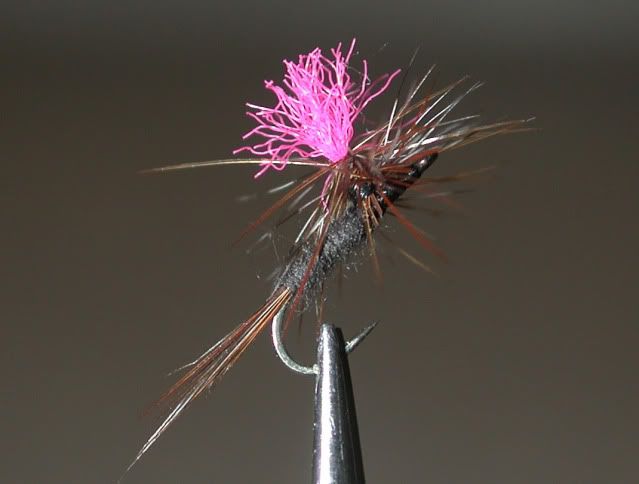
But a hot pink post is even more noticable especially with polarized glasses late in the day. This little size 20 fly was easy spotted a lot quicker than the size 12 tent wing caddis I had it tied to. It was the hottest fly I used last month during an eight day fishing trip - was on a few small creeks. The pink is a McFlyFoam product called McFlylon but not the soft spongy stuff used for egg patterns. The color is called Cerise.
My gosh, I scrolled down to see your fly and I was suddenly “blinded by the light” for almost twenty minutes. That is certainly one of the most visible flies I have ever seen. 8T
Flybugpa’s idea about using two different flies with different colored post should take care of any concerns about a fish avoiding the bright color. Just set the hook on any funny thing happening near the bright spot. Space the flies about 10 inches apart.
Eight Thumbs, no doubt that pink sticks out. The water I was fishing with it was gin clear. It had a fair amount of fishing traffic over the last week. The creek was just starting to warm up at the end of the run off but the water was still running very high. The fish were all small wild browns and bows and some hold over bows from the previous years stocking. No stocking had occurred due to the late runoff. If it had been the end of the season the fish might have been more selective.
In the late afternoon when the sun was off the creek and the creek was in subdued light but with lots of shimmering glare there was less detail visible. Putting on my polarized sunglasses made it even darker. I found it hard to navigate around with the glasses on. So I would take the glasses off to move around and then put them back on once in position to fish. Size 12 tent wing caddis and size 14 stimulators that worked well earlier in the day were very hard to pick up on the water. I may have had a good number of strikes on them for all I know. That little tiny pink post would instantly stick out like a neon sign even in heavy current. Sometimes it helped me keep track of the bigger fly also.
One thing I do know from a number of experiences over the years using hot pink or hot orange posts is:
Not seeing the fly means no fish. Seeing the fly means a lot more enjoyment out of the experience and at least some fish and sometimes a good number of fish.
 Just my 2% of a dollar. I’m sure others will disagree. 8T