My purchase of a kayak last year has led to a lot of fun fishing for gills and bass on ponds. One problem, though: even the lightest wind seems to blow me around like a feather. I have a small anchor (rounded; no edges to get caught), but I was wondering how to rig it for the best results.
I have an anchor trolley as well, on my right side, that runs from bow to stern. The easiest way to rig one to get two big carabiners, and clip onto to the carry handle at bow and stern. Take some parachute cord, and run a loop through the carabiners, and tie each end of the para-cord to a metal ring.
Use that ring as an attachment point for your positioning system. I have two anchors, but don’t use them. I prefer to use a Drift Sock, but I also have a Brush Clamp that I can use.
If you’re going to be fishing streams, or even in still water, you might want to consider two anchor trolleys. This will allow you to anchor off the bow and stern, to keep you from swinging in the wind. You can either rig a full-size anchor trolley on each side, or, two half-length trolleys on one side only.
I recently was on a float trip with several of my kayaking buddies here in OK. One gent had the split set-up for his anchors. Not really a trolley, but a few padeyes leading from the cockpit to the bow and stern. I think he had a couple clam-cleats at the cockpit. He would just thread the anchor lines from the bow and stern, leading to the cockpit. While paddling, the anchors (3 lbs hand dumb bells) would be up tight to the hull, but when he found a spot he wanted to fish, he would drop an anchor, either the bow or stern, and let that hold him in place while he thoroughly fished a spot. Very effective.
a simple thing to try is a snap shackle on the end of the anchor rope. i clip this to the side rope of that bungee arrangement on the stern deck and reach back to either push or pull it near me or far away. gives me a 3/4 angle to the wind or a straight downwind position. one of these day’s i’ll get around to installing the anchor trolley i bought at a show…
Get ahold of a (or make/have made) a small “Bruce” pattern anchor that will never foul the bottom and hold more fast than others. Its designed to back itself out of a jam. They are used on oil rigs on down to yaks. Texas Kayak Fishing (I think it is named) web pages have pics and maybe a source to purchase. Had one made for me from old lawn mower blades that I should have never parted with. Trolleys should be on your weak hand side and be configured to INSTANTLY jettison. A small float will allow to recover your anchor and line after an emergency release. Brush hook from Blakemore is the only one you want. All the above is mostly pertinent to fishing still water, anchoring in moving water is an invitation to swim.
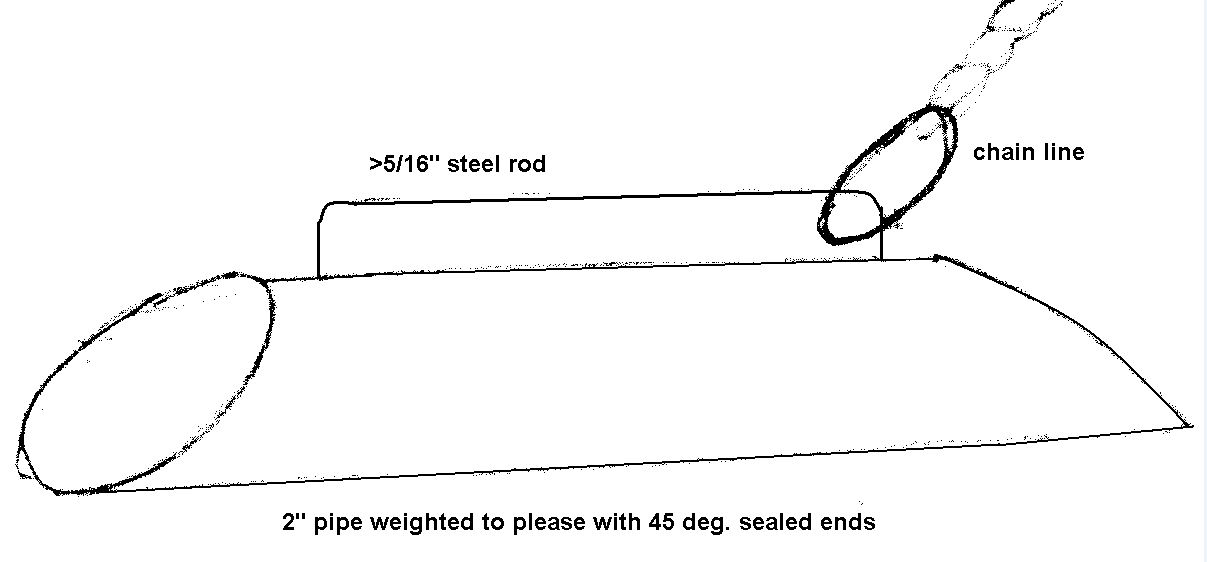
This is my rendering of a homemade anchor design. I think the original was made in the TVA pipe shop at Muscle Shoals, AL. THey would use stainless steel pipe and fill with lead to the desired weight. Lots of fishermen used it on the Tennessee River which has rocks, logs and mud on the bottom. It’s easy to retrieve when jammed by pulling it to the rear. I have a piece of PVC cut to make a Nucanoe version sometime in the future.
I use a small 2-lb. 4-pronged grapnel anchor on 50’ of 3/8" Milspec cord. I raise and lower it by hand. As the name suggests, it also doubles as a grappling hook. Never had a problem with it, even in moving water (within reason).
I put double anchor trollies on the back half of my kayak I primarily use drift socks in reservoirs. The biggest drift sock i use in the main wind side and I use the smaller drift sock on the other side for secondary wind in protected coves. On moving water i use simple claw-less anchor straight out the back.
The double anchor trolley also allows you to use an anchor on one side and a drift sock on the side as needed
I use a 4# (I think, maybe less) rubber coated exercise barbell the wife had in the closet. Yaks don’t need much weight to hold 'em unless its in a strong river current.
You mean a chunk of iron dangling below my boat won’t keep me from floating away? I had never thought much about it but I can believe some people don’t realize it has to come in contact with the bottom of the stream or lake. The speed of the flow makes a lot of difference in what will hold and what will not. I used a 10# vinyl covered weight off a barbell on my Fishcat float tube in the Hooch. There were places where that would not hold me in the stream. The total force of a stream is really easy to underestimate, as I found out when it flipped my tube.
You can also try a drift sock, I use mine all the time in a canoe. Depending on how you want to float down a shoreline, it can be tied at different parts of the boat to help position your cast.
I use an anchor trolley on the right side of the kayak using carabiners and a small pulley attached to the carry handles with a 8 lb dumb bell.
In addition to stop the kayak swinging in the wind. I have a 5 lb weight from the front carry handle with a line back to my seat. Drop it whenever needed.
I used to use the two anchor system on the kayak but the rear anchor jammed a couple of times, once the line jammed and the anchor was partly in the water and got caught up in weeds etc. I am overweight and too old to turn around and free it, almost a disaster. So I went back to the trolley anchor and point anchor, much safer for me.
take a look at www.texaskayakfisherman.com they have a lot of general info on kayak rigging. im pretty sure they have a video on rigging an anchor trolley, and probably have some recomendations on anchor styles, for both fresh and saltwater situations
I use a (what used to be a) 3 lb. coffee can with an eye bolt in the middle filled with concrete on a larger boat. Perhaps a (what used to be a) 1 lb. coffee can would work for a kayak.
I use a half of a sash weight. I have it tied to a float and then to the ring on my trolley with a slip-knot. That way if I have to let it loose, I can go back and get it. I also have a 3/4 piece of a sash weight, but have never had to resort to it.
If you know anyone who remodels houses sash weights are easy to get.