Mick Faherty is an interesting guy with an interesting
profession. Mick is a producer for Barrett Productions,
a media company specializing in television shows about
the outdoors and he travels the globe filming such
programs as Elk Hunters Journal, Fly Fishing America, and
Fly Fishing the World.
Which is pretty nice work if you can get it.

But before you hate Mick, realize that it was his own moxie
that earned him what many (myself included) consider a dream
job. Mick was just a sophomore at the University of Montana
at Missoula when he heard a rumor that a movie based on an
arcane fishing book was being filmed nearby. A little further
digging uncovered that the movie was based on A River Runs
Through It, the magnum opus of fly fishing fiction and
Mick’s favorite piece of literature, (even though it really is
a novella). Answering this Karmic call, he left books and
beer behind and, with his friend, Buck Simmons, headed
straight to the Boulder River (where the film was shot),
begged for a spot on the movie crew, and began a fly fishing
filming career that continues to this day.
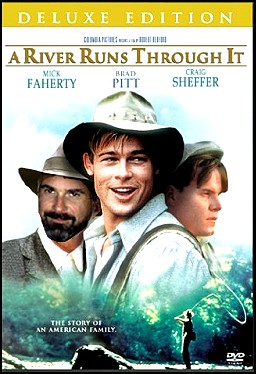
Mick spent that summer as a production assistant, while Buck
landed a role in the film as Humph, one of the cronies of the
McClean brothers who wisely decided not to “shoot the chutes.”
He crashed on Brad Pitt’s couch, (“he’s a great guy, but NONE
of those shots were of him fishing”), played croquet between
shooting days at Thomas McGuane’s ranch, and, latter, nearly
brokered a deal between Pitt and Jim Harrison to produce a film
version of Harrison’s novel, “A Good Day To Die.” Best of all,
Mick realized what many don’t; that you can make a career
of your passions.
Being a producer of fishing and hunting programs has
its privileges. Once, while on a quest to rid his
favorite river of the non-indigenous-illegally-introduced-trout-killing
northern pike, Mick was having problems getting those
voracious fish to take the large Dahlberg Diver he was
swimming in front of their very noses. Most of us would
have the option of continuing to flail with the Diver or
change flies; Mick’s solution was much more elegant.
He speed dialed Diver inventor Larry Dahlberg, and,
with a quick cellular on-stream tutorial, was soon
clearing the river of the nemesis of his beloved trout.
But it hasn’t been all fun and game fish for Mick.
He once hired the Buck Simmons mentioned above to
pilot him to scout remote filming locations in the
mountains of Montana. They were gone for a week,
going deep into the backcountry, catching fish in
rivers and lakes that “were seeing their first ever
dry flies.” This was a particularly dry summer, and,
on their return, they found that the Missoula airport
was closed due to the proximity of forest fires. Their
second option, Kalispell, was also closed, so they
headed to the tiny airport at Thompson Falls. They
were able to land only because this small airport had
no tower-the airport had been requisitioned by the Forest
Service and turned into their main base for fighting fires
in the region and, had they requested permission to land,
they surely would have been turned away.
There was no fuel available at Thompson Falls, so Mick
and Buck borrowed a car and ferried gas can after gas
can from the town to the plane until they had enough
to make it to Sandpoint, Idaho, where Buck has a
homestead. But the steep climb necessary to clear the
mountains surrounding Thompson Falls exacted its toll
on the small plane; the landing gear failed to fully
retract and when Mick attempted to manually lift the
wheels using a crank within the bulkhead designed
specifically for that purpose, the handle turned freely
in his now shaking hands. They were an hour and a half
from their destination, which is a pretty long time to
contemplate exactly where you’ll spend eternity.
They circled the airport at Sandpoint, burning as much
fuel as possible before attempting the landing. “Harnesses
were tightened, loose things secured, and final prayers
uttered,” Mick explains. “When we hit, the wheels fold
up and break away, tearing apart the underside of the
plane. Chunks of aluminum fly everywhere, there is
shrieking of tearing metal, and I bounce around
violently in the cockpit. As we finally slow to a stop,
enough of the fuselage is torn away so that I can see
the ground beneath my feet where the floorboards used
to be. We’re both very bruised, but other than that
completely ok.” Shooting the chutes seems pretty tame
in comparison.
My friendship with Mick (whom I call McFaherty) began
when he contacted me and expressed interest in filming
striped bass fisherman for his Fly Fishing America program.
I readily agreed, though feeling that his own adventures
would make a much more interesting story. And as I got
to know him, I was assured that not only was he perfect
to portray the fisherman’s passion, but we’d have a hell
of a lot of fun in the process.
As long as we didn’t have to fly to any remote locations.
Note: The resulting program, The 127 Shuffle,
will air on the Outdoor Life Network at 7pm and 11pm on
Friday, January 13, and at 8:30 am on Monday, January 15.
The revised River Runs Through It movie poster used in
this article was done by photographer and writer Chris Di
Guardia. ~ Dave
About Dave:

Dave Micus lives in Ipswich, Massachusetts. He is an
avid striped bass fly fisherman, writer and instructor.
He writes a fly fishing column for the Port City Planet
newspaper of Newburyport, MA (home of Plum Island and Joppa Flats)
and teaches a fly fishing course at Boston University.
Originally published January 9th, 2006 on Fly Anglers Online by Dave Micus.
Part 3
I was first contacted by Mick Faherty, of Barrett Productions,
about doing a striped bass fishing show for Fly Fishing
America in June. Seems that Mick read some of my stories
on FAOL and had somehow gotten it into his head that the
itinerant striped bass bum might make for an interesting program.
After some preliminary discussions, we agreed to start filming
in late September, which, I figured, gave Mick almost four months
to come to his senses and find a more worthy subject for a
television show. But Mick, displaying more conviction than
I, felt the show would work, and, as the date neared, we made
final arrangements.
They would arrive on Monday afternoon; shooting would begin
on Tuesday and continue until Friday. We would meet them at
their hotel to discuss logistics on Monday evening. So, firm
believers in the Stanislavsky System of Method Acting, co-star
Mike Tolvanen and I went fishing on Monday from 5 am to 7 pm
as a kind of rehearsal.
When it got too dark to fish any longer, we walked to Mike’s
truck only to find a message on his cell from Mick. When I
returned the call, Mick said he had been trying to reach us;
I explained that we had been fishing and I was still in my
waders. We planned to meet in an hour.
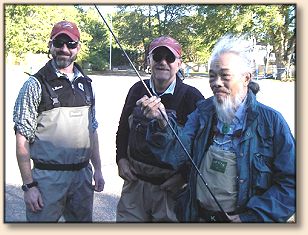
We arrived at the motel to find Mick and Aaron Selmanson, the
sound maestro, getting their equipment organized. Mick and I
had been corresponding for over four months at this point, and
I felt I had established more than just a business rapport with
him (in fact, I have come to think of Mick as the son I never
wanted). Aaron was a bright, personable young man who, shifting
through miles of cables and cords, obviously knew his stuff.
The two cameramen, Steven Theodore and Jeff Rhoads, were not in
their rooms, having gone in search of food (which, judging by
their subsequent behavior, seems to be an obsession with
videographers), but we would meet them the next day. Mike and
I both had a good initial impression; we all connected rather
quickly.
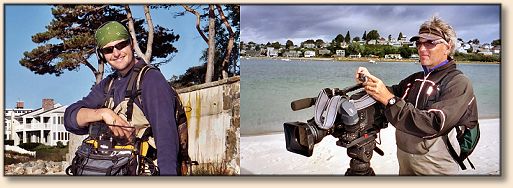
It did take us the first morning to get used to each other and
into the rhythm of things. We wanted to be fishing by first
light, while the cameramen, in their never-ending quest for
food, wanted to be eating breakfast. We would arrive at the
waters edge and charge right in, stripping line as we ran
down the beach, casting as soon as we were knee deep. The
film crew would call us back to the truck and chastise us
for not waiting for them to set up.
“I know you guys want to fish,” admonished Steve, “but we’re
making a TV show here. Now get back to the truck and let us
film you walking to the beach.” Mike, Kahn and I walked back
to the parking lot, heads bowed, seemingly compliant but
plotting our revenge. We stood by the truck until they were
set up. “Ok, we’re ready, come on,” Steve yelled. We didn’t
budge. “Come on,” he said again, getting impatient. We still
didn’t move. “What are you guys waiting for?” he finally
asked, exasperated. “You didn’t say action,” I yelled
back. Steve rolled his eyes. “Ok, action,” he said,
and, giggling like school children, we moved toward the water.
But by lunch of the first day we were all well into the filming,
understanding each other’s needs, and, more importantly,
thoroughly enjoying each other’s company.
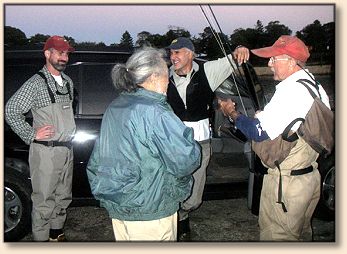
I was extremely impressed by the quality of the crew. Mick
has done over 30 shows for Barrett, had worked on the set of
A River Runs Through It, and came within a fish hair
of producing a movie version of Jim Harrison’s A Good
Day To Die. Aaron, though by far the youngest of us
all, had worked on many fishing shows as well as the Duck’s
Unlimited program on OLN. Prior to joining us, Jeff had been
filming reality television shows, most notably Fear Factor
(for which I hold him partially responsible for the decline
of western civilization), and Steve had been touring with
Britney Spears, working on a video she was producing. In
other words, an extraordinary crew sent to film three mere
striper fishermen (but I had to wonder what gods Steve had
offended to fall so far so fast-from Britney to bass bums).
I did have two major trepidations about the whole project.
One was we wouldn’t catch many fish. Mike and I had caught
over fifty striped bass between us the day before the shooting,
but, in that odd but predictable way of the angle, the fishing
was much slower when it counted. I expressed my concerns to
Mick. “You guys caught enough fish the first day to make an
entire program,” he assured me. “So don’t worry about that.”
(Much later Mick would write to tell me that of every show he
filmed this year we had landed the most fish.) My second fear
was more personal; when you’re involved in something like this
there is a nagging feeling that you are going to look and sound
like a fool, especially when compared to Mike and Kahn, who,
between them, have close to 100 years of fly fishing in the
striper surf. That was a fear I’d have to live with until I
actually saw the program.
By the end I felt that it was about the most fun I’ve ever
had fishing. Mike and Kahn agreed. The angling was good,
the company was better, the experience was interesting, and
spending anytime at all with Mike Tolvanen is sure to produce
some chuckles. At one point Mike and I were being filmed from
a distance, with the scenic Thatcher Island and its twin
lighthouses in the background. Nudging me, Mike said, “Do
you think that jackass with the headphones on can hear us
now?” Aaron, thirty yards away, stopped fiddling with his
sound equipment long enough to signal, with one finger, that
he heard us loud and clear.
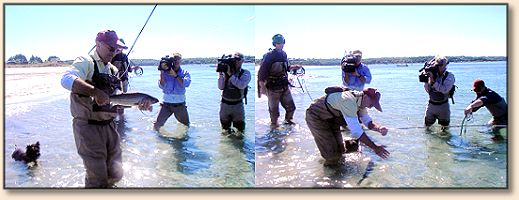
And then there was Cody the dog. Cody met us at Coffin beach
and followed us throughout the day. His owners must have had
a house nearby, because Cody had that confident, friendly
demeanor that said “this is my turf, but I don’t mind if
you hang around.” When we waded into the water Cody sat
watching, and every time Mike hooked a fish Cody jumped
in the water and frantically paddled after it, trying to
catch the fish in his mouth. At one point Mike landed a
bass and as he was picking it up Cody grabbed it by the
tail, and a tug of war ensued worthy of any Three Stooges
episode. We were all in tears.
“Did you catch that on film?” I asked Mick.
“I have bad news for you,” Mick answered solemnly. “We’ve
changed the focus of the show from striper fly fishermen to
Cody the Amazing Fishing Dog. You’ll still be in the program,
but only from the knees down.”
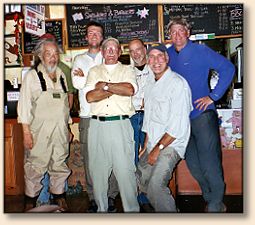
Our last day of filming rolled around all too quickly.
We were fishing the mouth of the Ipswich River, and it
was one of those situations where the planets aligned
and we were getting a fish on nearly every cast. It was
also time for the dreaded Interview. Kahn went first,
then Mike; I went last giving my nerves plenty of time
to jangle. I’m not exactly sure what I said, but it
seemed as if I was babbling incoherently. I could only
hope that through technological editing wizardry I would
be made to sound at least as if I was speaking English.
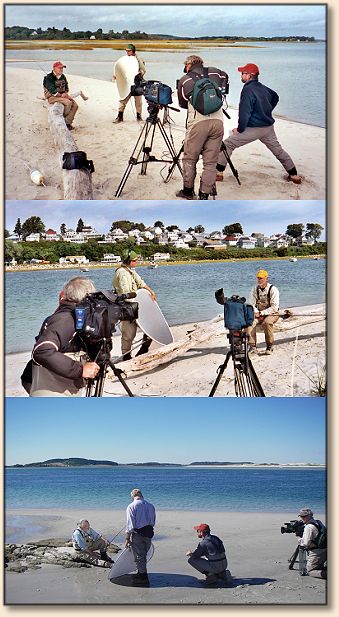
“You did fine,” Mick assured me. I wasn’t so certain.
We quit for the day and headed out to dinner, then it was
back to Mike’s house for coffee before our final goodbyes.
At this point we all felt like good friends were moving
away, and we exchanged email addresses and phone numbers
and promised to stay in touch (and we do). And, then, like
all good things, the filming of our TV show came to pass.
I met Mike the next day at 5am to fish, but our hearts
weren’t really in it. It seemed odd not to be with the
crew. We fished as we normally do, from dawn until dusk
with no breaks, but I have to admit that, when lunch time
rolled around, I kind of missed the cameramen with their
voracious appetites insisting that we quit even though
the fish were feeding to go get a bite to eat.
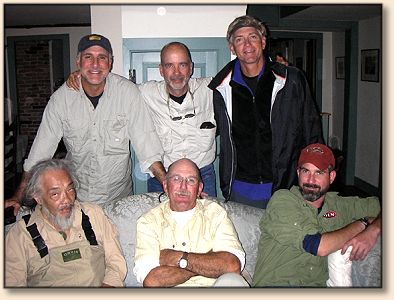
Back row: Cameraman Steven Theodore, Bass bum Dave Micus, Cameraman Jeff Rhoads
Front row: Bass bum Richard Kahn, Bass bum Mike Tolvanen, Fly
Fishing America Producer Mick Faherty
Missing: Sound technician Aaron Selmanson
NOTE: Repeats of the resulting program, The 127 Shuffle,
will air on the Outdoor Life Network (OLN) on February 21, 8:30-9:00am;
March 20, 8:30-9:00am; March 24, 10:30-11:00pm; and March 25,
2:30-3:00am. I would like to thank cameraman Steven Theodore
for contributing photos to this article, (as well as teaching
me the correct pronunciation of calamari). ~ Dave
About Dave:
Dave Micus lives in Ipswich, Massachusetts. He is an
avid striped bass fly fisherman, writer and instructor.
He writes a fly fishing column for the Port City Planet
newspaper of Newburyport, MA (home of Plum Island and Joppa Flats)
and teaches a fly fishing course at Boston University.
Originally published January 13th, 2006 on Fly Anglers Online by Dave Micus.
Part 4
“In the future, everyone will be famous for 15 minutes,”
pop artist Andy Warhol once said, and my fifteen minutes
of fame was kindly provided to me by Mick Faherty of the
Outdoor Life Network’s Fly Fishing America when he
and his crew filmed me and my crew fishing for striped
bass during the fall migration on the northern Massachusetts
coast line. And while the fame has lasted just a tad more
than 15 minutes, the experience will last me a life time.
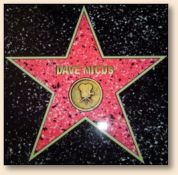
The actual shooting of the program would have been enough
even if it were never aired. The fishing was good, but the
camaraderie we developed was better, and it served as the
reminder that we all need now and again: fishing is much
more than just catching fish. But a program was produced
for all the world to see (well, at least that portion of
the world that enjoys fly fishing and has cable), and I
looked forward to it with a strange mixture of excitement
and dread. Who knows how we’d look or sound on film? Would
we come off as frauds or, worse, prima donnas? I couldn’t
help but feel a bit vulnerable, opening myself up to the
censure of that small but vocal hyper-critical group of fly
fishermen who feel that their way is the only way.
Being about the fall migration of striped bass, I assumed
our show wouldn’t be shown until the fall, but I got the word
from Mick that it would air in January. Now the pressure
was on. A local newspaper had gotten wind of the show and
printed a brief article with the schedule, and friends and
neighbors questioned me about the program. My anonymity
was breached; I had hoped to preview the program and assure
that I didn’t look the fool before sharing subsequent airing
dates with friends and relatives, but now that wasn’t an
option.
So it was with a sigh of relief that I received the following
letter from producer McFaherty:
“It is now 10am. I have 'til 1:30pm to finish your script,
at which time the audio will be put down. I’ve written and
produced over thirty TV shows at Barrett, and this is my
favorite. You will want to show it to everyone in the
whole world. Which is good, because they are going to
want to see it!”
On the night of the show, fellow 127 shufflers Mike Tolvanen,
Kahn, and I, along with a few other friends, gathered at
Mike’s house for a little premiere party. We had pizza
and beer, and then gathered around the tube for the moment
of truth. Our fifteen minutes of fame was at hand.
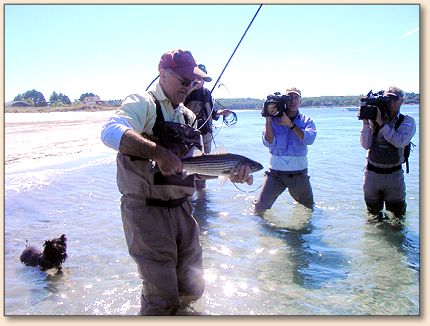
We all laughed when Mike got “bleeped” for his inappropriate
language (which also earned him a kick in the shin from his
wife, Maryann), and we howled when Cody the dog chased Mike’s
fish. Mike earned another kick when he said he would have
fished on his wedding night if he had been married in the
late spring. With each new scene, we reminisced about the
filming and the behind the scenes joking that went on, and
as I looked at Mike and Kahn I noticed they were grinning
from ear to ear. I’m sure I was too.
There were a number of things about the show that stood out,
first and foremost being just how well the program was done.
Mick, soundman Aaron Selmanson, and cameramen Jeff Rhoads
and Steve Theodore are consummate professionals who did an
outstanding job of the actual filming. Then Mick and the
editors at Barrett put what seemed to me at the time to be
a phantasmagoria of fly fishing footage into a coherent
story that captured the excitement of striped bass fishing.
I couldn’t have been more impressed.
I noticed that I still have a pretty strong Chicago accent,
even though I thought I had lost my Midwestern twang about
10 years ago. We clearly don’t recognize how we sound to
others, because Mike felt exactly the same way about his
New England drawl.
“Do I really sound like that?” I asked the assemblage after
a scene that featured me babbling about writing and dragging
out my 'a’s in that mid-western style.
“Yea, you do,” they all answered. A scene or two later Mike
was sharing his expertise on striper fishing, eliminating
the sound of ‘r’ from the spoken language and turning one
syllable words into two syllable words as New Englanders
do, there to they yah for instance.
“Do I really sound like that?” Mike asked.
“Yup,” came the reply.
While the filming was fun and the results even better,
none of the shufflers are star struck. We know Speilberg
isn’t going to call, and we haven’t hired agents. The
audience for these types of programs is small but select,
and the response to the show from fellow fly fishermen in
person, by email, and on various fly fishing bulletin
boards has been nothing but positive and gratifying
and that’s been more than enough.
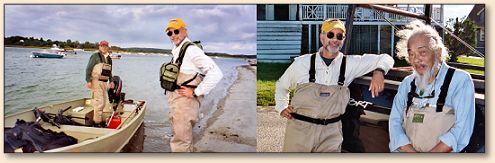
After all, this was never about fame, just fortune.
It is my good fortune to have met Mick and Aaron and
Steve and Jeff and to be able to now count them as
friends. It is my good fortune to know Jim Murphy
of Albright tackle, who gave me a not-yet-on-the-market
XX rod and Tempest reel to use for the shoot (great
outfit, by the way!). It is my good fortune to fish
with two of the best fly fishermen that one could ever
hope to meet, Mike Tolvanen and Richard Kahn. And it
is my good fortune to have access to some of the finest
fishing holes on the East Coast, if not the world.
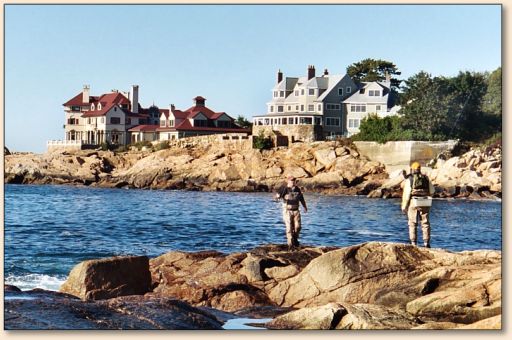
If I ever lose sight of my good fortune, I need only
to put on the tape of The 127 Shuffle and see the gleam
in my eye so well captured by Mick and crew. Then,
like the striped bass in the spring, it all comes back to me…
(NOTE: Repeats of The 127 Shuffle will air on
the Outdoor Life Network on February 21, 8:30-9:00am;
March 20, 8:30-9:00am; March 24, 10:30-11:00pm; and
March 25, 2:30-3:00am.) ~ Dave
About Dave:
Dave Micus lives in Ipswich, Massachusetts. He is an
avid striped bass fly fisherman, writer and instructor.
He writes a fly fishing column for the Port City Planet
newspaper of Newburyport, MA (home of Plum Island and Joppa Flats)
and teaches a fly fishing course at Boston University.
Originally published February 20th, 2006 on Fly Anglers Online by Dave Micus.