Living in the urban jungle of Phoenix,
AZ I like many others find it difficult
to make it to the high country to go fly
fishing for trout. However I have found
a great way to quench my fly fishing needs
and I have found that by the way of carp.
Carp are very spooky and selective feeders
not to mention their hard fighters and grow
to gargantuan proportions. Because they are
such an excellent challenge fishing for carp
will undoubtedly improve your casting which
also makes them great practice for trout. John
Rohmer once told me that “catching carp will
make you a better trout fisherman.”
While all this is well and good I think I
may be straying from the subject of why I’m
writing this article. Let me turn things
around a little, carp feed very heavily on
the natural vegetation found in the lakes
which I fish. Whether it be a clump of aquatic
vegetation or a mesquite bean pod that has fallen
from a tree carp love this stuff. However after
a quick search on the internet I couldn’t find
any existing flies to imitate such things so
I did what any self respecting fly fisherman
would do and made my own. Here are two very
simple flies I have found success using and
hope you have the same.
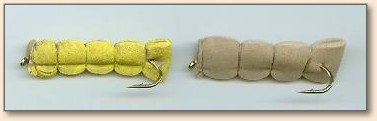
Mesquite Bean Pod
Materials List
Hook: Size 4 streamer hook
Thread: Tan
Body: 2mm Tan Foam
Tying Instructions:
-
First wrap a layer of thread
covering the hook and end at the bend. -
Now tie a half-hitch so the thread
will stay put when you remove the hook from
the vice. -
Remove the hook from the vise and insert
it in the middle of a piece of foam
approximately 3/8" wide and 4-5" long. -
After securing the vise back in the vice
fold the foam over and use the thread to
segment the body of the fly to represent
multiple seeds. -
Trim any excess foam and tie off.
-
(Optional) Paint the fly using either
a yellow finger nail polish or enamel. This
is to better match the color of a natural
seed pod. However I have found about the same
number of fish will take either.
Fishing Notes
The best and most exciting way, to fish
this fly is to plop it near and even sometimes
in the middle of a group of feeding carp. The
greediest of the group will readily snatch the
fly in a matter of seconds. You can also lead
a cruising fish by several feet and then just
let the fly sit. For some reason carp can’t
resist the bean pods that fall from mesquite
trees and this fly should prove to be an excellent
producer.
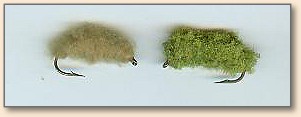
Algae Fly
Materials:
Hook: 4-12 Dry Fly Hook
Thread: Olive
Underbody: 2mm Olive Foam
Overbody: Light Green Woodland Scenics Foliage
Tying Instructions:
-
Tie in a base of thread ending at
the bend of the hook. -
Tie in a piece of foam in at the end
of the hook and wrap forward to the front
of the hook to secure it. -
Now bend the foam over and wrap to
the back of the hook. -
Continue this process until you have
3-4 Layers of foam. -
Trim any excess foam and wrap your
thread to the back of the hook. -
Cut a square piece of Foliage (Size
depends on hook size) and wrap it around
the foam body so it is covered. -
Make several wraps forward to secure
the Foliage and tie off.
Tying Notes:
Woodland Scenics Foliage can be bought at
nearly any hobby store or model railroad
shop. If you can’t get a hold of any you
can substitute green dubbing for the overbody.
Fishing Notes:
The best way to fish this fly is to lead
a feeding fish by about two feet. Fish will
not respond aggressively to this fly as they
will the mesquite pod fly.
As you can see creating flies that represent
natural vegetation is very simple. I hope
these two flies will not only help you catch
fish but inspire you to make your own patterns
that represent the aquatic vegetation found in
lakes where you reside. Whether it be a grass
fly made with deer hair or some other concoction,
fishing flies that represent natural vegetation
should bring you great success. Until we meet
again good luck and tight lines. ~ Jason
Originally published August 8, 2005 on Fly Anglers Online by Jason Cotta.