This is something everyone else has probably already doing, but it is new to me.
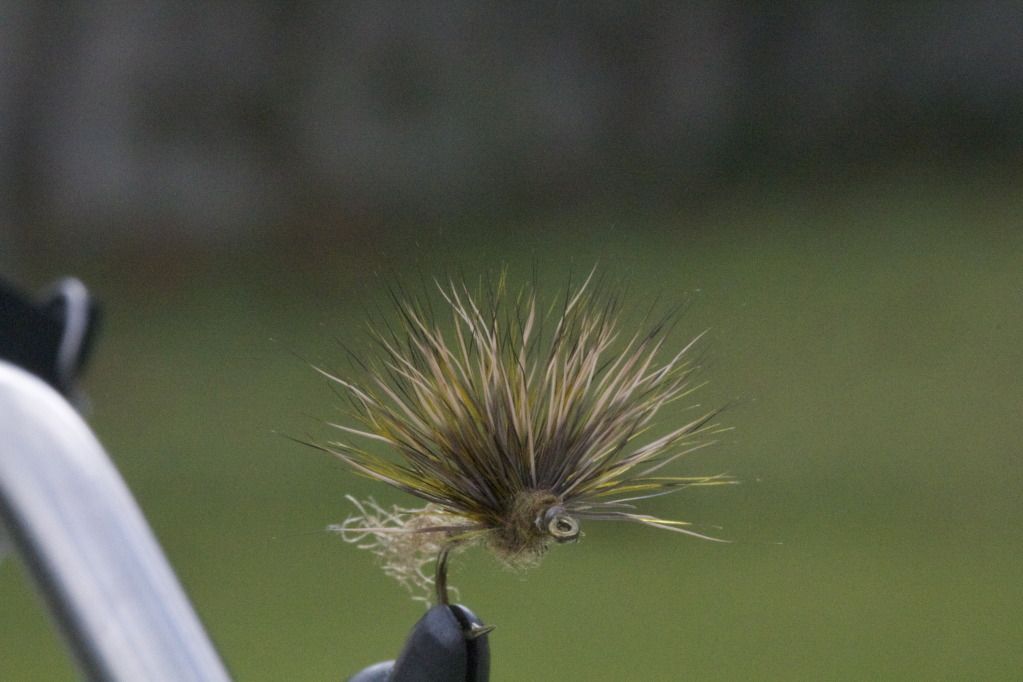
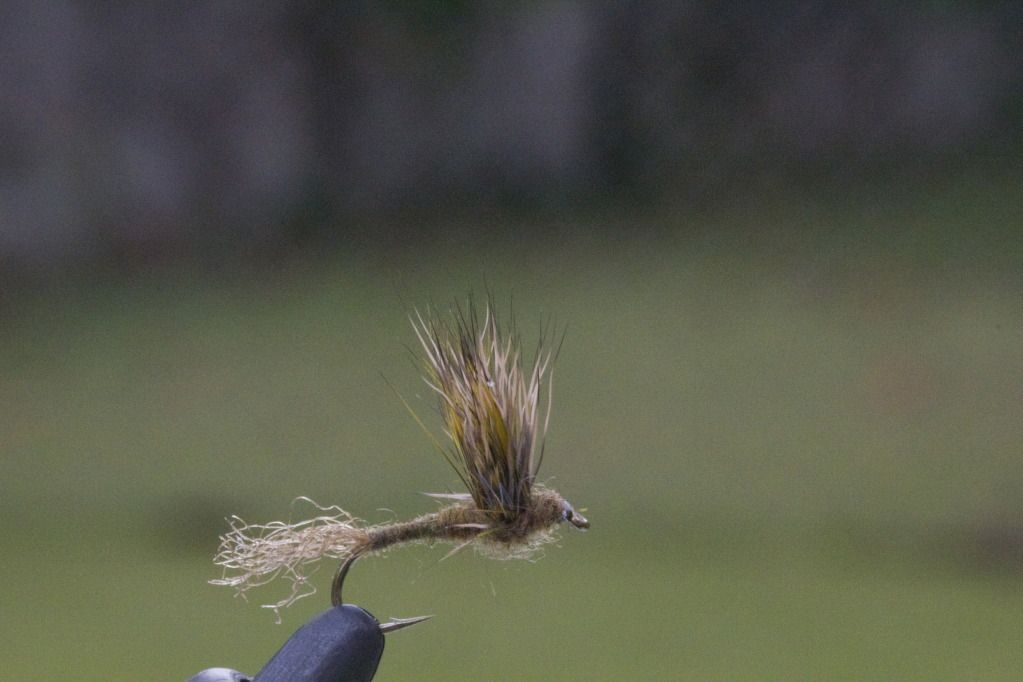
I was tying some Sparkle Duns for the Sept Drake hatch on Soda Butte and the Lamar in YNP. I did not have any olive dyed deer hair.
So, I flaired the hair and then wove an olive dyed grizzly hackle through the deer hair to give it the tint of that color. I think it works well. You just cut the hackle flush at the bottom before dubbing the fly.
You know how you sort of “jiggle” the hackle while wrapping so you don’t bind any deer hair. I start the hackle behind the deer hair and wrap it forward through the hair and then back through to the tie in point
Nice job Byron.
Because I do not dye hackle, and I sometimes need Olive for a fly (have not yet figured out how to produce some colors with my Genetic color breeding), I have found that the Prismacolor pens work very well and the color is for ever. For me the PM-28 Olive Green works well. They have many other colors as well. Being a cold dye it does no damage to the stem like hot dyes do. I just pluck how ever many hackles I want for a project, lay them out on a newspaper, swipe both sides, and in just a few minutes they are dry, ready to tie.
If I need the deer hair a different color than I have at my tying bench, I go ahead & tie the hair in on the hook, then use the Prismacolor pen to dye the hair. Still always get my fingers dyed also.
I have used Pantone “so-called” permanent markers on deer hair in the past. I have done this on the spun and clipped deer hair heads on muddler minnows. It looked good in my box, but after awhile the color washed out. Maybe another brand of marker would work better. Other materials seem to absorb the color better than deer hair; perhaps another brand of permanent marker would work better. I have had better luck cold dying deer hair.
Credit goes to anyone and everyone who can improvise ways to add color to hair or anything else with the least amount of effort and yet still get the effects they desire. I know a few guys who carry permanent marker pens in their vests. Maybe that works for them but I carry enough junk on stream so that’s not something I want to do. Personally, I like dyeing materials and get some satisfaction from a good dye job. It’s not difficult at all and I just consider it part of the fly tying process. The idea of hackling through the hair sounds reasonable. Just thinking about that, how about using a few turns of dyed ostrich herl? May not work as well for dries unless you add a little floatant perhaps. In the past I’ve mixed different shades and dyed colors of hair in a stacker prior to tying compara-type wings. Nice effect. Well, at least these wings look good to us. And after all, when we look into our fly box at a bunch of flies all of the same pattern, isn’t 90% of the reason we select one fly over the others because we like the look of it better than the others? Do the fish care? Age old question and we’ll never really know.
Maybe I was unclear as to how I use my markers. I use them to mark my flies ON THE RIVER when I do not have the right color of fly. I do not use them to color the material or flies during tying. Having the right color material is always preferable to coloring on the stream.
But it sure beats NOT having the right color flies and getting skunked. I learned this early on shortly after learning to fly fish. I was in Yellowstone and my family and I had stopped for lunch at a pull out. The pull out overlooked the lake and there was a fly fisher and some rising trout.
My two sons and I went down to fish and neither we or the other fly fisher could catch the rising fish. I looked carefully and they were rising to black bodied mayflies, probably a variation of a callibaetis. They would not hit my parachute adams. So went back to our RV and got a Sharpie to mark up the flies. We then started to catch fish.
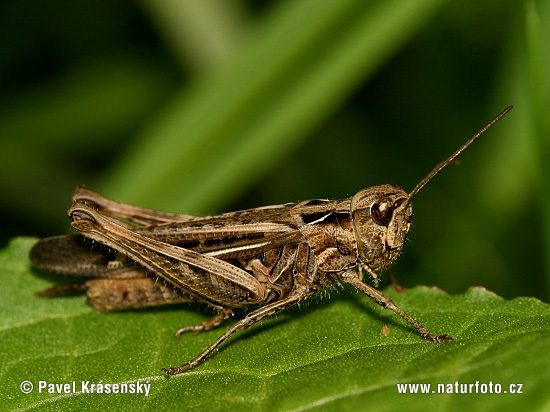
I regularly use the markers on hoppers. Hoppers vary in color from green to yellow to brown to orange to black and all colors in between. A marker gives you a very close match. The hopper patterns you have may or may not match the local ones in color distribution.
I know I get more hits when I match my hopper color to the local hatch. Many folks will fish a hopper dropper without checking out what the local hoppers actually look like and the hopper function more as a strike indicator than a fish getter.
Great post Silver. I think that is a good idea. It is just that I have used markers on deer hair before and it didn’t take well.
What exactly is the brand of the marker you use? Permanent marker?
Thanks,
Byron
These are the art markers that I use. Art markers are manufactured to be consistent in color. Certainly much more consistent than we fly fishers need. I use the double ended markers, that have that pointed nib and a thicker wider nib.
They do tend to dry out. So I renew my markers by injecting them with toluene or toluol, a solvent you can get at a paint or hardware store. I use a 1 cc diabetic syringe and a fine 25 or 26 gauge needle. Put the needle into the end of the marker between the nib and the plastic. Do not inject too hard or the marker will begin to leak.
I have not tried the Sharpie markers other than in black.
The markers are sold in fly shops but they cost more than $4 each and these are half the cost.
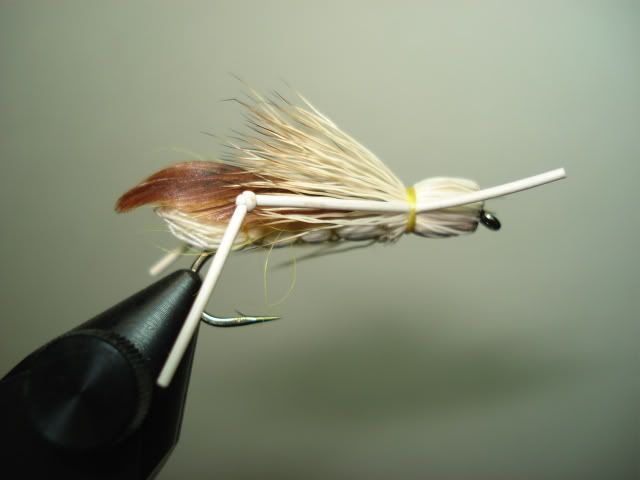
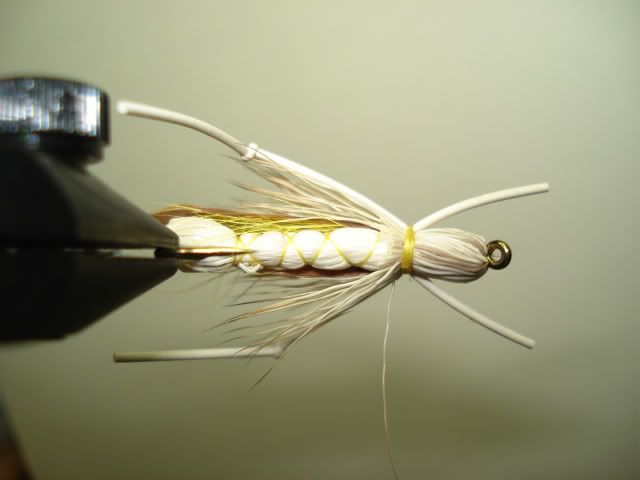
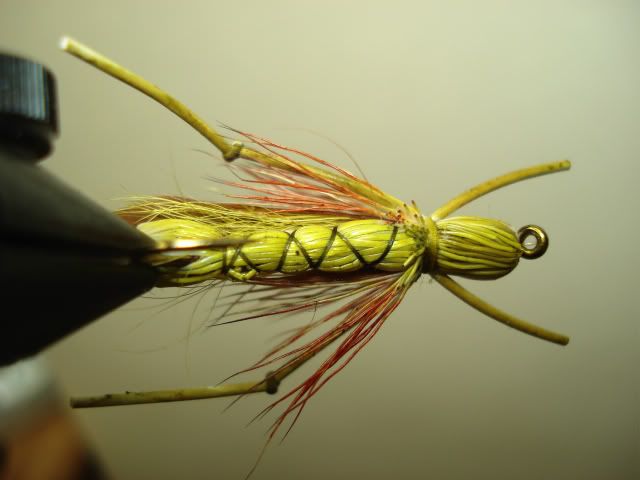
One of my favorite hopper patterns is the Henry’s Fork Hopper by Lawson. It floats low and is not sold in a lot of fly shops so the local trout do not often see this pattern. But it is tied generally with a white body. I use markers to color it.
I do the same thing for another one of my favorite flies, the Madam X. The Madam X is generally tied with a yellow body but I tie it with a paler body and color it. Here are several color variations of the Madam X What color would carry if you did not have art markers?
Henry’s Fork is the first hopper I tie on if my dropper is also a dry fly! A couple of those are actually Madam-X’s, which is just a slight variation. From my experience a true Henry’s fork doesn’t have the legs.
Madam-X has legs tied in on the sides, without the leg joint, often used as a stone imitation.
I never thought of coloring my hoppers since in most situations, I don’t think they can see the difference between White and olive or tan.
Your method of adding color to the wing by using dyed hackle is very creative and innovative, Byron. Good for you.
Having said that, color still is the lowest on the list of priorities for fly tying, at least for a lot of us, and for good reason. For an earlier discussion on that particular subject, follow the link.
I wouldn’t for a moment discourage anyone from using any technique they think will help them have fun on the water, and catch some fishies, too. At the same time, I do believe that a lot of discussions lack balance, and that bringing balance to the discussion is to the benefit of those actually engaged in it and onlookers, which may well include more visitors to the BB than actual BB members.
Thanks John,
I certainly agree that color is less important than size, and shape. I like to cover all my bases, though, in order that I give myself every possible advantage with Mr. Trout, especially in spring creeks like The Ranch on Henry’s Fork.
Having even one trout turn away because of color would upset me. Now, I know we can’t know for sure why a trout rejects a fly, and I suspect the least probable factor is color, but even if just that one…