| Sysadmin Note |
|---|
| Part 7 can be found here |
STREAMERS & LARGE SOFT-HACKLES
Meat Department:
Next I’d like to discuss tactics and techniques in more details. This chapter covers more details for fishing with streamers and large soft-hackles. Some of visiting anglers never think about using these “meat flies” at DePuy’s. Also others who claim to be “dry-fly enthusiasts” will never understand or even try to fish with these large flies. In my opinion, those anglers are limiting their opportunities. Information provided here is not limited to only spawning periods in the fall and spring at DePuy’s, rather these can be applied to any month and at any other spring creek.
Understanding Trout Behavior:
Why do trout chase and bite these large objects passing around them? Aggression and curiosity can explain this action among all sizes of trout. Trout become predatory and territorial as they grow larger. They attack threats in order to protect their resting spots (or spawning beds when they are in spawning phases). Then for the most practical reason, all trout want to eat the most with the minimum effort. Sculpins, minnows, baby trout, and leeches (all of these are abundant in most spring creeks) are “prime rib” for trout.
Attitude Adjustments:
So the concept is the same as fishing big rivers such as the Madison and Yellowstone . However some subtlety is required in your attitude. Walk along the bank and wade the creek very carefully. Approach trout just like when you target rising trout with dry-flies. Streamer patterns and techniques need to be adjusted as well. Before discussing successful methods and patterns I would give the following advice. No aggressive wading attitude. This may be permissible on big water but will spook trout before you make your first cast on most spring creeks. Humongous patterns make too much splash, repetitive castings, and super-fast retrieves will spook trout way before they see your offerings. Spending days at DePuy’s I have seen several anglers who were fishing with 5-inch streamers, 8 weight rods, and wading aggressively. I stayed away from them before I got snagged or run over.
Spring Creek Streamers:
Patterns lengthening from 1 to 3-inch (hook sizes 12 to 6) are suitable for DePuy’s (and for Armstrong’s and Nelson’s). Favorite colors are natural tan, black, and mottled (mix of olive, brown, black, tan, and so forth). Please check back patterns introduced in PART 4 and 6 also.
| EOTG Satoshi Yamamoto | EOTG Satoshi Yamamoto | |
| McKnight’s Home Invader – Black Hook: TMC 700 size 6 & 8 Thread: Red Ultra Thread 140 Barbell Eye: Small, color of choice Tail: Black marabou, two plumes (pheasant ramps are also great.) Body (rear & front of eye): Blackl fox tail wrapped around hook-shank Flash: Copper Flashbou Wing: Metz Magnum Cape Grizzly | Muddler minnow Hook: Streamer hooks misc. sizes Thread: Tan or white 3/0 or 6/0 Tail: Mottled turkey quill Body: Pearl tinsel chenille Under-wing: White calf tail Wing: A pair of mottled turkey quill Collar & Head: Deer hair | |
| Doug McKnight’s (www.bigwaterstudio.com) Home Invader in black is also my all-time go-to streamer. Combinations of colors (wings, flash, eyes, and tail) are unlimited. Each one can be “bite of the day”. | This classic is still a staple around here. Shown here is tied in natural appearance with an up-eye salmon hook to add some weight. Smaller ones are ideal to be trailed with large and heavy patterns. | |
| EOTG Satoshi Yamamoto | EOTG Satoshi Yamamoto | EOTG Satoshi Yamamoto |
| Yamamoto’s ZAC Fry – Natural | – Mottled Olive & Brown | – Mottled Black & Olive |
| Hook: Dai-Riki 280 size 8 to 12 Weight: .020 lead wire, 15 wraps on the front half of hook-shank Thread: 210 denier or MFC Streamer Thread in misc. colors Flash (optional): Krystal Flash in misc. colors under tail and both sides Tail & Top: Pine squirrel zonker Ribbing: Fine silver or gold wire Body: Ice Dub in misc. colors Collar: Webby portion of low grade saddle hackles: grizzly, olive-grizzly, tan-grizzly Eye: Small 3D or stick-on in misc. colors of choice Head: Built up with thread & coated with Sally Hansen Hard-as-Nail (clear). | ||
| (*ZAC = Zonked And Chomped!!) Large predatory trout seem to find these small Zonker types just suitable for “one quick bite”. Shown are three of my basic arsenals in my box. I experiment combinations of colors at my bench then at the creek. It can be fished by itself or trailed with larger ones. It also can be fished dead-drifting under indicator. |
Rigging:
6 weight 9-foot rod with a floating line is just fine. Leader is 9 to 10 foot ending with 2x tippet (with this set up one can change into a nymph or soft-hackle rig quickly). To target several deep pools and runs at DePuy’s I even use an intermediate (1.5-2.0 ips) or full (5.0-6.0 ips) sinking lines with a short (4 to 6-foot) and heavy leader. Some may wonder if I’m no different from those questionable (hazardous) anglers mentioned above, but I follow the rule of subtlety at spring creeks. So I’m using my “river gear” with a “spring creek attitude”. I have tested my rigging and proven its necessity and effectiveness. Remember that I can get away with 4x and 5x tippets during midge and BWO hatches. That’s because I master and adjust “angles of presentations”. The same idea can be applied here. By mastering subtlety and stealthy, a 15 pound test tippet under water with streamers doesn’t bother the trout at all. Furthermore, this may startle some readers even more, but I typically tandem-rig two streamers. My guidelines for combining two are 1) different sizes (one is larger than the other) and 2) different colors (one dark and the other light). I tie them on as depicted below.
| EOTG Satoshi Yamamoto |
Methods: 1:
Dead-drift or swing streamers in riffles with long (about a foot) and slow retrieves (adjust speed so they don’t snag the bottom).
2: Cast and sink streamers into deep holes and runs and retrieve with long and slow or sometimes Figure-8 method.
3: At deep spots, mend floating line so streamers go deep as quickly as possible. Sometimes I even apply split-shots.
4: When you locate trout at shallow spots, aim streamers several feet above them. Then by mending, slow down and bounce streamers deliberately toward trout’s faces.
Where to Look:
Apparent deep spots are obvious places, but also never ignore riffles, cutbanks, and many other structures. I often have opportunities for sight-fishing with streamers. It’s truly “eye-to-eye” experience. I have only one shot. It will be either bite or spook.
Large Soft-Hackles:
At DePuy’s, large soft-hackles essentially serve like streamers; minnow, sculpins, and such. But also, large soft-hackles are more undulating than most streamers, which definitely presents a different silhouette and perhaps taste to trout. Especially during spawning time this undulating effect combined with fly manipulations causes tremendous irritation and instinctive aggression among large territorial trout. On several occasions I have seen trout chased my soft-hackles for more than several feet and tried to crush them!! Sight is amazing, even terrifying!!
Patterns: Unlike the streamers mentioned above, I don’t really sort large soft-hackles into boxes for rivers or for creeks. Patterns I use for fall-runners in Madison within Yellowstone Park have been successfully catching trout at DePuy’s as well. Vise versa. That explains versatility of soft-hackles.
| EOTG Satoshi Yamamoto | EOTG Satoshi Yamamoto | EOTG Satoshi Yamamoto |
| Yamamoto’s COYOTE Version 3 (Spruce Coyote) Hook: Up-eye Steelhead/Salmon Hook Size 8, black finish Thread: UTC 140 Burnt Orange Tail: Golden Pheasant Crest Ribbing: Lagartun French Tinsel Fine Thorax: Yellow Ostrich Plumes Wing: A pair of hackle either grizzly, badger, ginger, or mottled brown Hackle: Cock Ringneck Pheasant Ramp | Yamamoto’s Mr. O-O Hook: Dai-Riki 280 or MFC 7231 size 8 Bead: Gold 1/8" (3.2mm) Thread & Body: UTC 140 Burnt Orange Rib: Medium fine gold wire Tail: Krystal Flash, rootbeer Hackle: Ringneck Pheasant Lower back feather | Yamamoto’s Brindle Sparrow Hook: Dai-Riki 270 or 280 size 4 to 10 Thread: UTC 140 Burnt Orange or Danville’s 6/0 brown Tail: Two plumes of pheasant ramp Body: Variegated Chenille, color of choice Hackle: Pheasant ramp Head: Pheasant aftershaft |
| Version 3 was born simultaneously with Version 2. It’s an evolution of Spruce streamers!! Strip, swing, bounce, or twitch it! Not only in spring creeks, try at big rivers like Yellowstone and Madison! | This is the new generation of large soft-hackles. From the first trial, it became the best and deadliest weapon of mine!! It can be used even as a nymph under an indicator. I believe the bead helps charging the depth, then extra-long & colorful hackle fibers cause further irritation among trout. | A slight modification of Sparrow. By changing chenille colors, one can present any kinds of organisms. Fish up-stream under an indicator as a nymph, then fish back down-stream by swinging (vise- versa). Either way it can’t fail to catch fish!! |
| EOTG Satoshi Yamamoto | EOTG Satoshi Yamamoto | |
| Gartside’s Soft Hackle Streamer Hook: Dai-Riki 930 size 6 or 8 Thread: UTC 140, color of choice Flash: Golden Pheasant Crest Hackle: Wrapped marabou – black, white, olive, brown, or mix of two Collar: Mallard flank, pheasant ramp & shoulder, webby portion of low grade saddle hackles | Multi Color Soft Hackle Streamer – Master Angler Version Hook: Dai-Riki 270 or 280 size 4 to 8 Thread: UTC 140, color of choice Hackle: Wrap one color, then next. Attach two more different colors and wrap them together toward hook-eye. Flash: Flashbou, one strand extending to the end, color of choice | |
| This simple and classic pattern still holds a spot or two in my box. It’s simply irresistible for trout. | Learned from Tom Travis, this one adds more colors, movements, and bulk on the original. It must look tasty for trout but in my observation, trout seem to bite this from irritation and aggression when it’s passing in front of them. |
Rigging:
5 or 6 weight 9-foot rod with floating line will do. Leader-tippet is 9- to 10-foot long ending 3x or even 2x. I rig up two flies all the time. My guidelines of combining two are: 1: contrast sizes (one large and the other small) and 2: contrast colors (one bright and the other dark). I tie them on my tippet as the drawing.
| EOTG Satoshi Yamamoto |
Methods:
With large soft-hackles I don’t target obvious deep runs and pools. Rather I look for riffles with moderate current and gravel bottoms (potential spawning beds/resting spots) and chutes (= “fish paths”). Methods I employ are:
1: Cast and swing down-&-cross, mending in order to slow down,
2: Add twitch and strips during swing, and
3: When trout are located at shallow spots, aim soft-hackles several feet above them. Then by mending, slow down and bounce them deliberately toward the trout’s face.
Your Options:
Fishing with streamers and large soft-hackles can be only options to fish at DePuy’s when SW winds blow so hard. Strong SW winds usually blow away insects on the surface, turn down rising trout, and make casting (dry-flies and nymphs) and line-controlling very difficult. In that case, rather than struggling against the winds, casting streamers and soft-hackles down and across is easier. This method usually saves the day at very end. Also as often quoted, overcast days (cloudy & rainy) produce surprising results. One of them can be truly a trophy which seldom comes up on dry-flies. Even when dry-fly fishing is expected, one should try streamers and soft-hackles before and after insect hatches.
If some anglers still refuse to fish like this or to adjust attitudes/methods, that’s fine with me. Information here is one of the examples of “adaptability and open-mindedness” at spring creeks. We have to understand trout and then adjust our methods and approaches according to what the trout do. After all, we all want to catch trout, don’t we?
Satoshi Yamamoto, https://leftyangler.blogspot.com, brought his passion for fly-fishing & fly-tying from Japan to Montana and became the first ever Japanese guide in Livingston, MT. He guides and fishes big rivers like Madison & Yellowstone, spring creeks in Paradise Valley, and various waters in Yellowstone Park. Hence, with his Regal Vise at the bench, his fly tying interests vary from tiny midges to 5-inch streamers and anything in between. Once his ideas are combined he goes out for experiments at those near-by waters. Satoshi submits his innovative patterns to Montana Fly Company (www.montanafly.com).
His own innovative original patterns can be purchased from his fly-shop, https://leftytyer.blogspot.com.
| Sysadmin Note |
|---|
| Part 9 can be found here |
Originally published May 20, 2013 on Fly Anglers Online by Tom Travis.
Part 9
| Sysadmin Note |
|---|
| Part 8 can be found here |
THE MIDDLE SECTION!!
Middle Section: I could go on details for each spot and section but if I would choose one to focus, that’s Middle Section. In this series of columns I define Middle Section as stretch one can reach from Anglers’ Hut (middle hut): Up-stream to a culvert below haystack and down-stream to a culvert above House Pond (of course one can reach from either end as well). Please go back and refer maps in PART 2. Why do I want to discuss this stretch exclusively?
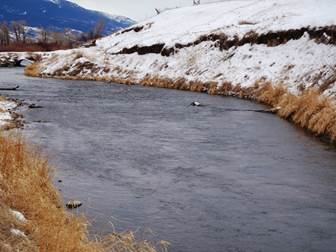
Below “Haystack”. “Diagonal Riffle” and “Log Hole”.
Uniqueness of DePuy’s: Character of this stretch is unique to DePuy’s. It consists of mostly riffles over weed-beds (with a couple of several-foot deep holes). Indeed this character occupies almost half of entire creek. Armstrong’s and Nelson’s don’t have this feature. However, this section is the least fished and least popular by visiting anglers and even by local anglers and guides.
| EOTG Winter at DePuy’s One of the deepest holes of the entire creek. Only beavers would ever see the reclusive giant trout in the bottom….. | EOTG Winter at DePuy’s “Middle Riffle” marks just about the middle of entire creek. |
Misunderstood Section: When I was just a regular customer paying the daily rod-fee, I ended up fishing here with fruitless results. I had informed by local fly-shops and they had directed me either “Upper” (Fly Shop and Fisherman’s Hut) or “Lower” (Eva’s Hut). Some shop staffs and even guides told me “The middle section is not productive!” But by the time I drove to either one the parking lot was occupied with several cars. That was why I had to fish the middle section. This section was so confusing to me at that time. At least I noticed this is not flat water as the upper, lower, or House Pond reach. I also noticed some cutbank-features with overhanging grasses. “Should I try streamers?” was what I thought. But even before I was ready, some big trout got spooked away from the cutbanks. I waded into middle of creek anyway to position myself to cast toward banks. Then many more trout got spooked away from weed-beds. Of course I did try nymphing. However regular methods and techniques that I knew at that time didn’t work but caught only weed-beds. So even after I became a guide, I had labeled here as “Unproductive! Skip!”…….
| EOTG Winter at DePuy’s A long run………seemingly featureless……..?? | EOTG Winter at DePuy’s How do you read here and cut into pieces? |
Enlightened: Along the way, I met Tom Travis who became my guide and mentor. I also met another highly acclaimed outfitter in Livingston, Brant Oswald. Both of them told me “that’s WRONG!! There are lots of big trout in middle section!” They even looked somewhat infuriated about the mislead information circulating in the area. Then came my Winter Pass with which I could conduct experiments and observation as many days as I wanted. I spent countless days at middle section. The more I fished (experimented and observed), the more I realized how misinformed I had been (Tom and Brant were correct). Now I’d love to guide and fish the middle section any time of the year.
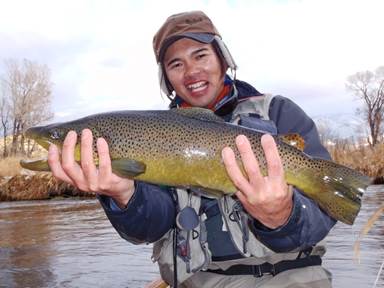
Best fish of 2012 came from the middle of Middle Section!
I have to quote what I have written in an early chapter (PART 2). Due to length, one cannot cover the entire creek in a single day. Also due to the daily rod-fee, not many anglers can afford to visit so many days. Then who would want to spend days for experiments and observation after paying rod-fees? So they tend to fish “Upper” and “Lower.” I outgrew that level as a guide and an angler. I am going to unfold the methods and techniques and demystify the middle section.
Satoshi Yamamoto, https://leftyangler.blogspot.com, brought his passion for fly-fishing and fly-tying from Japan to Montana and became the first ever Japanese guide in Livingston, MT. He guides and fishes big rivers like Madison & Yellowstone, spring creeks in Paradise Valley, and various waters in Yellowstone Park. Hence, with his Regal Vise at the bench, his fly tying interests vary from tiny midges to 5 inch streamers and anything in between. Once his ideas are combined he goes out for experiments at those near-by waters. Satoshi submits his innovative patterns to Montana Fly Company (www.montanafly.com).
His own innovative original patterns can be purchased from his fly-shop, https://leftytyer.blogspot.com.
| Sysadmin Note |
|---|
| Part 10 can be found here |
Originally published May 21, 2013 on Fly Anglers Online by Satoshi Yamamoto.