| Sysadmin Note |
|---|
| Part 2 can be found here |
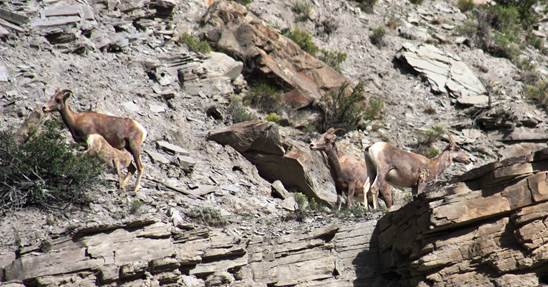
In late August through early September this is the time period that I want to on the Lamar River as often as I can and the reason is simple as this is the time period when the massive flights of ants appear on the water. Before I delve into any of the fishing days that I have enjoyed on the Lamar River I wish to discuss the importance of ants to both the angler and the trout. One should never forget that the wonder and beauty of the park, this morning as we came into the park heading for the Larmar we found the Big Horn Sheep out and about along the Gardiner River, and we stopped for photographs and then resumed are journey.
Many of the terrestrial food forms are only available during limited or specific time periods. Ants, however, are available to the trout from April to October. There are several colors and sizes of ants, from large carpenter ants to tiny, reddish brown flying ants. Many anglers refuse to fish ants because they can’t see them. If this is your problem, simply fish the ant as a dropper behind a pattern that you can see.
Many anglers ask, “When should ants be used?” We, as a people, seem to like things in very neat and ordered categories, and because of this we often fail to realize the natural happenings on streams; thus we lose some very good and interesting fishing opportunities. This happens when we become too rigid in our thinking and fail to observe. Trout often feed opportunistically on terrestrial food forms, and during the warm months of the year most streams have a constant Terrestrial Drift going on. Not only will this drift activity bring surface rises, it will also induce subsurface activity. Ants, being very active and extremely numerous, often end up in the water as part of the terrestrial drift. Therefore, employing the use of ant imitations, both wet and dry, during the warm weather time periods of April to October is an excellent choice.
Anytime there are super heavy numbers of ants on the water, the trout can, and will, become selective to the ants. This is just like fishing any other hatch. Work the feeding trout using good presentation methods and good imitative patterns.
Often the observant angler will find a trout or two stationed in a feeding zone where they are seeing a lot of ants, even when other trout may be seeing none or only a few. These trout can be quite fussy, and may only take a properly presented ant imitation. During the slack times of the day I like to use a two fly system, fishing both a dry ant and a wet ant.
Many anglers fail to consider wet ant imitations. Well, remember wet ant patterns were effective for hundreds of years before the coming of the dry fly. Many think only of the dry ant and think that ants float forever and never end up under the water. Nothing could be further from the truth. They do end up subsurface, just like everything else that fall into the water. Therefore, it stands to reason that if the trout will rise to the surface to feed on the floating ant, it will also feed on the drowned, subsurface ant. That is why I use the wet/dry two fly system.
ANTS
Class: Insecta
Order: Hymenoptera
Suborder: Apocrita
Super Family: Vespoidea
Family: Formicidae
Ants are cousins to the related families of bees and wasps and together they form the Order Hymenoptera, which is a very diverse group of insects with more than 12,000 individual species. The Family: Formicidae has some 22 Sub Families.
There are also some insects which appear to be ants, but are not. Termites are often referred to as White Ants. Velvet Ants, although resembling large ants, really are a wingless wasp, though I doubt that the trout care!
Studies have shown that ants can make up 15% to 23% of the terrestrial insect biomass. Ants are found along every trout stream in America. As a side note, ants are found nearly worldwide with just a few exceptions. You don’t have to worry about ant imitations if you are fishing those frozen trout streams of Antarctica, Greenland or Iceland or parts of Polynesia and other remote islands.
As a general point of information, many anglers feel that terrestrials are only important on breezy days. Nothing could be further from the truth. Terrestrials are always falling off the bank and into the water for a number of reasons. I like to think that in most cases it was just bad judgment on the part of the terrestrial in question.
Yes, the wind can blow them in, but that is not the only way they find themselves in the water and a part of the daily diet of the trout. Ants fall into two major categories, carnivorous and scavengers. Thus they are always out and about looking for a meal, often times along the banks of a stream, where all it takes is misstep and they are on the trout’s dinner list.
Notes on Flying Ants
On certain trout streams, every year, around the same time period the anglers and the trout enjoy a three to six day period where flying ants litter the water. Normally this occurs during the late summer or early fall.
Ants are a very social insect with a complex order. As the time for mating occurs, the males and female of the colony begin mating flights. Normally the females are larger than the males. However, the males outnumber the females by a considerable margin. On a side note - once the mating is complete, the females (queens) drop to the ground, lose their wings and try to begin a colony.
If there is water around the swarming insects they seem to be attracted to it, like moth to a light. I am sure that there is some reasonable scientific reason for this, but I have yet to discover it and the reason is not relative to trout fishing. When the ants litter the water it is like fishing another hatch or flight the angler might encounter. Use good imitations, careful approach and proper presentation methods and you will be successful.
One final word of advice when choosing an ant imitation as a searching pattern - use larger imitations, from size 10 to 16. The smaller sized imitations always work the best during specific angling situations but the larger imitation are better as a searching pattern and they sure are easier to see on the water.
Now, back to fishing on the Lamar River. Today I am not guiding but here fishing with my long time fishing partner Paul Gates. We arrive on the river about 9 A.M. and drove to the about 1½ miles downstream from the junction of the Lamar River and Soda Butte Creek which is where the picnic area use to be. At this point the river makes a bend and runs right toward the road and then makes another bend and runs right along the road.
Admittedly it is an obvious place to fish and sees a lot of anglers however over the years I have seldom had to wait very long to fish this section of the river and most of the anglers go through this water like starving man on the way to free lunch. As we pulled into the parking area Paul noted that there was an angler in the area that I wanted to fish but by the time we had gear up and walked down to the river he was gone.
There is a nice riffle that empties into pool and on this morning I sat along the bank and watched the water, I noticed that the trout were begin to feed and I knew that they were feeding on tanish brown fly ants about a size 16 as several had landed on me. As there were several nice trout feeding in the riffle and at the base of the riffle I choose as size 14 tan foam ant. I figured with the faster water they would not be keyed into size and this proved to be the case as over the next two and half hours I just had a great time. Paul had gone downstream and worked back toward my position and reported the same action on the same pattern. We decided that now would be a good time to take a lunch break.
After lunch Paul headed upstream as I returned to the riffle and pool. At present time there were no insects on the water so choose a Mini Chernobyl Black Ant size 12 and trailed a size 14 Hot Pink Foam Ant on a dropper 20". In this case I was prospecting as there were no visible trout feeding, the first Cutthroat rose at the base of the riffle and I noticed that the Hot Pink Ant was the fly taken. During the afternoon I took several more Cutthroat Trout on that same Hot Pink Foam Ant, Paul finally returned and found me in the same pool that I had started day fishing. We then headed for the truck to move up to Soda Butte Creek for the rest of the day, I showed him the pictures of the Cutthroat with the Hot Pink Ant and gave him a couple to try on another day.
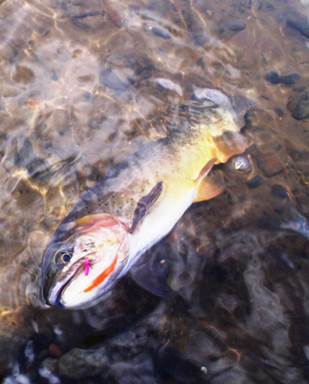
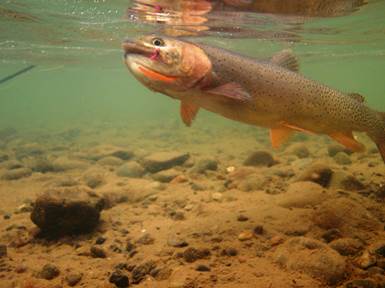
WB Pink Ant
- Hook: Dai-Riki#125 or TMC 101 Sizes: 12-18
- Thread: 12/0 Black
- Body: Pink Dry Cell Foam
- Hackle: Black, dry fly, trimmed on the bottom
Note: The WB stands for Wild Bunch a name that seems to fit, as I show these flies to angler I get a lot of “You have got to be kidding, trout will really eat that wild pink thing!” yep they sure do and soon many of them have become believers in the Wild Bunch Hot Pink Ant and some of the other wild colors that I use. They are sure easier to see on the water so give them a try and try some wild colors of your own.
Enjoy & Good Fishin
| Sysadmin Note |
|---|
| Part 4 can be found here |
Originally published April 22, 2013 on Fly Anglers Online by Tom Travis.
Part 4
| Sysadmin Note |
|---|
| Part 3 can be found here |
As you enter the north entrance of Yellowstone National Park which is located on the outskirts of Gardiner Montana you don’t drive very far and the first river that you encounter is the Gardner. To many of the visitors the Gardner appears to be that typical brawling western freestone stream as it rush and tumbles on its way to join the Yellowstone River. The Gardner runs close to the road for several miles however many anglers take one look at the rocky bottom and the turbulent water and keep heading further into the park to some of the more famous streams that are easier to wade.
The famed Lewis and Clark expedition 1804 to 1806 never explored the Yellowstone Park area they traveled north of the Park neither did John Colter who was with the expedition and returned to the area in 1809, though there may have been others the town of Gardiner Montana and the Gardner River was name for Johnson Gardner who was a free trapper who worked the area between 1830 and 1831. Later during the 1870 Washburn, Langford and Doane Expedition which was the first expedition to map and explore the park area. During the expedition a phonetic mistake occurred and that is why the river is call Gardner and the town is called Gardiner both with different spelling.
The park was formally established March 1st 1872 by President Ulysses S. Grant and the town of Gardiner officially began on February 8th 1880 with the establishment of the territorial post office and thus concludes the little history lesson and now we will return to the important information on the river.
The Gardner River begins high on the slopes of Joseph Peak in the northwestern section of the Park and is around twenty five miles in length as the Gardner tumbles down is join by Straight Creek, Fawn Creek, Winter Creek, Panther Creek, Indian Creek and Obsidian Creek.
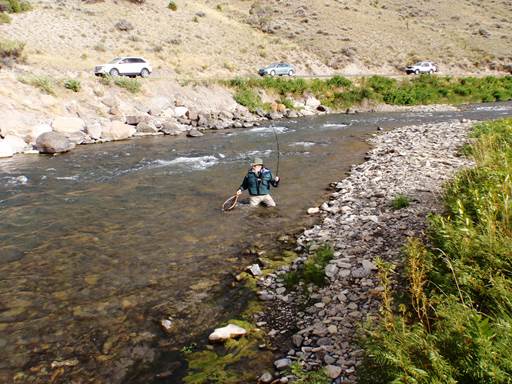
Then we come to Sheepeaters Cliff and Osprey Falls which is one hundred feet in height and after tumbling down over Osprey Falls the river turns north and is joined by Glen Greek and Lava Creek. It continues to flow north and for a while it is just off the main entrance road, it enters the Yellowstone River just to the south of the town of Gardiner Montana, the entire length of the river is contained within the boundaries of Yellowstone National Park.
From a trout fishing standpoint the Gardner River is broken down into two sections, above Osprey Falls the river and the tributary streams contain Brook Trout and to the causal angler they all appear to be six to ten inches in length however there are larger Brook Trout in these waters for those who are patient and willing to explore.
The section of river below Osprey Falls contains Rainbows, Browns, Cutthroats and Whitefish and the park rates the size range between eight to fourteen inches. During September and October Brown Trout from the Yellowstone River run up the Gardner to spawn and during this time period Brown Trout from Twenty to Twenty Four inches have been taken.
During the early summer of late June to early July the Salmon Flies Pteronarcys californica hatch along the river and during this time period it seem that larger trout seem to appear in the river to feed on this large food source during the hatch you can also take trout up to twenty two inches or so, it is claimed that these trout move up from the Yellowstone River to feed.
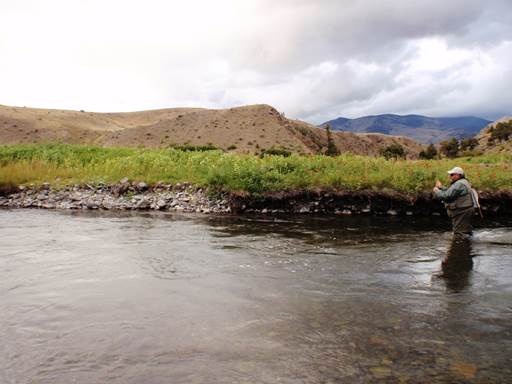
However I believe that some trout may move up from the river that many more of the larger trout live in the Gardner River on a year round basis. I actually target the Gardner Rivers a few days each season for my own personal fishing. Seldom do clients ask to go there and then the Gardner is always the last resort, which is sad as the Gardner has riffles, pools and runs just like the grownup rivers and offers all the challenges of any other stream.
For most anglers who have done a little research the Gardner River is not high on the list of rivers to fish streams like Slough Creek, Lamar River and Soda Butte Creek are much more enticing as these streams hold larger trout on average.
However, there are times when the weather can drive you from some of the other streams and as you head to the entrance you find that the weather on the Gardner is far different that the weather you encountered on the streams in the northeast corner of the park and you did come to fish so you give the Gardner River a try. Some are successful, many are not because they are not familiar with the stream and they have heard that the Gardner River has smaller trout therefore they figure that the smaller trout are easy to fool and fail to show the proper respect for this fishery and thus are often frustrated and fishless.
I know this is true as I have watched this happen many times over the years, the size of the trout has nothing to do with the ease of catching the trout. One afternoon is late September we had be blown off of the Lamar we stopped and checked out Slough Creek but it blowing there as well, when I say we were blown off the wind were thirty miles per hour and I know that superman can cast in winds like that but none of my clients nor myself is gifted enough to fish under those conditions.
By the time we reached the Gardner River we found ourselves in a different weather system and decided to stop and fish, we had been blown off before the Baetis hatch and I knew of a decent pool where I the Baetis fishing was normally pretty good, we park and geared up and head to the pool and found that no one else was there fishing and we barley arrived before the trout began to feed. I checked the water and sure enough the Baetis were beginning to emerge, I told them that the same patterns that we had planned to use on the Lamar would work here on the Gardner and we had discussed the patterns and techniques as we had driven back towards the Gardner.
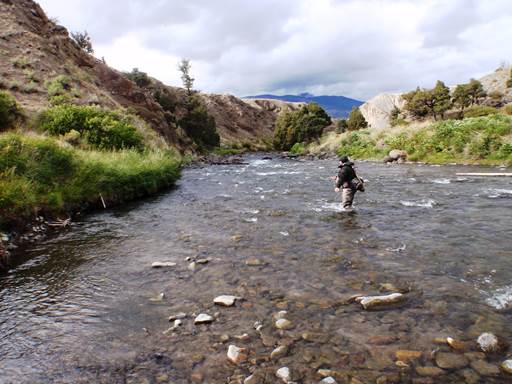
One angler moved to the head of the pool were the riffle entered and began to fish, soon he was into a nice rainbow trout using a size 18 Hot Top Baetis Paradun with size 18 Olive Sawyer PT Nymph dropped sixteen inches behind the dun.
The other angler had move down to the bottom of the pool and began to fish the tailout I continue to watch the angler at the head of the pool and soon he had another Rainbow and both were taken on the nymph which was normal for that time period of the hatch.
I kept looking back down to the other angler and I still hadn’t seen him hook a trout so I head downstream to see what the problem was. The first thing that I notice was the dry fly was larger and different from what I suggested, he tangled the cast and reached to untangle it and noticed the nymph was larger and on a longer dropper than I had recommended, when I asked about the different flies, he replied that “I saving my Baetis patterns for real trout and how tough could these small trout be!”
Well, I just looked at him and said I guess you will find out and twenty minutes later he still had not hook a trout and there were several actively feeding within easy casting range.
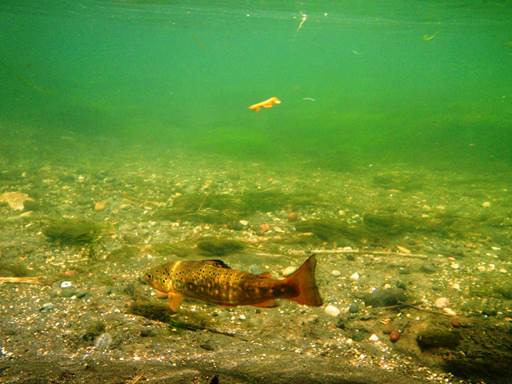
Finally I suggested that we use the patterns that I had suggested earlier and soon he had a nice eleven inch brown trout in the net. I carefully use a stomach pump and show him that the trout use full of the small Baetis Nymphs and Dun and that is why the flies worked. I also explained that size of the trout has nothing to do with selective feeding especially during a hatch, as they are feeding on what they are seeing and the size of the trout has very little to do with how easy they are to catch.
Now in faster heavier water you might be able to get away with a larger pattern, but would find that matching the hatch will still get you more trout. This is an important lesson to remember.
The Gardner River is a fun fishery that offers fine fishing and many challenges that the angler must adapt to and overcome. So the next you need a place to fish after the weather has pushed you off your regular water or maybe you only have a short day to fish then give the lower Gardner River a try.
Enjoy & Good Fishin’
| Sysadmin Note |
|---|
| Part 5 can be found here |
Originally published May 06, 2013 on Fly Anglers Online by Tom Travis.
Part 5
| Sysadmin Note |
|---|
| Part 4 can be found here |
The Firehole River is one of the most storied of the rivers contained within the boundaries of Yellowstone National Park. Many notable angling authors have shared their stories of time spent on the Firehole, Ray Bergman, Charlie Brooks, Ernest Schwiebert and Rene Harrop are but a few of those who have regaled us with the mysteries of this hauntingly beautiful river.
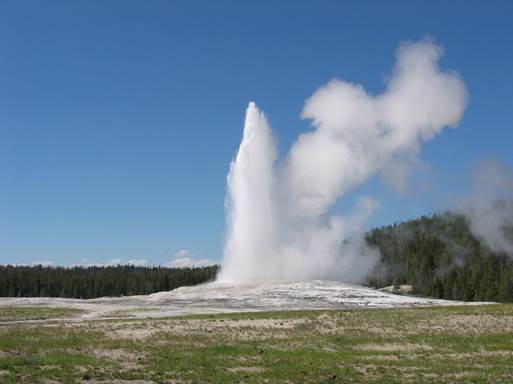
The early trappers named the river for the steam that makes it appear that the river is smoking as if it were on fire and thus the river was called the Firehole. Madison Lake lies at 8,200 feet on the north facing slopes of the continental divide and is the source for the Firehole River. As the river travels on its journey to join the Gibbon River and forms the Madison River it run through some pretty spectacular country which includes Old Faithful Geyser Basin and the single most famous geyser found in Yellowstone Park. It also travels through Kepler Cascades, the Upper Geyser Basin, Midway Geyser Basin, and found along its banks are Morning Glory Pool, Excelsior Springs and Ojo Caliente Springs and the Falls of the Firehole. So even if you encounter a day when the trout are being less that agreeable you will still be fishing in some of the most beautiful country in the world.
During the course of its journey from Madison Lake to Junction Pool where it joins the Gibbon the Firehole has several tributaries that enter and add to the flows; they are Sentinel Creek, Fairy Creek, Iron Spring Creek, the Little Firehole River and Nez Perce Creek. In the early years of discovery the Firehole River was devoid of fish above the falls just above Junction Pool.
Brook Trout were introduced above the falls in 1889, they soon move to the water above Old Faithful Geyser and all the way up to Madison Lake. In 1890 the Brown Trout were introduced and soon begin to thrive in the waters of the river.
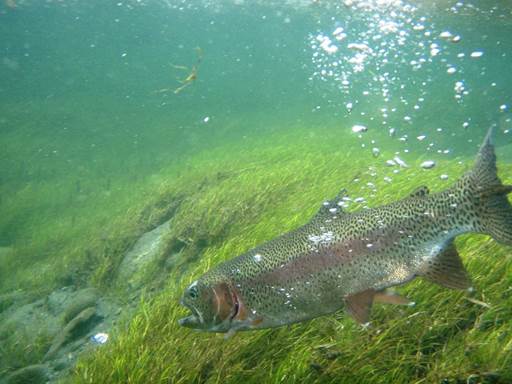
The Rainbow Trout were introduced in 1923.As was common at the time, the U.S. Fish and Wildlife Service continued to stock the water of the park until 1955 when all stocking ceased. While the trout that the anglers catch today are totally wild many studies have been conducted to figure out how these trout survive in water temperatures of the Firehole River which is considerably warmer at certain times of the year than trout are suppose to be able to tolerate.
On August 17th 1959 at 11:37 P.M. an earthquake measuring 7.6 on the Richter scale struck the Hebgen Lake and the Madison River creating Quake Lake. Aftershocks of 5.8 to 6.3 continued to rock the area including the geothermal areas of Yellowstone Park. The geysers, hot springs and mud pots along the Firehole River went wacky and it was six months to a year before the Firehole settled back into a normal routine. During this time period the water temperature in the river rose and the water turned color as the unusual activity caused by the earthquake pumped a whole lot of different chemicals into the river. These changes in turn resulted in some fish kills. However the river and the trout have both rebounded from this natural event and today it holds good populations of Brown and Rainbows.
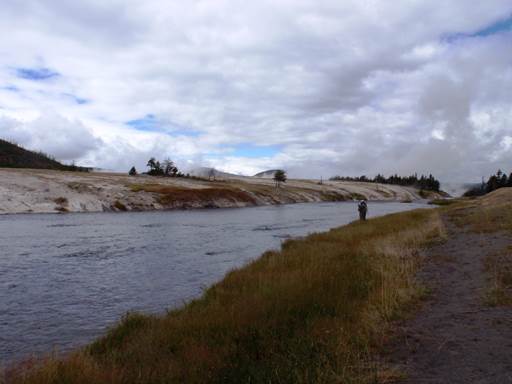
I began to fish the Firehole River in 1976 and over the years I have enjoyed many adventures on the river and I have learned that the river that smokes is one of the most challenging rivers that the angler will ever fish and at the same time it is one of the most exciting river that the angler will ever fish. Being new to the area, I was soon to meet such notable anglers like Bob Jacklin, Bud Lilley, Charlie Brooks, Craig Mathews, and Sylvester Nemes all of whom would have an impact on my career and broaden my knowledge base.
The Firehole from Old Faithful Geyser downstream is a rich river, as far as hatches and aquatic food forms are concerned, therefore the angler can encounter both standard hatches as well as complex hatches. The river has thick and heavy weedbeds, riffles; deep smooth flowing runs and flats. Basically it appears to be a very rich spring creek and is often classed as such.
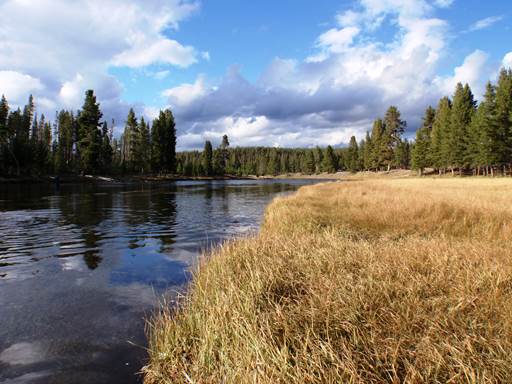
The section from the upper geyser basin to past the Nez Pearce Picnic area is the most heavily fished area of the river, the section above Old Faithful to the source is a typical high plateau woodland stream with brook trout and pan sized brown trout to be fished for. The differences between the upper river and the section that runs through the geyser basin are startling as are the difference between the water below the falls and that of the middle section of the river; it is like having three difference rivers to choose from. Most choose the middle section, however both the upper and lower sections of the river have anglers who wish to challenges these waters and learn the secrets of the water.
Because of the constraints of time I primarily fished the Firehole on the traditional Memorial Day Opener and the month that follows and again during the fall of the year starting around September 15th to the end of the season, which now is the first Sunday in November but in the old days it was October 31st. I am often asked, “Is the Firehole River a big fish fishery?” The answer is NO, however the river does hold some large trout. Many of the trout will run 8 to 12 inches with 12 to 15 inches not uncommon. Larger trout of 15 inches plus are fewer in numbers, yet the Firehole still holds some true trophies of 3½ to 5½ pounds that on occasion fall prey to the angler’s fly. I will tell you that my favorite time on the Firehole is in the fall. There is something about the beauty of the river, the plumes of geyser steam and the crispness of the air on a fall day that restores my soul and brings me peace. The Firehole River should be on every angler’s “Bucket List”.
Enjoy & Good Fishin’
HIGHLIGHTS OF THE HATCHES FOUND ON THE FIREHOLE RIVER
IN YELLOWSTONE NATIONAL PARK
Due to the effects of the thermal features on the water temperature, I choose only to fish the Firehole from opening day (approximately May 28) to July 1 and then again in the fall from September 15 to closing (the first Sunday in November.) Therefore, the information contained on this hatch chart deals with these time periods. The emergence dates may vary from year to year due to weather conditions. Also the hatch chart is centered on the middle section of the river.
| MAYFLIES | SIZE | AVAILABILITY DATES | |
|---|---|---|---|
| Western Blue Quill | Rhitrogena | 14-16 | June 1-June 30 |
| Pale Morning Duns | Ephemerella inermis | 14-20 | May 31-July 1 |
| Blue Winged Olives | Baetis parvus | 16-20 | May 28-June 15 |
| Small Western Green Drakes | E. flavinea | 12-16 | June 1-June 30 |
| Fall Blue Winged Olives | Baetis tricaudatus | 18-20 | Sept. 15-Oct. 31 |
| Tiny Western Olives | P. edmundis | 18-24 | Sept. 15-Oct. 31 |
| CADDIS | |||
| Little Tan Caddis | Glossosoma | 14-20 | May 28-June 30 |
| Grannom | B. occidentalis | 12-16 | June 5-July 1 |
| Brown Caddis | Brachycentrus | 14-16 | May 288-June 20 |
| Little Spotted Sedge | Hydropsyche | 16-20 | Sept. 15-Oct. 15 |
| Little Dark Micro Caddis | 18-22 | Sept. 20-Oct. 20 | |
| STONEFLIES | |||
| Little Olive Stone | Alloperla | 14-18 | June 10-July 1 |
| Little Yellow Stone | Isoperla | 14-18 | June 5-July 1 |
| TERRESTRIALS | |||
| Black Ants | 14-22 | June 10-July 1 | |
| Black Beetles | 12-20 | June 5-July 1 | |
| Flying Black Ants | 16-22 | Sept. 15-Oct. 10 | |
| MIDGES | |||
| Spring Midges | 16-20 | May 28-June 15 | |
| Fall Midges | 18-26 | Sept. 15-Oct. 31 | |
| NYMPHS/AQUATICS | |||
| Pale Olive Damsel Nymph | 12-14 | May 28-July 1 | |
| Brown Damsel Nymph | 12-14 | May 28-July 1 | |
| Dk. Brown/Olive Dragon Nymph. | 6-10 | May 28-July 1 | |
| Grey Crane Fly Larva | 6-10 | May 28-July 1 | |
| Olive/Brown Leeches | 8-12 | All Season | |
| Black Leeches | 8-12 | All Season | |
| Assorted Minnows | 6-12 | All Season |
| Sysadmin Note |
|---|
| Part 6 can be found here |
Originally published May 20, 2013 on Fly Anglers Online by Tom Travis.
Part 6
| Sysadmin Note |
|---|
| Part 5 can be found here |
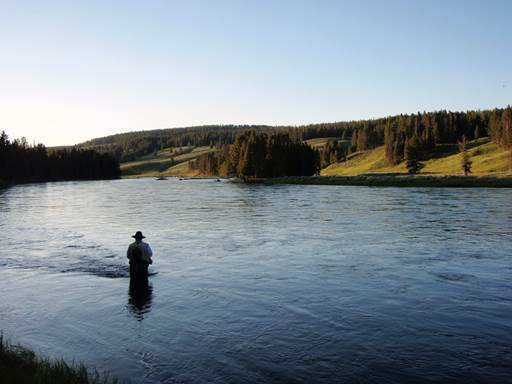
The most majestic river in Yellowstone National Park is the Yellowstone River and it is by far the complex and challenging river in the Park and because of its length and diversity of habitat it is one of most interesting rivers that the angler will ever encounter. Each major section of the river differs somewhat from the other sections; therefore I will break it down into five sections. First, we will discuss the section of the river from the outlet of the lake to falls of the Grand Canyon of the Yellowstone. Besides discussing the section that I have chosen for this column I will regal you with some historical information on how the river obtained its famous name. I will be giving you a brief overview of the fishery that we can find in this section of the river.
The Yellowstone River has had many names. The Crow Indians referred to it as the Elk River, the Mandan’s called it Stone Creek, the early French trappers referred to it as Roche Jaune or Yellow Rock River; however the name Yellowstone was commonly known and accepted as early as 1780. The Lewis & Clark Expedition recorded the name as the Yellow Stone River, the river was explored by William Clark in 1806 and the Clark’s Fork of the Yellowstone bears his name. However Captain Clark never traveled into Paradise Valley or near what was to become the first National Park. That expedition had to wait until 1870.
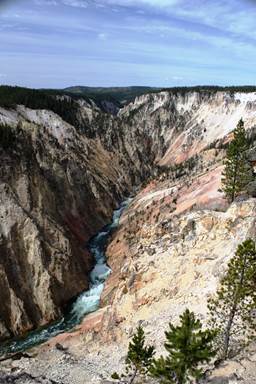
The section of water between the outlet of the lake and falls of the Grand Canyon of the Yellowstone is much like the Firehole River with geysers and hot springs entering the river in various places. This added richness makes this section a strange mix of spring creek like and freestone water and the richness of the hatches is legendary.
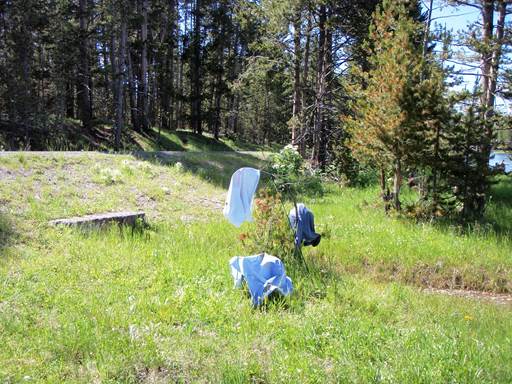
But make no mistake, the Yellowstone is this section is big water and the currents are swift and all it takes is a careless moment or a misstep and you can be swimming with the fish so wade carefully!
The fishing season for this section of the river doesn’t begin until July 15th due to the cutthroat trout spawning season and it closes on the first Sunday in November as does all the fishing in the Park.
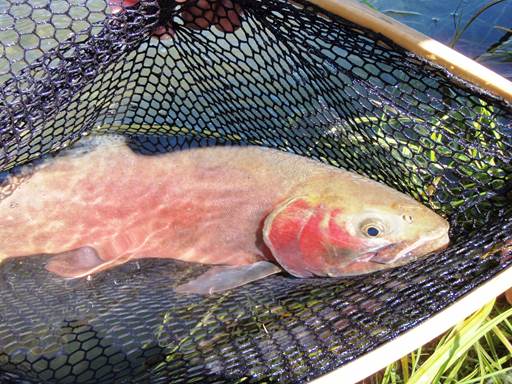
The fish that are found in the waters of this section are few in numbers the main attraction is the Yellowstone Cutthroat Trout, Oncoryhynuchus clarki bouvieri, also referred to as Salmo clarki bouvieri, and is the only trout found in these waters. The cutthroat trout are now considered to be the native fish of the Yellowstone River, however in geological time the cutthroat is a new comer as these trout we originally only found west of the continental divide. Sometime around six to seven thousand year ago they made their way into the east side of the divide and found a ready home in the waters of the Yellowstone River and its sister streams. When Captain Lewis traveled the bank of the Yellowstone the cutthroat trout was the only trout in the water.
Cutthroat trout live up to eleven years and are late spring and early summer spawners, forming pairs and digging redds in smooth even gravel as do other trout. They begin their spawning run normally after the river has peaked from the annual runoff and begins to drop. Though cutthroat trout are known as tributary spawners and in the case of the Upper Yellowstone it is a giant spawning tributary for Yellowstone Lake. Besides the thousands of trout that drop down from the lake to spawn there also is a resident population cutthroat trout in the river that never travels to and from the lake.
Over the year’s cutthroat have been praised and condemned depending on when the anglers visited the river. The anglers who arrived at the time that the cutthroat trout are coming off the spawning beds will crow over the number of stupid cut’s they were able to catch. Then in the next breath demean the fighting ability of the cutthroat claiming that they offered no fight and just came right in to the net.
However if you think about it you will understand, the trout are coming off the spawning beds and during the spawning process they use up a lot of energy and stored body weight, once the spawning is over they begin to feed to regain their strength and begin the process of growing for the season. Of course they will be easy to catch and often times they can be less than fussy over what they eat! Now for those anglers who arrive to fish the river after August 10th find that these same trout which would eat anything a month ago now can be very fussy and in fact can be somewhat frustrating, this selective behavior continues on into September and October.
Once the spawning process is completed and the trout begin to regain their strength they also begin move back to the lake in slow easy stages, and during September and October you have to know where to look for the fish. It becomes much like fishing in New Zealand where you are searching for the trout and once you find them you must stalk them and present the proper imitations in the proper manner.
This is a river where the power of observation is one of the most important skills that the angler can have, and those who are in a rush often find the Yellowstone not to their liking.
Now let briefly talk about the lake trout, in 1994 the lake trout were officially recognized by the Park officials as being in Yellowstone Lake. That set off a huge outcry and lots of finger pointing about how they got there and how they were going to destroy all of the cutthroat trout in Yellowstone Lake.
I could write several pages on what I think of the views of the Park Service and the money that is being spent to remove the lake trout from Yellowstone Lake, however I will limit my comments to a couple of questions that I am most often asked. Are the lake trout the villains that they are made out to be and are they the prime reason for the decline of the cutthroat populations in Yellowstone Lake and the Upper Yellowstone River?
I believe that the lake trout were place in Yellowstone Lake back in to the 1920’s when other lakes in the Park were stocked with the lake trout which means that they have been there for a long time. They will eat young cutthroats but they will also eat the long-nosed suckers, long-nose dace, the redside shiner and the lake chub and their own unwary young.
Lake trout do have an impact on the cutthroat, but they are not responsible for the population crash that happened a few years ago. In cases like this there is seldom a simple answer. I believe that the advent of whirling disease in some of the tributary streams to the lake has had a much greater impact than the lake trout. Also there is the fact of the increasing population of pelicans on Yellowstone Lake, and furthermore there are many species of wildlife that feed on the cutthroat trout, yet we as a people are always looking for the simple answer that points the finger at a villain.
There is one fact of nature that never changes and that fact is that nothing and I mean nothing in nature ever remains the same. Nature is always in a constant state of change, some of the changes take a long time to become apparent, others are quicker, even though they are some in the scientific community who will not accept any change that they can’t document, yet most of their studies are done in the lab and seldom do they spend long hours on the water studying the trout in their natural habitat. I could list many examples of this behavior, however I am sure you would find this discourse boring and off the subject of the fly fishing.
There are a few other species of fish found in the Upper Yellowstone and though most anglers would not find them exciting they are of important to the cutthroat trout as forage fish.
The first of these is the long-nosed sucker [Catostomus catostomus]. This species is a late spring or early summer spawner and can reach 5 pounds in weight, and the newly hatched fry and young suckers are prey upon by the cutthroat trout. Next is the long-nose dace [Rhinichthys cataractae]. These minnows can reach six inches in length and they spawn in shallow riffles during the early summer or when the water temperatures reach 53 degrees. Finally there is the redside shiner [Richardsonius balteatus]. This minnow also spawns in the early summer and tends to be a school fish and they are normally only found from the big bend water and upstream towards Fishing Bridge. Again the cutthroat trout will feed on the fry and on the minnows that can attain a length of seven inches. There are no sculpins in the river above the falls at the head of the canyon.
In every disaster there can be a bright spot and one of the bonus’s of the cutthroat population crash is that the Upper Yellowstone River is now seldom crowded. During the past, before the population crash, certain areas of the upper river could be somewhat crowded. What was then called Buffalo Ford, and now renamed as Nez Perce Crossing, could be alive with anglers. But once the news got out that the population had crashed anglers turned to other waters.
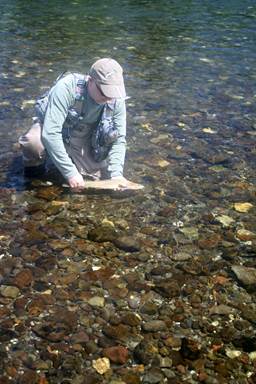
This is fine with me as I continued to fish the fabled waters of the Upper Yellowstone and soon noticed that the number of fish were down the size of the cutthroat trout were increasing. Today it is not unheard of to catch a 22 to 25 inch cutthroat trout, and that my friends is a great trophy by any standard.
So the next time you visit the Park set some time aside to explore the water of the upper river, consult the hatch chart and be observant and you should be well rewarded for your efforts.
Enjoy & Good Fishin
| Sysadmin Note |
|---|
| Part 7 can be found here |
Originally published May 21, 2013 on Fly Anglers Online by Tom Travis.