…
…
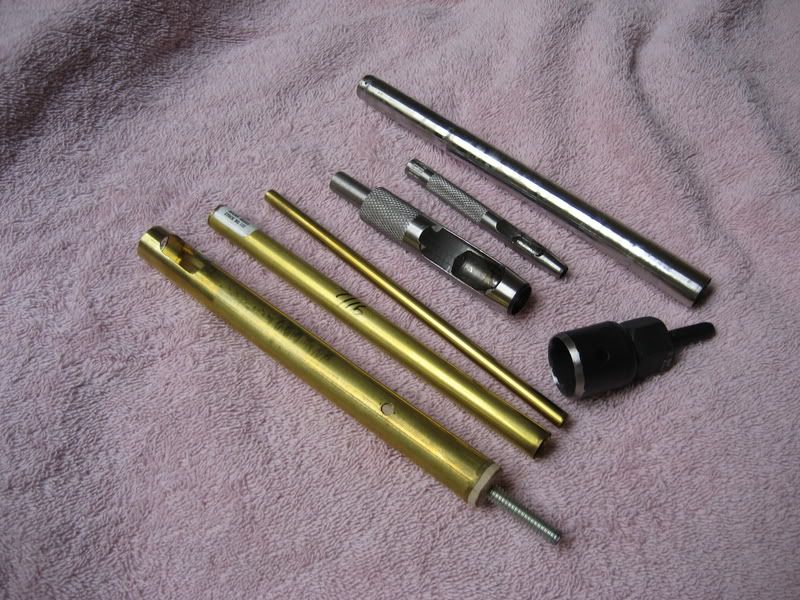
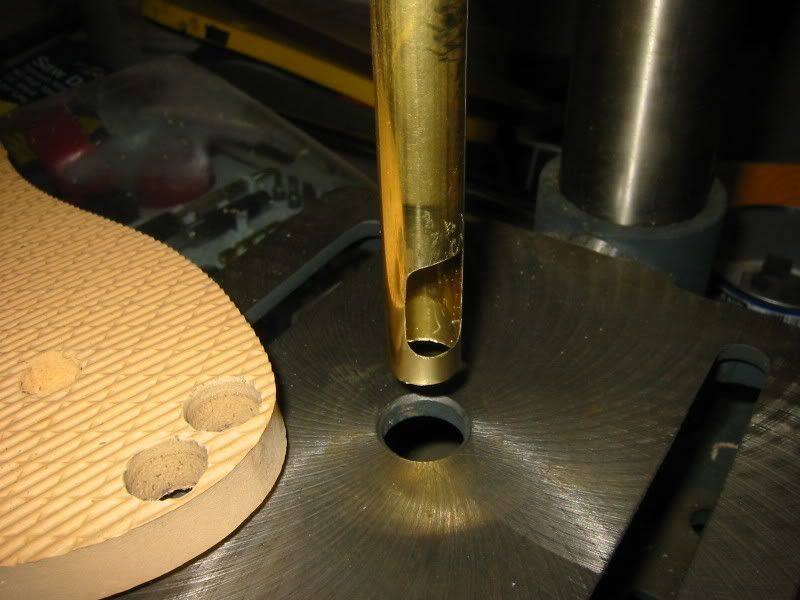
If you will take a piece of wood dowel that fits inside this cutter; cut one end off at about a 60 degree angle, and mount it into the lower end of the tube with the ‘heel’ of the cut flush with the top of the window, which results in the ‘toe’ of the cut being down the inside of the tube and along it’s backside opposite the’ window’, the plugs will ‘automatically’ eject from the tube through the ‘window’. The ‘toe’ of the dowel should be at least 1/8" up from the bottom edge of the cutter; 1/4" won’t hurt. You can epoxy the dowel into the tube, but this creates problems when the tub is sharpened back to the toe of the dowel. I prefer drilling a small hole through the tube walls and the dowel and pinning it in place. This makes relocation relatively simple when you need to re-do the cutting edge of the tube. I use a soft piece of wood, such as white pine, as a cutting backer. This gives a clean edge to the bottom of the plug and minimizes the need for resharpening. A hard grained wood will necessitate very frequent re-sharpening.
aged sage
I have a set of foam punches that were custom-made for me by a good friend and fellow fly fishers. He is a excellent craftsman and made me several in different sizes, along with a wooden base to keep them in and a removal tool and a sharpening stone to keep them ready. They all chuck into a 3/8" drill.

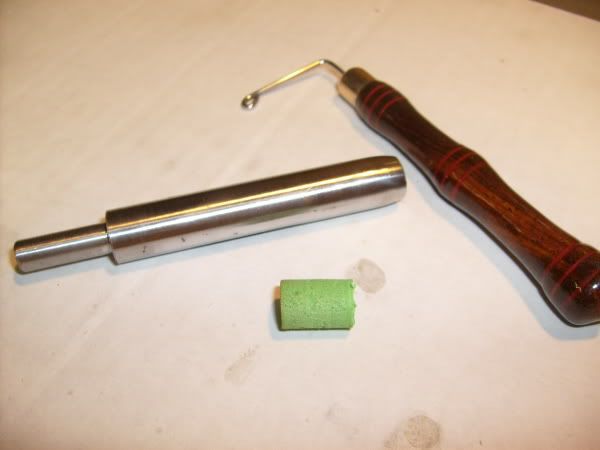
Wiggle Minnow bodies made from drilling my own foam from flip-flop soles:

aged sage…I have a metal set from Harbor Freight…the third one from the drop in the picture that does that. The set only goes to 1/2" so maybe I’ll try that one the larger tubes.
However ,having said that I haven’t been real happy with the flipping out method since they fly all over my garage…tried making a crude hood out of cardboard box but wasn’t very satisfactory.
I believe it was Jim Hatch who said he had the same issue…have you ?
ducksterman:
I have not had that problem; but then I slow my drill press down to it’s slowest speed for this purpose. I can definitely see where this could be a problem, particularly at the higher speeds of your drill/drill press. For a hood to work, it would have to completely encircle the cutter and still allow for one’s hands to be inside of it, as well as the stock material.
If you can’t slow your drill/drill press down sufficiently by the normal method, one can employ a simple rheostat in the power supply. Yes!, I am fully aware of the fact that using a rheostat with an AC motor that does not have brushes in it can ruin the motor. But this occurs typically to motors that are routinely and regularly run with a rheostat involved. They get hot and ultimately burn up. Operating it for brief periods on a periodic basis should not harm it. You just need to be sure that the motor doesn’t get hot! You can make a simple rheostat using a light dimmer switch, a rectangular metal switch box, a short piece of electrical wire and a male plug and female receptacle.
Hope this answers your question and helps with the problem.
aged sager
Jim:
Why not just mount a piece of 3/16 rod in the drill chuck and press the primers out, as reloaders do? It should not be too difficult to properly align things for it to work. In fact, it should be a very simple task to make a jig for your drill press that would make alignment automatic, just like on a reloader.
aged sage
I use Crease Flies for 'poppers. They work better for me than ‘hard’ flies. I tie them from Striper, and Bass size, all the way down to bluegill bugs. Here are some of my best patterns:
I use Crease Flies for ‘poppers’. They work better for me than ‘hard’ flies. I tie them all the way from Striper and Bass size, down to bluegill bugs. Here are some of my best patterns:
Best thing to use if your going to turn them on a Dremel is needle files.I know Jim Hatch use to use finger nail files to turn his.I sent him a set of needle files I picked up from harbor Freight for a few bucks.And they work fast and can cup the foam with no problems.I use to make hula popper bodies is all size.


