
i really dont have a lot of room for clutter on my bench 
i usually take out just what i need to tie whatever i’m gonna tie.
i really dont have a lot of room for clutter on my bench
i usually take out just what i need to tie whatever i’m gonna tie.
I’d say this about wraps it up for me what peregrines says - I have only been tying since 2005 and I need to learn just soooooo much. As for the materials - that is a nightmare when you only have part of an idea of what is good and what is not. And as for mixing up your own fleximent and stuff; that has proved to be my biggest nightmare of all - to the point where I gave up in the end.
Jeanne
Hi Normand,
I like your whole tying area. I know in advance that the problems is most likely glare but if I had a set-up like that, those blinds would be pulled up and God’s natural light would be streaming in. I love a good view when I’m tying. Take care! 8T
I’m with SteveP on this one. There is no one single skill to master. However, if I were teaching a novice, I would key on these points that are pretty common to most, if not all patterns.
Base layer-learn to anchor the thread well, and get in the habit of coating the hook shank, and base layer with head cement. A good structure requires a good foundation.
learn the proper proportions for each type of fly.
learn how to dub, and work with floss, chenelle and yarn neatly.
learn how to shape, and tie on wings neatly.
learn how to work with hackle neatly.
Learn how to tie bucktail on neatly
learn how to make a neatly finished head
Most importantly-learn to do a good, neat whip finish.
All the other techniques (IMO) are more intermediate, such as spinning deer-hair, working with foams and different adhesives, etc…
Keep it simple!
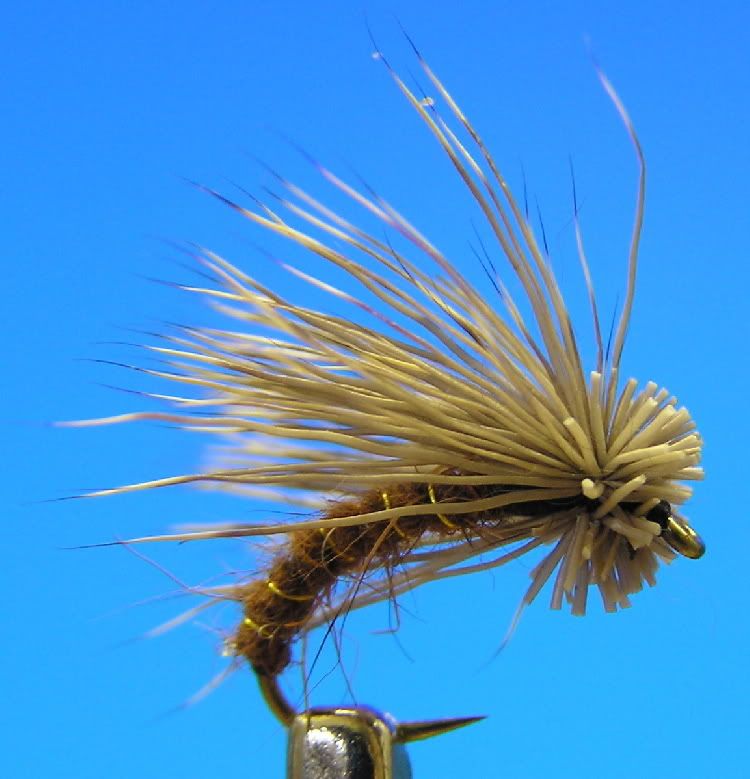
just begin to tie some flies like this one.
Only a ribbing, a little bit of dubbing and some deer hair is needed.
quick and easy to tie but very good to start with when your are trying to tie with deer hair.
I’m going to suggest that a skill to master is fishing (and tying!) for absolutely everything. The skill is essentially an open mind. Not necessarily catching, however I know that things I learn by trying a new saltwater fly work their way into my trout flies. Tie for trout, tie for saltwater, tie for bass, panfish, carp, stripers, northerns, muskies, salmon, steelhead. Tie for friends at work who are taking a rod with them to the beach. Try tying crappie flies, crease flies, pigboats, clousers - even if you will not fish them right away.
I’m not a great tyer, but I know that practice will help me get better. Tying for different species helps me expand my abilities and become more well-rounded.
My mentor taught me 35 years ago that there are two different kinds of flies. There are flies that catch fish and then there are flies that catch fishermen/ladies. While proportions and not crowding the head are very worthwhile endeavors I believe too many people get caught up with tying the perfect fly.
That’s to say it is appealing to their eye. I love to look at good looking flies and am proud of many I tie…but many times my average flies are the ones that catch the fish. It all boils down to where your priorities are.
Good stuff.
I’ve fished several times where I’ll fish for hours without a fish, then I get one that musses up my fly, and after that, the fish seem more willing to take it now that its been “roughened”. If it falls apart and I put a new one on, action slows down till that fly gets a bit disheveled.
Of course, most of my flies come out of the vise disheveled, so this is rarely a problem. 
Watch good tyers. Attending the Shallow Water Fishing Expo and watching and listening to better tyers and better casters there have helped me more than about anything else. I have never had anyone instruct me at a vise, I have ask questions at fly shops and I have a friend who grew up fishing and tying for trout. My trout flies aren’t very pretty but they are effective I think it’s because they look like cripples. If they look bad enough I take a razor blade and clean it off and start over.
As already said, dubbing. But not only the run of the mill twisted on on the thread dubbing method, but dubbing loops too.
None. There’s no need to master any single technique in order to tie exceptional flies.
It is, however, best to strive toward increased proficiency in all aspects of fly tying, from material selection and organization to material preparation and manipulation. The result will be better than that from a tyer that has “mastered” thread control but understands little of proportions.
For me, it is to tye the next fly better than the last. And to keep at it until I am satisfied with the results.
Perfection is a fools game. Success lies in doing your best, and quitting when you don’t feel you are doing your best.
I get tired and quit for a while. Then a little later find myself trying again.
Something that has helped me a lot is #28 hooks, and 14/0 thread. Takes patience, and I love the challenge. It’s just me and the materials. (And my mageyes…) :shock:
Can I do it? Well, I keep trying.
Besides, it’s easy on my wore out back. Which is nobodies fault but my own.
But it’s been fun getting here. 
So one thing?
Perseverance.
For me it’s the technique of “paying attention”. I think I’ve become successful as a fly tyer because I pay attention, not only to how I’m tying the fly - proportions, materials, etc. - but I pay attention to other tyers and try to learn something new that may help me become better with my own tying.
Oh, yea, don’t crowd the head!
Kelly.