Thanks Dave. I agree completely. The point was that such flies are needed now days in heavily fished waters with catch and release. Fish that get caught a number of times during their life tend to become more and more selective.
As George Grant once said, in talking about the old times on the famous Western Rivers, “In those days, it would be hard to find a fly which wouldn’t catch trout”. I am paraphrasing, but it was pretty much accurate…
My take on this is that the Ranch section of Henry’s Fork and Harrop’s flies and flies tied based on his patterns are irrelevant to the huge majority of fly anglers. And if I were in the area and did decide to fish the Ranch, it would be with flies I tied based on my own patterns, not some one else’s. But there are so many other places that are more beautiful than the Ranch ( to my tastes ) and so many other fish that are just as interesting, if not more so, as the fish in that little stretch of water, that it’s unlikely I will ever spend any time there.
Having said that, I hope those that go there enjoy the experience, whatever flies they use, however they fish it, and whether they catch any fishies or not.
I have a hard time reconciling Harrop’s statement about the Madison with the success rate of the Brown Rubber Legs. Maybe he’s referencing a different section than the 50-mile riffle.
I would not for a second discount Rene Harrops patterns, tying ability or knowledge of the bugs he studies. That being said, nobody…and I say “nobody” has it all figured out. Everybody knows “their” water better than they know somebody elses. And everybody “thinks” that they’re hardest and most selective stetch is by far the hardest of all. But at best, we are all just trying to catch trout.
I would not discount ANY fly pattern or style of patterns as being irrelevant today. I would be foolish to do so in my opinion. Trout eat what trout feel like eating that floats by…and it changes by the hour on a given day. And while certianly some patterns may seem to do better on a particular water than others…or better in general…there are no perfect flies. Nobody can claim anywhere, that any given pattern causes EVERY fish that is feeding at the time, to eat it as it floats by. That fly does not exist. If you fish over 20 fish, and your new pattern catches 6 on the day…hey good deal! That’s what we hope for. But there is nothing to say that 30 mintes later, another guy can’t come strolling by, tie on a catskill pattern, and catch 6 more.
Having fished on both coasts I can honestly say, there are streams in the northeast that can and do send many a west coast angler back to the truck scratching his head as fish dimple the surface all around them. And on the contrary, a stream like Henry’s Fork can be a daunting image and lessen in matching the hatch to the first time Eastern angler. Selective trout are where you find them. It doesn’t take a pristine mountain setting…or decades of flyfishing lineage to make a water difficult.
I fished a little stream here in PA yesterday…crystal clear…never more than about chest deep…full of wild brown trout. It’s quite possibly THE most difficult little witch of a water that I have had the privilage of fishing. I had fish take “todays” CDC style patterns…an EHC…and a catskill style BWO trimmed as a spinner. When you start thinking you or anybody else has it ALL figured out…those little brightly colored 8" fish will humble you soon enough.
Once again…my point, and that of Rene Harrop…is that in heavily fished areas, with catch and release, trout become very cautious about taking the fishers’ offerings. To allow one to be MORE successful in such water, new designs of flies, taking into account what we now know about the stages of insects and what they look like and how they behave, new flies have been developed.
This is not to say that old styles and old patterns will not catch fish. But, usually, the fisher is looking for his/her best chance of taking a rising trout. It is for such fishers, in such heavily fished waters that these flies he has designed and tied are for. It is an attempt to give the fisher a better chance of fooling the fish. These flies and the designs of them are not developed and tied to fool naive trout.
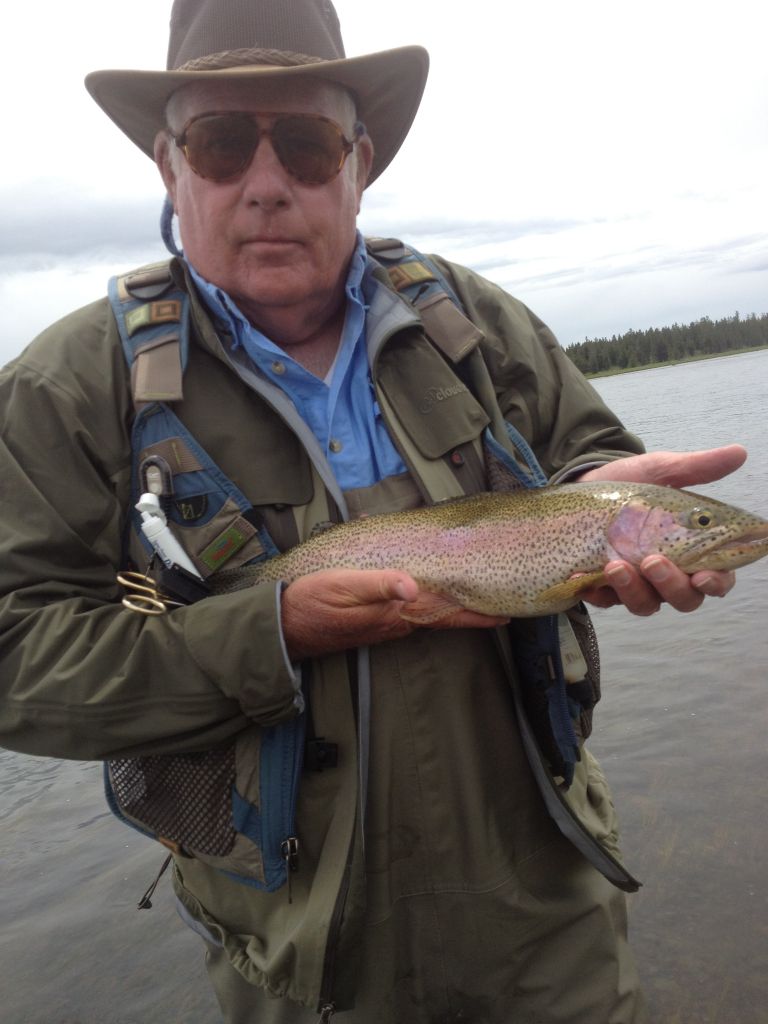
Here’s one I caught on the Ranch I caught on a Green Drake emerged pattern of Rene’s:
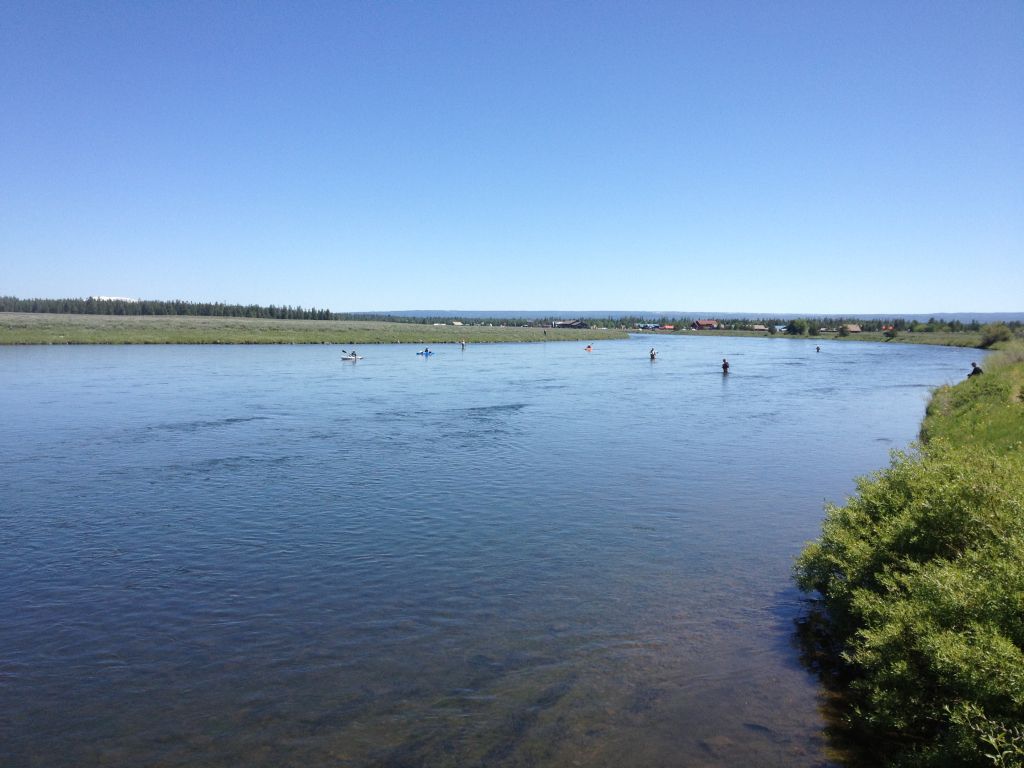
The area just above The Ranch a day or two before the Ranch opened.
You are dealing with a fish with an average lifespan in the wild of about 5yrs…NOT taking into account the impact that C&R has on that lifespan, how many times a particular fish is caught…and how long a fish’s brain can actually retain reasoned thought. All very interesting topics for discussion on their own accord. So basically a fly created 5 yrs ago that was the HOT fly then but is seldom used now is a new fly for the vast amounts of fish today.
In heavilly fished areas, I would say I can see how it could be a problem…but really only when it pertains to the “not new flies” which are generally “new” flies that for some reason or another seem to trigger more strikes. Especially in tourist beats on stretches of some streams that see a HUGE influx of fisherman each season, and a huge amount of folks are fishing those same new flies from the local shops. “Trigger flies” come and go year to year without rhymn or reason really…hot one year, and dead the next. That’s always been the case.
My thoughts would be more in the lines that heavy pressure causes fish to be more “skittish” when feeding rather than “selective”.
Certainly not trying to be argumentative; and I agree with a lot of what you say. However, these patterns of Rene’s are not “hot new flies”. He has been tying and fishing them for years and years. They aren’t “new” flies to him and the shops he sells them through. They really aren’t “trigger” flies. They are more “realistic” designs from his having fished the rivers around the Henry’s Fork and studied the fish and the insects. He observes the river nearly each day.
Trout do learn. Most of us have had a strike with a fish in which the fly was taken, but immediately came off. Once the fish has “felt the steel” or even seen unnatural actions of the artificial, good luck catching him again for quite a while…
Understood…no argument here, just discussing thoughts and opinions.
I agree, that for “some period of time” a fish will shy from feeding or be tough to take on that same pattern. But quite often a fish that was previously lipped on a dry, will readily take a nymph presented later. So how long is that “learned information” retained?
On new vs old fly patterns…my point was that aside from that seasons hot fly…all flies are pretty much new patterns to a given fish. So I would not rule out any fly pattern as not as effective because of age. I have caught too many fish on catskill style patterns to think otherwise.
And I’m not too solid on “realistic”…when flies with 4 layers of cut foam, metal beads and plastic materials are tearing up water everywhere. LOL
Not sure what you mean by “quite a while” Byron, but I’ve caught a couple fish twice in not much more than half an hour, and a couple more twice in the same outing, all in the past year.
I caught one dummy that I named Howard six times in just a few weeks last year, and another dummy “felt the steel” five times over about the same period.
If you take a look at my thread “Same Fishies” from last year, you can meet Howard and some of his dense friends.
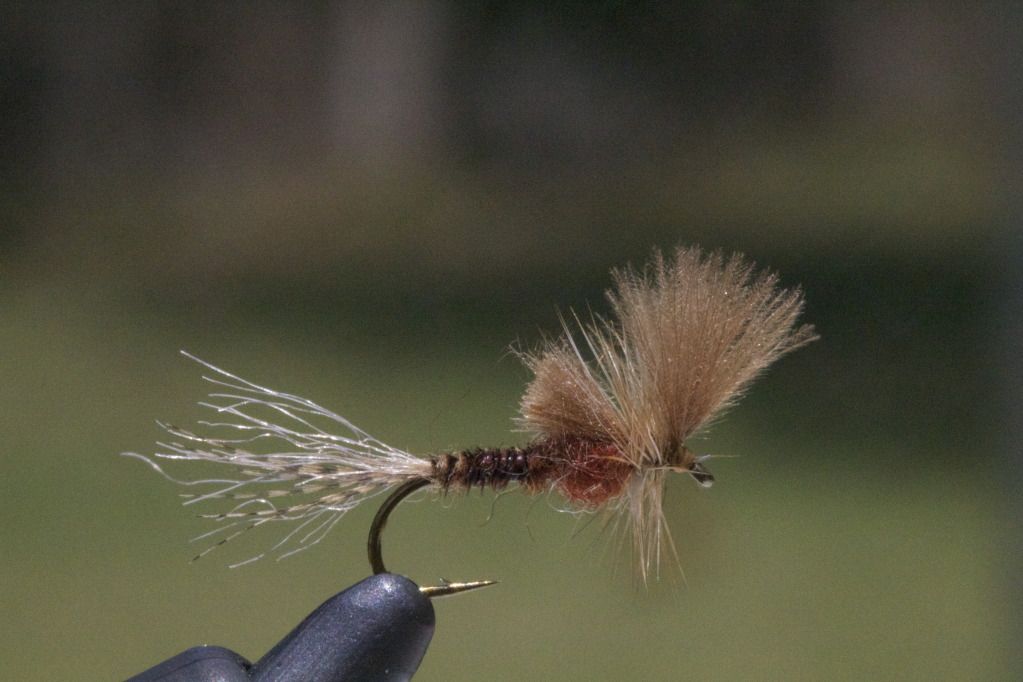
My attempt to apply Harrop’s design to a March Brown cripple.
John: I guess you have definitely blown a hole in the basic principles of selective fish…
Not really, Byron. Just pointing out that some fishies, and probably many more than we realize or take note of, eat flies, even the same patterns, at relatively short intervals. Having the opportunity to catch the same fish in a short period of time is one thing, and recognizing the same fish is another, something I can only do by fishing the same water with high frequency and taking a fair number of pix while I am at it. I did get to the point of recognizing Howard and a couple other fish at the time they were caught, but mostly it is a matter of examining photos and comparing spot patterns.
For folks that fish the same stretches of water less frequently and / or don’t take many pics, the odds of recognizing / realizing what is going are greatly reduced. Several years ago, an acquaintance down in Idaho Falls told me about a big Henry’s Fork rainbow that his wife caught and broke off - about fifteen minutes before he caught the same fish, with the fly he had tied for his wife still stuck in the jaw.
Nice fly, by the way. Even some of the smart ones would eat that one a couple times a day given the chance.
One has to wonder…If trout do “learn,” why haven’t they “learned” to avoid Harrop’s patterns? My presumption is that after all these years, these flies are popular on the streams to which you are referring, but maybe not.
They are popular there - particularly amongst the guides
Here’s the story:
Generally or somewhat representative patterns work best on rivers with little fishing pressure. As I said, at the end of the perspective, famous tier George Grant once said that in “the old days” on great Western rivers, “it would be hard to find a fly that didn’t work”.
Unfortunately, today some of those rivers get hammered day after day by fishermen and by guided fishermen. The trout become conditioned to “hopper/droppers”, etc. They become skidish and more selective in their feeding.
On really technical rivers, Rene has developed some more realistic patterns which take advantage of newer materials (not new, but “re-discovered” in the last 10-20 years - CDC, etc.)
The concept is that such flies which closely resemble the various stages of insects with materials that allow the imitation to “behave” like the real insects are more effective on such rivers or sections of such rivers receiving the most fishing pressure.
Now, you are certainly free to dismiss this belief. However, I would like to meet anyone here on the Ranch of the Henry’s Fork in the last two weeks of September. I will use patterns designed by Rene for that water and you use standard catskill patterns and we will have a little contest?
Maybe I am not explaining myself well enough for others.
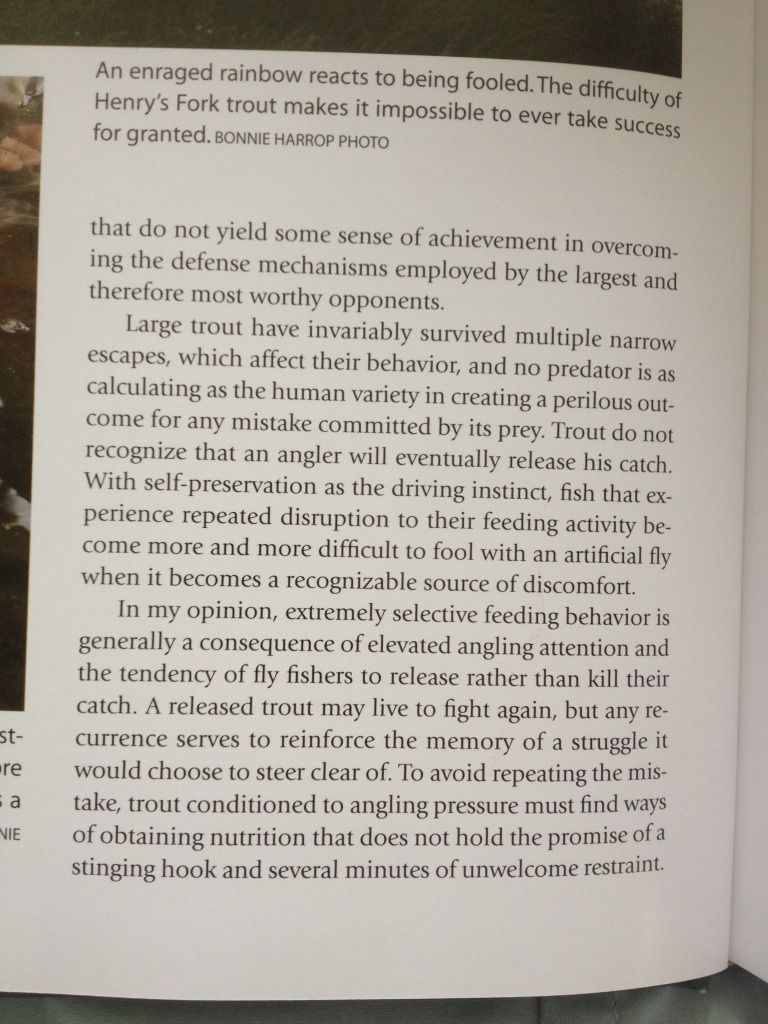
I found this passage in Rene Harrop’s great book “Learning From the Water”. Now, I know most here are much more knowledgable than Rene, but I’m not. Here’s what he says at one point in his book.
Byron,
You know that throughout this conversation, I have not implied or stated my opinion RE: the initial point of contention. I simply stated that everyone is entitled to their opinion and none is necessarily more valid, on any given day or given water, or specified condition, than any other opinion. However, I would like to know, again I’m not even giving my opinion RE: the initial point, what is this anti-Catskill position you constantly take? “I will use patterns designed by Rene for that water and you use standard catskill patterns and we will have a little contest”. You probably know what a Catskill style dry fly looks like and the general make-up of one. However, I really doubt you have any idea what a Catskill fly is. There are many varied styles, materials, stages, etc. No one need stick to dries to be within the Catskill fly family.
Oh, and by the way, a challenge as you described means nothing because it’s not a challenge. Additionally, next time you see or speak to Rene Harrop, ask him if he’d accept such a challenge vs. someone knowledgeable on the West Branch Delaware at a time specified by the Delaware fisher. He might accept because he’d want to fish the water and could afford the expense but probably would anticipate not doing as well as the native person. So, in short, your challenge is total BS and you know it. Or maybe you’ll accept a similar challenge by coming east and fishing the Delaware with only flies from the Harrop collection?
Again, I have not offered my opinion about your initial question.
Thanks for the invite Allan, but I already have my airline ticket to Last Chance Idaho.
By the way, I do know what a Castskill fly is. I have tied them over the years, have a shadow box of Mary Dette’s flies and have read extensively about them.
Aloha Allan!
It strikes me you argue two different things: 1) more realistic patterns are better than less; 2) trout learn.
I accept that one will catch more fish on heavily plied water using patterns that more realistically imitate life stages, move like the real thing, sit on the water properly etc., etc. But I’d suggest this would be true on any water.
What I find hard to accept is that trout with the brain a size of a pea “learn” (no matter what your definition of learning is). And if they do learn, one has to make the argument that they are smart enough to figure out, after awhile, to recognize a catskill, but not smart enough to recognize one of Harrop’s flies. I simply find it hard to buy this.

 ”
”