Great Canadian Flies American Coachman
By Arthur James Lingren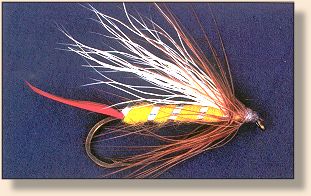
From Fly Patterns of British Columbia, Published
by Frank Amato Publications.
We appreciate use permission.
In an article title Tidewater Trout: Part 2, which
appeared in the July 1968 issue of Western Fish & Game
magazine, Jim Kilburn mentioned that for sea-run cutthroat beach
fishing his “first choice is the American Coachman streamer” and
that this “streamer has a lemon-yellow wool body ribbed with silver,
a white polar bear wing, a tail of either red polar-hair or red wool,
and a full brown hackle.”
In my response to my inquiry about the fly’s origin, Kilburn wrote
back saying that he “first came across the pattern in a sporting
goods store in Courtenay in the late 1950s.” “It was labeled
‘California Coachmen,’ but because it bore no resemblance to that
particular pattern,” Kilburn renamed it. The California Coachman
was developed by a San Franciscan, Mr. J.W. Fricke, in the first
quarter of this century [1900] and was originally called the
Yellow Royal Coachman and, according to A. Courtney Williams in his
book Trout Flies (1932), was exact in detail to the
Royal Coachman “but with a yellow silk body” (page 123). The only
resemblance between Kilburn’s Courtenay-found pattern, which he
named the American Coachman, and the California Coachman is its white
wing, yellow in the body and brown hackle.
Details
Hook: Number 6.
Tail: A slender strip of red swan.
Body: Lemon-yellow wool.
Rib: Flat, silver tinsel - three turns.
Collar: Brown hen hackle.
Wing: White bucktail.
Originator: Jim Kilburn.
Intended Use: Wet fly for sea-run cutthroat trout.
Location: Beaches and estuaries.
~ Arthur James LingrenCredits: From Fly Patterns of British Columbia
by Arthur James Lingren. We thank
Frank Amato Publications, Inc. for use permission!
Originally published March 25th, 2002 on Fly Anglers Online by Arthur James Lingren.