Its been quite a while since I have glued cork rings together and turned my own cork handle. Almost all of the rods I build get exotic hardwood handles and the ones that dont normally got a pre-made cork handle.
My next project will involve turning my own cork handle and just thought I would see what type of glue folks on the site like for this purpose. I would be gluing the corks and shaping on the lathe using a mandrel and then reaming and attaching to the rod blank.
I remember from years past when I did this using a 2 ton epoxy that it was often a very delicate process tyring not to get the ridges at the glue lines from the hard epoxy.
I was thinking of using U-40 rod bond but thought I would lean on the collective knowledge of the board before I did my glue up. Just wondering what glue you all use and why?
I use Titebond 3. No ridging and easy cleanup with water if you get squeeze out.
I usually wrap my mandrel with teflon plumbing tape or wax it with an old candle. then glue up right on the mandrel and turn. then remove and clean up/ream the interior. the other glue of choice is Pliobond but I’ve had trouble getting it in my area.
Pliobond is the only thing I use on cork. It’s a flexible waterproof contact cement. Available at nearly every hardware store and most online rod building sites. If you’re gluing up to turn a handle, squeeze out isn’t an issue since it will get sanded off anyway.
By the way, I glue up the rings on a 24" lenght of 1/4" threaded rod and clamp with fender washers and double nuts on each end. Pretty standard practice I imagine. Once dry, I chuck that in a 1/2" drill I built a turning jig around <http://colo2.flyanglersonline.com/bb/blog.php?b=216 >. Lock on and ‘turn’ with various grits of sandpaper.
Been meaning to post this and now seems like a good place to throw this out for comment. The article here on FAOL by Al Cambell however, starts with the threaded rod idea to clamp up the rings while the glue sets, but then he changes the cork over to a solid 1/4" rod to turn on. Just wondering why switching to a solid rod when the threaded rod works without any problems. Matter of fact the small aoumt of glue on the inside actually glues the cork to the ‘mandral’ while turning keeping it secure. To release you just need to remove the nuts and washers, grip the cork and turn on the drill and it unthreads right off the threaded rod.
Threaded rod tends to be pretty crooked. Using it to turn a grip would cause the grip to not be perfectly centered around the bore. It may not be noticeable in some cases, but it can it can ruin the grip if the front or back is very off-center.
The solid rod tends to be straighter. Some rod building stores sell mandrells specifically for this purpose.
I use the Devcon epoxy for the corks and a drillstock mandrel. I’ve learned how close to the center i can apply the epoxy on both sides of each ring so as not to epoxy it to the mandrel but i don’t worry about the outside, though it’s better if the epoxy isn’t on the outside. Not a huge prob if it is though…unless i’m shaping completely by hand, in which case i’m more stingy with the epoxy out towards the edges.
Since the rings are on a smooth mandrel i don’t clamp them, rather stand the mandrel and rings on end with the bottom cork supported against the top of the vice jaws that’s holding the end of the mandrel then i slide something on the top end that presses the corks a little…it doesn’t take much…something like few fender washers or whatever is handy.
I always used threaded rods for cork grips. Clamps as has been posted ( double nuts and fender washers) and when it came time to turn them Id unbolt the washers and set them aside so that my “shaping” tools didnt run into them.
When Id first buy them Id center drill one end and that way the live center on my Jet lathe would always center up just fine.
I didnt make it a habit of turning grips from glued rigs because the price of AAA quality rings was about $2 less than a completed Struble AAA quality grip PLUS the struble grip was already conuter bored for the reelseat nose.
Reelseat inserts I used a “pen mandrel” which fit the hole I had to deep bore in the wooden seat insert.
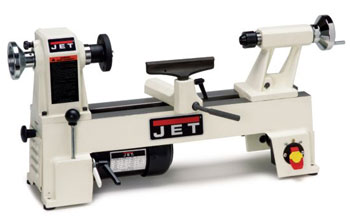
Sully - You’ve described the exact way I was going to turn my handle. I used to use a drill lathe as shown by Bass_Bug for this type of thing but I now have a large Jet woodworking lathe I use to turn my wooden handles that I think would work much better using the mandrel set up you describe. Mudhole sells smooth mandrels for exactly this purpose but I figured I could rig one up out of threaded rod that would also allow me a little more clamping pressure during glue-up.
Seems everyone has there own favorites for glue. Anyone else care to comment?
I will probably just go with the U-40 rod bond as that is what I have on-hand…unless of course someone can convince me otherwise.
As I posted before Id use the U40 Rod Bond but someone suggested PlioBond…that works fine also. With either the rings arent going to break AT the glue joint for sure.
I dont use my Jet anymore. I got poisoned from the dust of certain exotic woods I was using…I had a BAD ( and I mean BAD) case of HIVES for over a year
Couple things here. A drill ‘lathe’ is really only good for cork. For those turning wood or doing anything fancy, I’m sure a real lathe is a must. If I added poker chips or whatever for plastic accent rings, my setup might not work.
I’ve never bought AAA/flor grade cork and never will. I personally like the character that $.35 rings have over the bland looking $2 each super clean rings. I mix the dust from turning with carpenters glue to fill in any pits, let dry and polish with 320 grit before sealing and they look great. Compliments tiger maple and birds-eye maple type wood grain reel seat inserts too.
Not sure I follow you how the front and rear can be off center when your turning something on the same axis? Never even came close to what our describing
The threads itself might make a longer threaded piece wobble a little more than a solid rod, but a 8 or 9"’ portion of any 1/4" rod doesn’t have any noticeable flex to it.
I’ve seen this done in books, and for the life of me cant figure why anyone would even want to do it this way. I just don’t see any advantage to turning a grip on the blank -vs- turning it on a mandrel. Do you chuck the butt end of the blank in a drill to turn it? Someone please tell me what I missing here.
They will eventually. They have a little so far, but nothing that inhibits the final product. I’ve looked at bronze bushing to press in the holes, they just haven’t enlarged enough yet. However, as simple at those supports are, I can make a replacement the pair in about 15 min.
Use a hand-crafted chuck out of PVC for the butt-end with something to protect the reel seat and thumb screws for adjustment, same for the other end of the rod, it works great. The advantage is each ring is glued to the blank and the next ring in line - no voids or such from reaming, etc. Also, the handle is turned and tuned to the blank. I guess I just thought everyone did it this way since it’s the way my mentor taught me. Also, I can get the grip just the size I want for my hands, although it sounds like the way you all do it this would be the same. The pre-made ones from the suppliers are just a litle too, well, little for my hands. I use 30-minute epoxy for the rings.
How do you release the handle from whatever mandrel you’re using, especially the threaded rods?
Ive never seen any sort of home made PVC chuck that would hold even a bare grip to my satisfaction…at least not the way I bear down on the cork in the roughing stage. I bought an “engineering” chuck to fit my lathe and built a steady rest I use 3 feet out to support the blank. Ive turned DOWN some factory made rod grips for people but never had to build any up .
I have small hands so turning down a ready made cork grip works fine for me.
The first time you mess up a grip thats been already glued to the rod blank…you’ll wish you hadnt done it after that.
As for any “voids”…with the tight fit a grip SHOULD fit the blank after reaming it out inside…any voids wouldnt amount to doodle squat.
The area where the mandrel is bent will not be on the same axis.
You can see it wobble when you turn the grip. Any part that wobbles is not going to be centered. You will get better results using a perfectly straight mandrel.
Titebond or Pliobond for gluing the rings up. Rod Bond for EVA or other materials to cork. Threaded rod normally is not very straight due to the mfg method. It is possible to yield straight, shorter sections from the longer sticks. As stated above, I add machined center to the tailstock end. Please use caution with the full threaded mandrels. Any catches or abnormal pressures will force the nut to continue spinning itself up the thread. Normal shaping methods (drywall screen, files, grit paper) are normally safe, but please use caution.
A long time builder of 20 plus years taught me something the other day. He uses the inexpensive cork (is there really such a thing) to build his grips with. Like some if there is a big pit he wil mix it with glue and dust and fix the pit. This is what he does different. When the cork is done he takes parifin wax and presses it against the cork while it is turning on the lathe. It blends everything and puts a nice finish on the cork that is not slick. For the record I use pliobond to glue cork rings when I have them and turn on the lathe with a mandrel.
I would never use 2nd or 3rd quality cork on any rod I was going to SELL with my name on it. A brush beater for myself…I may not even fill any voids…unless it was maybe 1/2 a ring that had split out.
My time is worth something…and it takes me no longer to shape a grip from top notch rings as it does sub-quality rings…and with the better rings I dont have filling to do.