Hi,
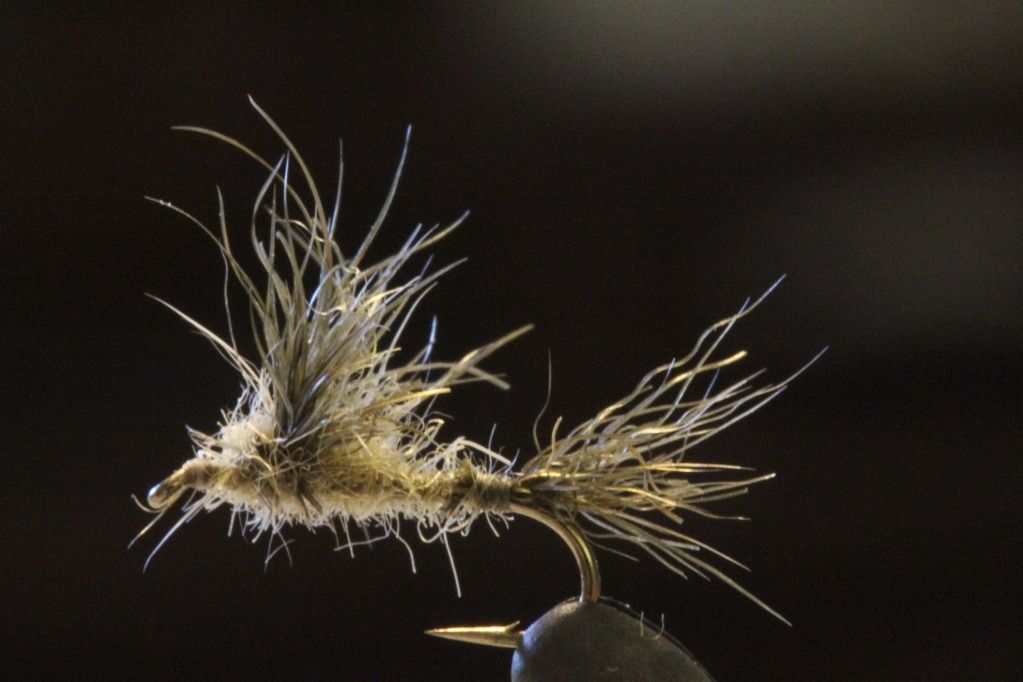
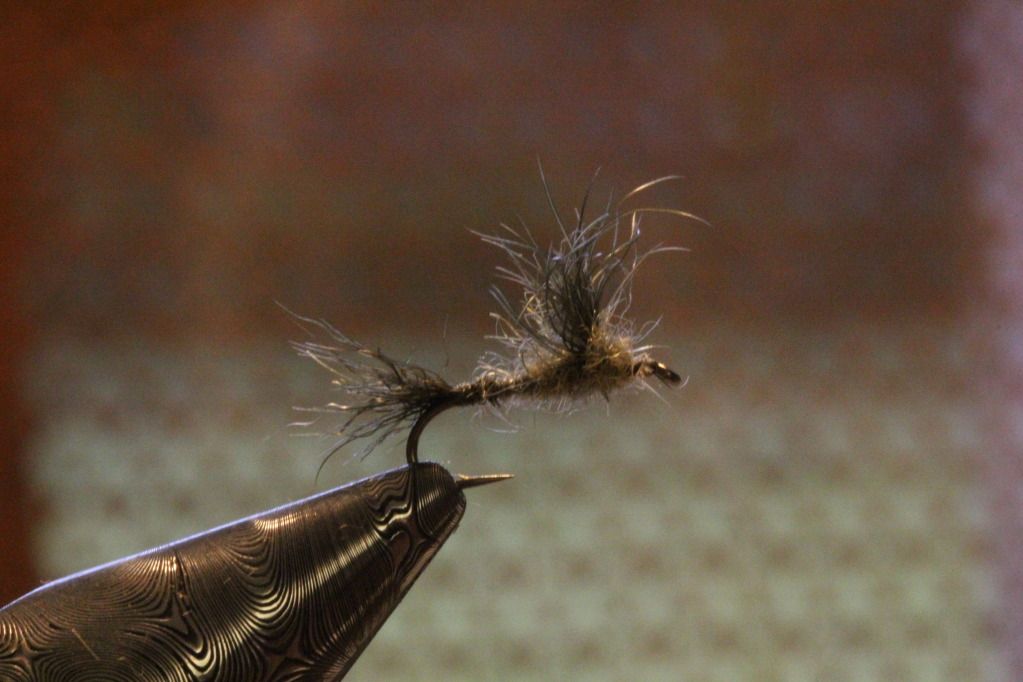
Recently got some snowshoe feet from Blue Ribbon Flies in West Yellowstone. Anyway, my first attempt at Fran Betters’ Usual. Only difference (I hope) is that I did not use red thread. Size 16
Does this pass? Anyone use them on their waters?
Thanks,
Byron
Byron, I use The Usual and I’ve had luck with it. I’ve also found that it does well as a starting point to experiments. I can’t tell how spent the wings on your fly are, but I generally tie mine as duns. Sometimes I don’t even split the wings. Sometimes I tie the wings Trude.
Byron, I tie and use them a lot. Generally with fire orange thread and the most natural white feet I can find. Size 16 and 18 mostly and have them work almost everywhere in northern CA. Your are waaaaay neater than all but about 1% of mine and I am sure it will work like a charm. Size has seemed to be the biggest thing with me, the smaller ones always work better even when larger caddis are about.
Nice fly as always Byron but without the bright orange thread its just not a true Usual. I think the bright color showing slightly through the transparent snowshoe fur is the real attraction of the orignal pattern. Just my two cents.
I use Usuals a great deal, both in Ontario and in Connecticut. With an olive body and blue/gray wings they are a good BWO imitation. "Grey’ is the colour of thread listed for the patter on page 74 of his book. However the ‘modern’ Usual is made with fire orange thread. I have 3 flies tied by Betters, and regardless of the material or dubbing colour the thread is fire orange. On a white Usual the orange shows through like the body of an orange caddis or female PED (sulfur with eggs), while the dubbing forms a halo around thread-wrapped hook and looks like a bursting shuck. The fly is shown on the cover of his book has obvious orange wraps.
Byron, I like your first one better than the second one, I think the wing on the second one is possibly too sparse. One test is to put floatant on only the wing and saliva on the body and tail - it is an emerger and can float butt down. If it still floats in a glass of water the wing is full enough.
Actually, I believe, the Comparadun is tied Usual style, and the Usual is tied Haystack (the first Betters’ iteration) style. Like EdD I tie the wing several ways now and much of the time just plunk it on after the body is tied - the tips of hair toward the eye and the very trimmed butts toward the bend like a burst wing case. They all work. The pics of Betters’ Usuals show the wing canted somewhat toward the eye on most of them.
Bill Phillips, who is credited with naming the fly, would fish it down to a fish, (or at least with a curve cast) so that when he tugged the line the fly would appear to skip (upstream) like it was trying to escape the film. If it went under so much the better - then the wing would float it back to the surface like an emerging bug - right in front of the fish. This method works almost every time to a rising fish - if the Usual is small enough.
Byron, sometimes I use a tippet which is undersized (e. g. 5x tippet on a 2x or 3x leader end) to promote having the line and leader skip the fly. Learn to flip/roll it so the line moves only a little but the tippet causes the fly to make 2 or 3 hops upstream. The often provokes a strike when the fly drifts back down and allows onw to re-work the water if the first drift doesn’t connect. I have had good luck with the Usual tied in shades of blue dun.