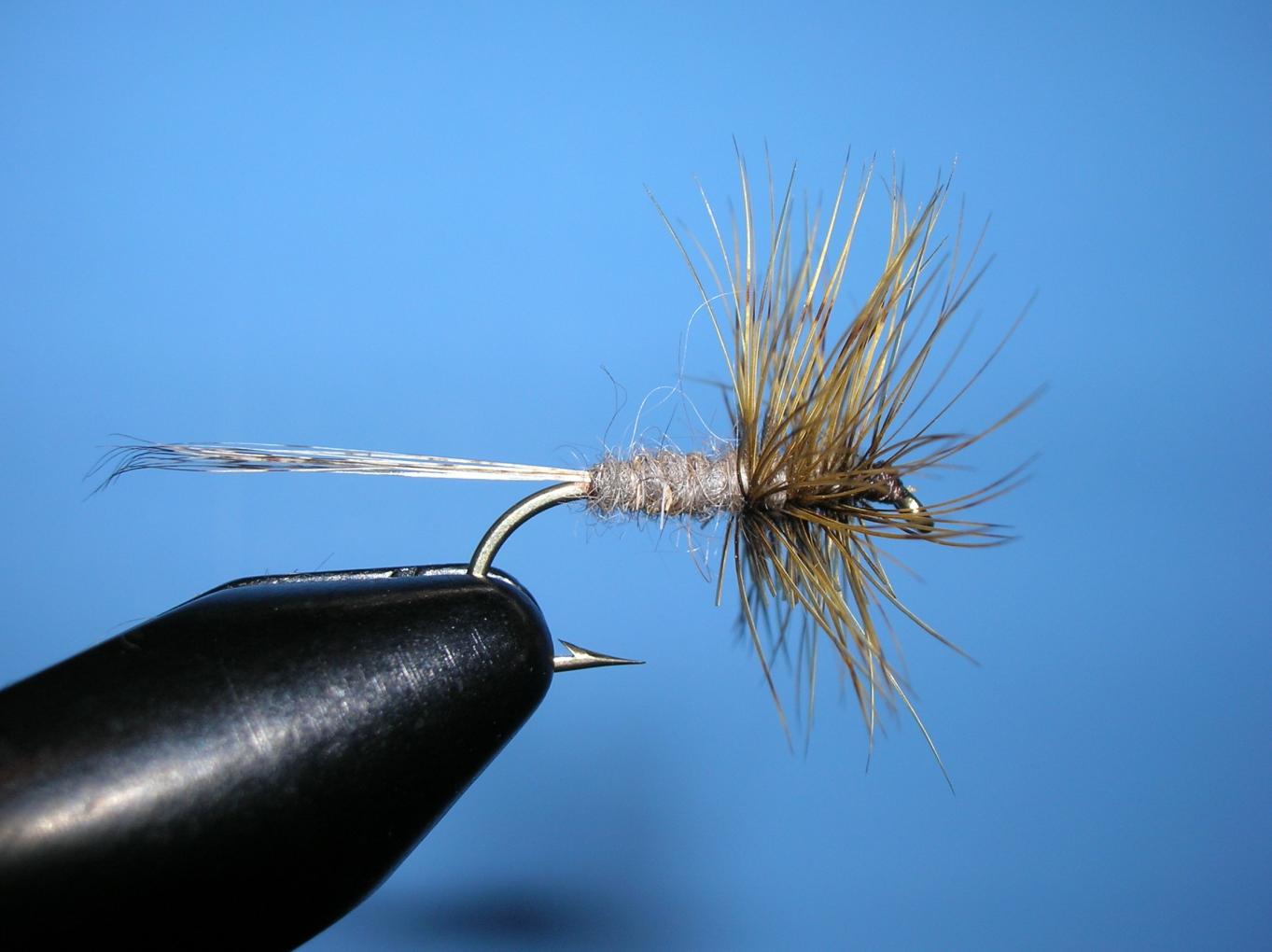
Dry Fly wings..

James (Castwell) Birkholm, did a 12-Part Series on “Dry Flies!”, and what the fish sees beneath the water surface.

James Birkholm was a good friend of Vincent Marinaro, was a major contributor in the presentation and development of Vincent Marinaro’s book, “In The Ring of The Rise”!

I saw James Birkholms slide presentation of the above series, in 1999 at the South Dakota Fish-In. It is very illuminating to say the least!

It helps explain to the Tyer, the reason for the wing on dry flies, and how the fish perceive dry fly. You will find that wings do play a important part in the presentation of the fly pattern to the fish.

~Parnelli

I too saw Jim’s show about his work with Vincent Marinaro, at the Michigan fish-in, and it was great. But long before that I was convinced of the importance of wings to dry fly fishing, especially on spring creeks. Maybe on faster moving water, where the fish only get a cursory glance at a fly as it blows by, they don’t matter, I don’t know. But half the fun of fly tying for me is doing the wings, so I do them. And how well does a spinner work without wings? We’re supposed to be fly tiers here, this is after all the fly tying section. But I continue to hear things like “the fish don’t care”, “flies for fishermen, not fish”, and an Adams has no wings. By the way, a Variant is a particular style of fly with extra long hackle from the Catskill region, not any fly that varies from the recipe. That would be a variation, or, to put it another way, an incorrectly tied fly. But do what you feel. Just don’t use “doing what you feel” as an excuse for an inability to master basic fly tying techniques. Consider this a warning from the traditional police.
Eric

It was called a variant in the literature in which I found it. If you wish to argue that point…argue with the author…not me

Definitely usable flies. The wings catch more fishermen than fish. Which is fine, and part of flyfishing as well.:wink:

I tie several variants that work 100% as well as their winged brethren. All the way up to #10 patterns.

Tiny little works of art for sure.

I watched some of the tyers at the local show yesterday…Geeze!! One had a #32 nymph there that the wife and I both had to look using a magnifier. Talk about SMALL!!!

I’d point out that Marinaro’s most famous student, Datus Proper, argued in “What the Trout Said,” that there was very little to be gained from adding wings to the traditional hackle-style (Castkill, if you will) fly. Given that: a) the traditional wing, unlike that advocated by Marinaro, is only slightly longer than the hackle itself; and b) the fly is likely to be facing downstream anyway, it is unlikely that the wing can be differentiated at all.

Which is actually one of the reasons that my preferred style is a wonder-wing parachute.

Sorry Sully, my argument truly is NOT with you. My argument is very much one with some ill-informed modern writers who have misconstrued the term “Variant” at best, and completely lost the historical context of this fly at worst. J. Edson Leonard in “Flies” says this about the Variant, a fly he lists under general categories of fly styles, like Bivisibles, Fore-and-Aft, etc.:

"The Variant is purely an American version of the dry fly…The Variant type is dressed with a hackle several sizes larger than regular…The neatest variants are tied with hackle-tip wings a little shorter thant the wings of a regular fly, cocked approximately midway between the position of the spent-wing and the upright. "

From a book that’s only a couple of years old, Terry Hellekson also gets it right with this description of the fly type “Variant”.

“Dr. William Baigent of England gave us the Variant design around 1875. Tha Variants are tied the same as spiders, with one exception-they have wings. Many prefer the Variants over the Spiders just for that reason, thinking that the fish may have some slight advantage from distant angles, and a wing might possibly make a difference.”

Dick Stewart’s Universal Fly Tying guide has the Variant listed under “Dry Fly hackle Variations”, along with thorax, parachute, spider, full and sparse" and I could go along with that.

Dave Hughes in “Trout Flies” (1999) says this:

“Variants have overlength tails and ovesize hackles, and they imitate the impressions made by an insect’s appendages dimpling the water rather than representing the insect itself”.

Of course, the most famous Variant of all is Art Flick’s Gray Fox Variant. I think this is where some of the confusion over the term Variant originates. I think people see this fly as a variation of Preston Jennings Gray Fox, which it most certainly is. I think they then assume that Variant in this case means variation, which it most certainly does not. In the words of Flick from “Master Fly Tying Guide”:

“in all cases the hackle sizes are much larger thay would be if tied on a conventional dry fly. For example, if I were making the Variant on a size 12 hook, the hackles would be about the size or larger than they would be if I were making a size 8 or 6 regular fly. A size 18 Variant would have hackles the size that one would use on about a size 14 fly.”

I could site many, many more examples from all sorts of fishing and tying literature to support the notion that the Variant is a type or style of fly, as is the parachute, thorax, bivisible, etc. Now I will say that I’ve seen several sources that call certain strains of hackle “variants”, typically ones that are multicolored or stripped. That said, when referring to flies themselves, a Variant is a very specific fly type, and not simply any change to a known pattern. I hope this clears this up.

Eric

I know this thread has been somewhat “necroed”, but I just found mention in another book about leaving the wings off an Adams once you hit size 18 or smaller. The general idea of an Adams is that it is an “impressionistic” fly, originally built for fast water where the fish can’t discern every little detail. Once you go that small, it seems, even the wings might be overkill and the hackle itself does the job of representing the shape of the fly.

The same resource also mentions the Adams as a great midge imitation, and I have a serious problem imagining someone putting the wings on a 24 or 28 hook. Given all that, I’d say leave the wings off for 18 plus where you’d still use an Adams. If the water is clear/calm enough for the fish to get a good look at the fly, you’re in comparadun (or similar) territory anyway.

The problem is, “variant” is an overloaded word in fly fishing. (The most notoriously overloaded word is “dun”, which can mean a color, the sub-imago mayfly - i.e. as opposed to spinner – or a specific type of mayfly – as in pale evening dun. The phrase “dun dun dun” actually makes sense in context.)

Variant can mean:

  1. A type of fly with oversized hackle.

  2. A rooster cape with feathers of more than one color (even though each individual feather is only one color.)

  3. A single hackle with more than one color – e.g. a grizzly or a furnace.

  4. It’s standard English meaning, which is simply a variation.

And of course, if you don’t already know what a “dun variant” is, you could be mightily confused.

I tie flies to catch fish and don’t care what the original pattern(s) called for.

I haven’t tied a traditional Adams in years, and personally don’t think much of hackle tip wings.

However, I do fish parachute Adams a LOT, and my versions all have a white Zelon or Antron post (wings). The post is very easy to tie, regardless of the size, and becasue it also makes the fly a lot easier to see on the water I believe it makes the fly more effective.

John

p.s. I never met Vince Marinaro, but I do understand and appreciate his theory on wings. It’s just that I’m not a particular proponent of trying to be as exact as I believe he was in creating realistic wings.

Fly tying…like fly fishing…has room for all kinds of folks. From the purists in the sense of the old english craft, to the Epoxy baitfish and tubeflies. It’s all got a place. None of it’s wrong.

Never met the man either, but I’d suggest getting a copy of “A Modern Dry Fly Code.” It’s as timely now as it was when it was written in 1950 or so.

The color plates show flies with HUGE wings. Nothing very realistic at all.

I will note, that fewer and fewer of my personal winged patterns have “split” wings. Most are tied in a thorax style wing post, or a naturally flared winging. The hackle itself provides the impression and illusion of wings for the most part. IMO:D

I would not call these hugh wings, and I disagree if you are implying that Marinaro’s intention was to create flies with unrealistic wings. They are certainly prominent though.

I believe he took great effort to create flies with realistic wings, particularly with his thorax style flies with cut wings - such as those pictured in the 2nd Edition of his “Code”.

He emphasized the improtance of wings, stating that as the fly floats downstream it is the wing of the insect that’s the first thing the trout sees.

Marino’s “In the Ring of the Rise” published in 1976 continued to place emphasis on wings, and commented on wing cutters that had come to the market, not available in earlier years when he relied on cutting these wings by hand.

John

Sorry, no.

It’s clear from the “Code” that the purpose of the cut wings wasn’t to make them look realistic but to make sure they held their shape. They were cut in such a way that the fly wouldn’t spin.

Look at the color plates and you’re looking at size 14 duns with 2 wings. That doesn’t happen in real life.