Bluegill Mortality Rate.

:confused: Now that you mention that: http://www.flmnh.ufl.edu/fish/gallery/Descript/AlligatorGar/AlligatorGar.html a short bit on the Alligator gar will find you this:[b]

"Conservation

[/b]The alligator gar is rare, endangered, and has even been extirpated from many of the outer areas of its range. Studies in Alabama, Mississippi, and Louisiana have shown that the alligator gar is very susceptible to overfishing. It has been classified as rare in Missouri, threatened in Illinois, and endangered in Arkansas, Kentucky, and is soon to be in Tennessee." And my bet is there are other species of Gar that are in the same boat. Whoops! :oops:

:idea:As for Carp there are any number of fine folks that practice catch and release on Carp as it was Lee Wulff, who Charles Kerault once said, “was to fishing what Einstein was to Physics,” that said, “a game fish as too valuable and too precious to be caught only once.” :cool:

As far as large Bluegills go down south, they do fare a bit better than the Redears but “science” definately shows that large Red Ears are susceptable to overfishing.

:?: As for the rest: You said, " the idea that big fish spawn big fish. ," I must have missed where that was said, so could you be a bit more specific??? I do know that Big male Bluegills generate a lot of research and some of that seems at odds with what you said above. Here, what do you think? http://www.bassresource.com/fish_biology/bluegill.html Sure sounds to me that sound fishery management might be concerned about keeping those big boys around for awhile?? :sunglasses:

It wasn’t fishing for alligator gar that has lead to its demise. It was them being considered a trash fish of no value and worse as a nuisance species. Whenever gar have been taken on trot lines or on rods and reels they have been typically killed rather than released live. Gar were not recognized as a sports fish or a food fish but as a predator that killed desirable species.

I know in Louisiana the meat is prepared into Gar balls, but if a Cajun cook cannot make it taste good it is probably beyond help. I do not know of anywhere else in the south gars are taken for food. There are movements afoot to promote the alligator as a freshwater sports fish. I view it was a southern musky, fresh water shark, something along those line.

I do believe this thread on bluegill has been completely hijacked.

We were not discussing Redears, a totally different species with a limited range, and much stricter habitat requirements.

Gar are not listed on any official Federal Endangered, or Protected Species list. Nor are carp. The state lists mean nothing because species are placed on the states list often just because they have limited range in that state, and probably always have. Gar are warmwater fish, and places like Ohio, Mn, Ky, are marginal for gar to start with. In these cases, there is no attempt made to determine if the population is in decline, or just historically rare. There is no shortage of gar in their prime habitats like Texas, Fla., Ga., and the only reason Al. shows any concern is that they took some flak a few years ago for being characterized as ‘not environmentally-friendly’. The populations in that state are fine. It was a political move to silence the environmental-whackos before an election. Gar have a somewhat diminished range from their original one, but that is due to loss of habitat through modification of streams and rivers for navigational and flood control projects, not over-fishing. They are going to be listed as threatened in Tn. because of the loss of habitat due to the TVA projects in the Tennessee River Basin, not from over-fishing. TVA has more projects going on in Tn. than any other state in the Union. If you attempted to practice catch and release on gar or carp here in Ga., you would lose your license to fish, be fined, and maybe even jailed, because it is illegal to return a carp or gar to the water once it has been caught, in this state. That should tell you something. They also do not allow ‘culling’ of bluegills.

Anyone can post anything on the internet. Most of these ‘studies’ are simply a bunch of students with seine nets and shockers counting fish. This not a ‘study’. The entire environment has to be taken into account over specified periods of time, and the possible causes analyzed and tested. Then the results have to be published in a peer-reviewed MLA/APA paper for rebuttals. This is the Scientific Method, which is seldom practiced in these ‘studies’. Most of these ‘studies’ are just ways to get grant money. My B.S. Degree was in Biology, and I minored in Ecology. I have participated in dozens of these ‘studies’ when I was an undergrad. They are conducted mostly to give the students some field experience.

You can believe what you want, even if every actual scientific study shows that bluegill, carp and gar are no where near being endangered as a species, and not ever likely to be in the near future. Personally, I would accept the findings of properly conducted scientific studies by known experts in the field, over statistical analysis from some government ‘hacks’, any day. But that’s just me. I also know what I see for myself, when I go fishing.

I don’t accept those reports findings. and consider their conclusions and methodology to be seriously flawed. They are only good for asserting political pressure. The day I can go to the spillways behind the locks on the Cumberland River, the dams at Lakes Norris, Douglas, and Old Hickory (all lakes in Tn. that I fish regularly), and the Tennessee River near, Chattanooga, and Lakes Chickamauga and Nickajack, and have trouble catching gar or carp, then I may lend a bit more credence to these ‘studies’. As it is, in these places, it is difficult not to catch a gar right now, if you are bait-fishing. And there are more bluegills in these places than you can shake a stick at.

Happy fishing.

I agree. We seem to have drifted from the topic somewhat, and I am guilty as charged. I suppose I was caught up in the heat of the moment. I do enjoy spirited debates of a scientific nature.

My apologies to all.

We were not discussing Redears, a totally different species with a limited range, and much stricter habitat requirements.

Gar are not listed on any official Federal Endangered, or Protected Species list. Nor are carp. The state lists mean nothing because species are placed on the states list often just because they have limited range in that state, and probably always have. Gar are warmwater fish, and places like Ohio, Mn, Ky, are marginal for gar to start with. In these cases, there is no attempt made to determine if the population is in decline, or just historically rare. There is no shortage of gar in their prime habitats like Texas, Fla., Ga., and the only reason Al. shows any concern is that they took some flak a few years ago for being characterized as ‘not environmentally-friendly’. The populations in that state are fine. It was a political move to silence the environmental-whackos before an election. Gar have a somewhat diminished range from their original one, but that is due to loss of habitat through modification of streams and rivers for navigational and flood control projects, not over-fishing. They are going to be listed as threatened in Tn. because of the loss of habitat due to the TVA projects in the Tennessee River Basin, not from over-fishing. TVA has more projects going on in Tn. than any other state in the Union. If you attempted to practice catch and release on gar or carp here in Ga., you would lose your license to fish, be fined, and maybe even jailed, because it is illegal to return a carp or gar to the water once it has been caught, in this state. That should tell you something. They also do not allow ‘culling’ of bluegills.

Anyone can post anything on the internet. Most of these ‘studies’ are simply a bunch of students with seine nets and shockers counting fish. This not a ‘study’. The entire environment has to be taken into account over specified periods of time, and the possible causes analyzed and tested. Then the results have to be published in a peer-reviewed MLA/APA paper for rebuttals. This is the Scientific Method, which is seldom practiced in these ‘studies’. Most of these ‘studies’ are just ways to get grant money. My B.S. Degree was in Biology, and I minored in Ecology. I have participated in dozens of these ‘studies’ when I was an undergrad. They are conducted mostly to give the students some field experience.

You can believe what you want, even if every actual scientific study shows that bluegill, carp and gar are no where near being endangered as a species, and not ever likely to be in the near future. Personally, I would accept the findings of properly conducted scientific studies by known experts in the field, over statistical analysis from some government ‘hacks’, any day. But that’s just me. I also know what I see for myself, when I go fishing.

I don’t accept those reports findings. and consider their conclusions and methodology to be seriously flawed. They are only good for asserting political pressure. The day I can go to the spillways behind the locks on the Cumberland River, the dams at Lakes Norris, Douglas, and Old Hickory (all lakes in Tn. that I fish regularly), and the Tennessee River near, Chattanooga, and Lakes Chickamauga and Nickajack, and have trouble catching gar or carp, then I may lend a bit more credence to these ‘studies’. As it is, in these places, it is difficult not to catch a gar right now, if you are bait-fishing. And there are more bluegills in these places than you can shake a stick at.

Happy fishing.

Gigmaster,
There are lots of bluegill and lots of gar. There are even a lot of alligator gar. But the fact remains that populations of large fish, be they bluegill or alligator gar, can be reduced dramitcally by over-fishing. In fact, the overall stocks in creeks and small rivers can be greatly reduced in a short time by overfishing. One of my local rivers has been pounded and in two years went from being a very good stream to a very marginal one. Larger bodies of water may be more resilent or may show it later than the smaller bodies of water, but large 'gills CAN be over-fished. I’ve seen it on streams. I know that my statement won’t count as a scientific study, but that doesn’t make it less true. It does make it less respected as an article of research, it is merely anecdotal, but I’m going by what I have seen. And that 7" bluegill that gave me such a spectacular jump is to be treated with the greatest care I can muster. :slight_smile:

Regards.
Ed

I gotta say, for me, the idea of culling seems cruel and unusual to the fish. If you gotta cull, do it in the moment, not after making the fish live in the well for an hour or more…

Streams are a different story. Each section of water can only hold so many fish. However, when the fishing slows down, if everyone will give that section a rest, new fish will soon move in to fill the void from upstream, or downstream. But the population in the entire stream system will be fine.

Gigmaster, a couple of points: Read above as my initial post wasn’t concerning bluegills but rather desired bluegills or rather “bigger,” bluegills. :?: Secondly that wasn’t just anybody that did that Gar research but quite a well accredited source.:confused: On another note, could you’d share what page in the Georgia Fishing Regs that your assertion “that it’s illegal to catch and release Gar and Carp in Georgia,” is listed, or did I misunderstand you?? I know that on page 22 or 23 it says that you must release Grass Carp, etc etc. :-?

Here’s a bit more on Gar that seems to fly in the face of your reality: " Recent surveys suggest populations are far below historic levels and could be declining further. In some northern states, they are believed to have been extirpated or reduced in number to non-viable populations requiring reintroductions through stockings in some locations. For these reasons they have been identified as an imperiled species by the American Fisheries Society and a focal species of the U.S. Fish & Wildlife Service. Numerous states have already or are in the process of increasing conservation and management through regulations, habitat restoration, and stocking. That, by the way, is from the US F&WS and you can read the entire report here: http://www.fws.gov/warmsprings/FishHatchery/species/alligatorgar.html Note these sentances: “Historical pictures, accounts, and fishermen all support the substantial decline of the species. Studies in Alabama, Mississippi, and Louisiana have shown that the alligator gar is very susceptible to overfishing. It has been classified as rare in Missouri, threatened in Illinois, and endangered in Arkansas, Kentucky, and is soon to be in Tennessee.” :?

http://www.sdafs.org/alligar/AGar_Maps.html Shows just how bad off the Alligator Gar really is. by the way Uncle Jesse, the primary problem with our Gar in general is and has been habitat destruction, followed by the reasons in your note. Add to those netting, spearing and bowfishing and discarding and you’ll have it just right.

By the way, like you Gigmaster, I also read, researched and participated in many studies on streams, fish and wildlife, plus watersheds and habitat, but unlike you I saw that many were done correctly, of great value and accredited by virtue of peer review in research papers, Master’s Thesis and Doctoral Dissertations. Over many years I have learned that what a single individual sees when fishing in Georgia for instance has very little to do with fisheries in Texas or Ohio and tends to give one a very limited and generally erroneous viewpoint of the overall condition of species in question. :oops:

Back to the original discussion which was on the proper way to keep Bluegills if you are culling. Most likely the best, depending on water temps, etc is in a well aerated livewell that’s been treated with conditioner. I draw this conclusion from the fact that I suspect that Bluegills are a lot like Bass in that regard and that subject has been very well scientifically researched and documented by the American Fisheries Society, implemented and lauded by B.A.S.S. and is now the mode when it comes to tournaments Sorry that we got off track but I was aparently misunderstood I posted initially as it wasn’t just Bluegills but rather big Bluegills, that I was clearly speaking of with this reply to Uncle Jesse, “Exactly but in keeping with that fine tradition we oft times decimate the populations of “desired,” Bluegills :sad:and in turn this upsets natures balance. Research shows that the big fish across their range (i.e. from north to south) can be fished out easily, as with any fishery, and this, in turn, causes problems and the result is stunting and overpopulation of these tiddlers, especially in smaller ponds and lakes. With these fish, keep the small and medium ones, and leave a good bunch of the bigger ones for breeding stock. Should you have too many tiddlers already in your pond, add a Flathead catfish of respectable size (12 lbs or so) and this will help a lot as they love those small fish…:cool:”

Good discussion folks!

Gigmaster,
I suspect that we generally post within the context of our experience and mindset. The stream that I was most thinking of, the Little Harpeth, has been hammered. Above the falls, the stocks of quality fish are well down from where there were 5-7 years ago. The falls do a fairly good job of preventing restocking from bigger water downstream. The area above the falls gets all the pressure it can handle and probably more. The number of large sunfish is vastly less than it was a few years ago. If the stream can produce a total of 100 pounds of fish per acre per year and the river averages 10 yards across, each mile produces only a few limits of large bluegill each year. Given the hard pressure on the stream (it runs through Nashville’s Edwin Warner Park), catch and keep has greatly affected the availability of large bream. I have fished this stream for over 40 years and I have seen it do downhill in the last decade.

Regards,
Ed

I would bet that the largest impact on bluegill mortallity is the place it was hooked. They are an aggressive eater and live bait tends to moe than not guarantee a mortal hook set. But a lip hooked gill, is a very hardy fish. It takes quite a bit to kill them…unlike a bullhead or channel cat that can live in your trunk…on the spare tire, overnight. :slight_smile:

That’s one of the reasons why I use size 12 and larger hooks for tying bluegill flies. Also, the Ketchum Release Tool ( http://www.cabelas.com/product/Waterworks-Ketchum-Release/709749.uts?Ntk=AllProducts&searchPath=%2Fcatalog%2Fsearch.cmd%3Fform_state%3DsearchForm%26N%3D0%26fsch%3Dtrue%26Ntk%3DAllProducts%26Ntt%3Dketchum%2B%26WTz_l%3DHeader%253BSearch-All%2BProducts&Ntt=ketchum+&WTz_l=Header%3BSearch-All+Products ) is extremely useful in retrieving swallowed flies. I released a 4" bluegill that had swallowed a 2" long streamer so deeply that the eye of the hook was well and completely inside the fish. The de-barbed nature of the hook helped, but that tool slid down and extracted the hook as neatly as a surgeon could have done. THe patient swam off vigorously.

Ed

Blue gill mortality? Didn’t think you could kill one of them!

Last year: Caught a blue gill. Put in the back of the kayak (in air). Fished another hour. Drove home. 30 minutes later I was filleting bass and that one blue gill. The bluegill was swimming in the sink after I filled it up! I think they are about the most hearty fish there is. Bass a close second. Trout? Look at a trout the wrong way and it will die! :slight_smile:

That’s true! Trout are so touchy.

Three of my favorite bluegill holes are clearly marked “catch and release only”. Kinda takes any discussion out of the equation.

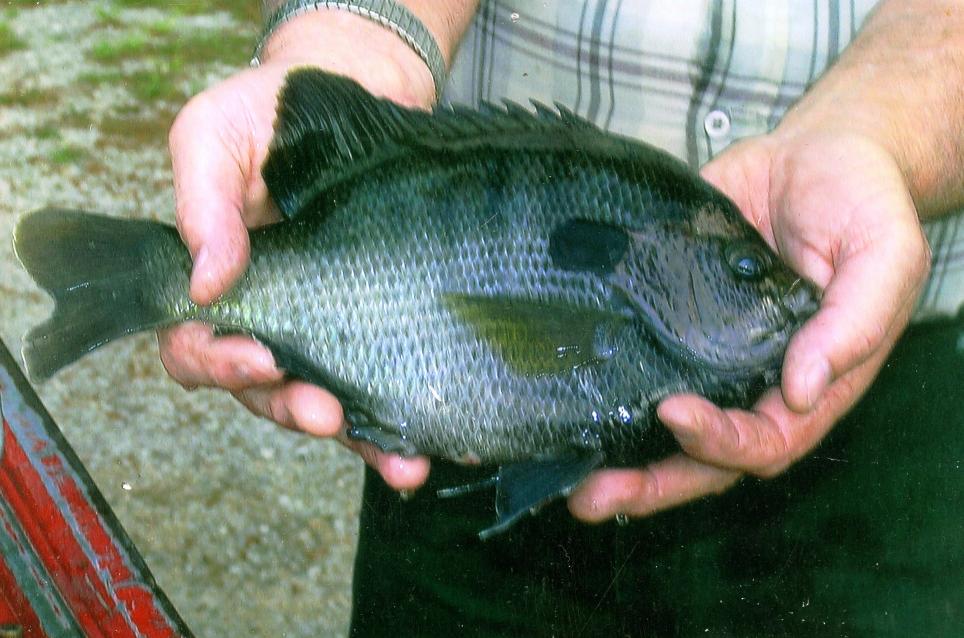
From what I have been told about bream in the south, that would not normally be consider good management practices because the reproduce so frequently. There will be fish on the beds here for 5 months, makes the bass happy, happy, happy. But leaves the bream small if not removed. I emailed this photo to a few friends yesterday, the guy holding the fish raises them to stock pond over in Mississippi. This is a Coppernose Bluegill, 23 oz. 12 1/2" long. To get a preceptive of the size of the fish save the photo and blow the total format size to 15", the resultant size of the fish is lifesvize. This is the result of a very well managed pond, feed and fertilizer.