Q.
Hatcheries and hatchery programs have come
under fire lately for numerous reasons, but
especially the issues of gene dilution and
costs associated with stocking fish in marginal
waters for questionable recreational value.
Very little discussion has been given to the
pollutional effects of hatchery effluent. In
some situations the presence of a hatchery on
a stream can have serious consequences. In
central PA there is a limestone spring creek
that has lost its native brook trout due to
hatchery effluent. The gravel interstitial
water in redds becomes hypoxic (DO values~4.5ppm)
after 40-60 days. Benthos in the upper 3 mi.
below the hatchery consists mainly of pollution
tolerant forms, especially isopods. We found only
two references to failure of reproduction below
hatcheries (both European). Are you aware of the
potential of hatchery effluent to cause these
kinds of problems? References?
A.
I’m sure there are places where hatchery effluents
can degrade water quality downstream, but I would
also guess that problems are largely site specific
depending on the characteristics of the effluent
and the receiving stream. One of the ongoing
plans to enhance anadromous salmonid returns
to the Yakima River system in WA was to add a
series of rearing ponds in the drainage to
supplement natural reproduction. I was asked
to determine if the effluents would have any
effect on the primary production (algal growth
and oxygen production) in the receiving streams.
I examined this by determining how much nitrogen
and phosphorus would be added from each pond,
whether this would change the existing ratio of
nitrogen and phosphorus in the stream, and
predicting whether the change in the nutrient
regime would be significantly enough to enhance
algal production. In no case did the added
effluents change the nutrient regime significantly.
Now, this is just one situation that I was involved
with, and I was not concerned with benthic fauna.
I’m not sure whether this was published by the
state or not; I retired and left the lab and have
lost track of what happened to the report. I
could find out if you want me to pursue it;
contact me at cecushing@aol.com.
If you have a question, please feel free to contact me.
~ C. E. (Bert) Cushing, aka Streamdoctor
105 W. Cherokee Dr.
Estes Park, CO 80517
Phone: 970-577-1584
Email: streamdoctor@aol.com
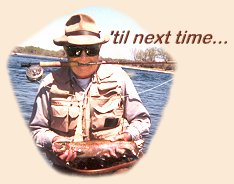
The ‘Stream Doctor’ is a retired professional stream ecologist and
author, now living in the West and spending way too much time
fly-fishing. You are invited to submit questions relating to
anything stream related directly to him for use in this Q & A Feature
at streamdoctor@aol.com.
Originally published July 19th, 2004 on Fly Anglers Online by Robert Younghanz.