| Sysadmin Note |
|---|
Case #2: PMD on Lamar River & Soda Butte Creek – Part 1
In General
First things first; Pale Morning Dun (Ephemerella excrucians & Dorothea Infrequens) are not peculiar in our area but an anticipated hatch that presents joyful actions to both trout and anglers in many area waters. The most famous and notable actions are during the period from late June to early July on Livingston’s spring creeks (Armstrong’s, DePuy’s, and Nelson’s). (NOTE: PMD hatches trickle down as summer goes by but it’s still a viable hatch that trout rise for. Also PMD actually hatches and is observed all through the year.) In northeast corner of Yellowstone National Park, fishing seasons arrives a little later than the surrounding areas. PMD hatches also come late, of which prime time is in August.
Understanding Cutthroat
Native Yellowstone Cutthroat is well-known and popular for their rises to dry-flies, especially to large attractors. Such instincts of Cutthroat and effectiveness of attractors are true. It’s not overly difficult to understand. Cutthroats spawn during early summer (June to part of July). Waters in NE are still in runoff conditions during those days. Once the water clears, it coincides with the time when cutthroat start to feed after spawning, prime feeding time just like other trout species. So, now you get a picture, seeing big dry-fly = big meal floating above, hungry cutthroat are going to grab them!
What’s New?
So the hatch is well studied. However this hatch would look peculiar to visiting anglers if they have high expectations and images of big rises on big attractors and if they aren’t able to change their views and to adjust the fishing situations. I can’t emphasize the fact NE waters are some of the best match-the-hatch fishing among Yellowstone Park waters and also rival many other waters in Montana. When insect hatches occur, these formerly easy-to-rise cutthroats are going to be super selective inspectors. They definitely rival their cousins in the Livingston’s spring creeks. If anglers are not prepared to match the hatch with the right flies they will be nowhere close to catching. Indeed cutthroat can ignore anglers and their miss-matched flies without any mercy.
One Day in Lamar
That was on one August day in 2011. The year is remembered as one of the highest water years in the history. Most waters in our area were not fishable until August. The Lamar River was no exception. I was fishing the popular meadow section (Lamar Valley), walking down-stream. When I look back now, after two summers of normal flows, it’s still interesting to me. The high water of 2011 created a couple of braids in the meadow sections and kept flows going all through the summer. I don’t mind telling you exactly where (though it’s hard to describe) as it’s been dry for the past two seasons! I guess the high flows kept the water cool and that made cutthroat wake up late and slow. I was fishing and walking till I reached one particular braid, I caught a few cutthroat on small dry-flies but not with big ones. Then suddenly I saw a group of rising trout right at the head of the braid. They were constantly rising and sipping on something. I looked around in the air and on the water and figured out PMD were hatching on good numbers.
Just Like at Spring Creeks
At that time, I was nowhere close to what I am now in terms of knowledge, understanding, and fly selections. I still had a pre-conceived and amateur idea: “even though cutthroats seem selectively feeding, they are still ‘Cutts’. They will rise on any well-presented dry-flies that looks like mayflies.” I was totally wrong. Though my fly presentations were not bad (down-cross and drag-free), I just couldn’t take them at all. I even got on my knees on rocks (which were not comfortable even with waders on) to get a little closer. At least I brought good number of PMD patterns (I recall at least I must have known of PMD hatches on the Lamar). I tried every fly with every two-fly combinations I could think of (dun plus emerger, emerger plus bead head nymph, etc.). Nothing worked. Though I couldn’t tell when, the clock was ticking to the end of the hatch. Further frustratingly, a couple of trout among the group looked just like submarines!! I hope my readers get a new picture now, which is just like one typical scene at spring creeks during intense insect hatches. Yes, that’s what will happen on the Lamar.
Solution Fly
All the flies I used were generic and locally known patterns. All were my ties and shouldn’t have been bad looking. I was getting slightly desperate. Then I noticed that I brought another pattern, which I was just developing at that time.
| Yamamoto’s Pheasant Tail Mayfly Cripple * Hook: Standard dry or Emerger size 16 & 18 * Thread: Light olive 12/0 * Tail & Abdomen: Pheasant tail * Rib: fine gold wire, counter-wrapped * Wing: Synthetic fibers such as EP Fiber, Poly yarn, Widows’ Web. White and gray work well. Black can be used for low-light overcast conditions. * Thorax: Superfine dub, PMD olive * Hackle: Dun |
Just as a last resort and without much expectation, I gave a shot with this fly. Believe or not, this was the only fly that was taken by them!! The very first (and finally!!) was a really large one. It broke off my tippet with the fly on. I recall I had one or two more of PTMF Cripples. I tied on the next one and it still worked. I hooked a couple more instantly but all were gone before coming to my hands and camera. That’s why there are no pictures here. But I still remember the whole incident vividly. Hatches and rises lasted probably two hours and a bit longer.
I came back to the same spot for a couple more days during the summer. Repeatedly I had both exciting and frustrating feelings. My own PTMF Cripple kept working and developing its own effectiveness and entrusting from me. After the PMD hatches were over, the cutthroat seemed warmed up and started taking large attractors and hoppers through the afternoons.
Planning a Day on the Lamar
“Be prepared” summarizes it all. First have good “match-the-hatch” flies. PMD hatches usually starts mid-morning and lasts for over two hours, so plan where you would be and when you want to have lunch. Then after the PMD hatch you can fish with attractors and terrestrial dry-flies all through the afternoon. As for “where”, the Lamar consists of many text-book holding structures. Of course if you spot risers, that will be great. But even if you can’t spot them or the likely spots are occupied by others, walk along and look for structure.
Satoshi Yamamoto, https://leftyangler.blogspot.com, is a guide and a professional fly-tyer in Livingston, MT.
| Sysadmin Note |
|---|
| Sysadmin Note |
|---|
Case #2: PMD on Lamar River & Soda Butte Creek – Part 2
At Soda Butte:
Soda Butte Creek is one of major tributaries to Lamar River. Indeed its junction to the Lamar is as popular and crowded as “Junction Pool” on Madison River (where Firehole and Gibbon Rivers merge). Food sources, effective flies, holding waters, and trout actions are very much the same as for the Lamar. The only one difference is the volume is far smaller. Yet this doesn’t mean the sizes of the cutthroat are smaller than those in the Lamar. Indeed one can be surprised by the sizes and quality of cutthroat on the Soda Butte.
Another PMD Memory:
Introductions to cutthroat behavior and PMD hatches are the same as stated in Part 1. In this part, I’d like to share another fond memory while fishing the hatch. In the middle of August last year, I guided a group of two gentlemen. One angler was really skilled and his own flies in his boxes were really good. We didn’t see many other anglers on that day along the creek so we could fish anywhere we wanted. I suggested to start with hopper or foam attractors (not gigantic ones) plus a bead head nymph trailed below. Considering the clients’ skillsets and situation, I thought we would have a good start and trout would even rise on hoppers! I was wrong. It was really slow for us at the beginning. However, I wasn’t worried at all. I knew we would see good PMD hatches. So I encouraged my clients to hang in there. Just around 10:00 to 10:30 a.m., we started to see rises. Also we started to see trout actively feeding in the deep pools. “Suddenly they became visible! Where had they been?” That’s the typical response from visiting anglers. I set each of client a bit apart and I left a more skilled angler with good supply of flies alone and worked with the other client at the beginning of hatch. Eventually we regrouped. The skilled angler was doing well as we caught up. He was enjoying dry-fly action, but also I noticed several trout were feeding in the water column of the pool where he was fishing. The scene was very familiar to me. It was just like trout feeding on ascending nymphs during PMD hatches on the Livingston spring creeks. My client and I had generic flies, which working well, but I knew I could do better. I quickly went back to my truck and picked up my “spring creek” flies (the best part when fishing road-side streams!!). I tied on my own Pheasant Tail Mayfly Cripple (covered in the previous chapter) trailed with the must-have Sawyer Pheasant Tail Nymph (Master Angler version).
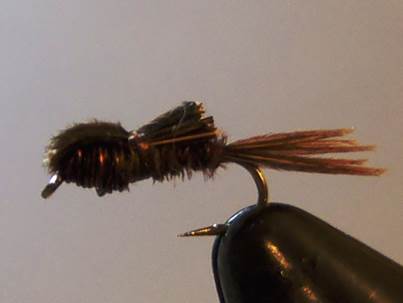
Pheasant Tail Nymph – Master Angler Version
- Hook: standard dry size 16 & 18
- Tail, abdomen, & Wing-pad: Natural pheasant tail (dyed brown, yellow, and olive can work)
- Ribbing & thorax: small copper wire
He went on fishing and indeed hooked into the nice cutthroat feeding in the water column with PT. It wasn’t surprising to me considering the client’s skill and my observation but very satisfying, of course!!
| Nice one! | Bigger ones’ lunch menu: more nymphs than duns. |
After lunch we had good fishing with hoppers, ants, and beetles, and my clients caught even larger ones.
Sweet Little Creek:
The Soda Butte can be as popular and crowded as the Lamar and any other road-side streams within Yellowstone Park can be. So it’s the same story as at the Lamar. Most visiting anglers fish with large attractor dry-flies. They even seem to spend such short periods as if the Soda Butte is just a quick stop with the easy catching of little cutthroat. However, I can’t emphasize the quality of this sweet stream as “match-the-hatch” water. Soda Butte offers high quality dry-fly fishing with respectable sizes of cutthroat.
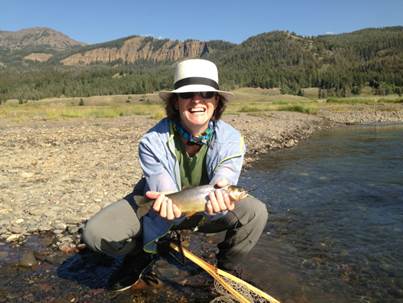
Satoshi Yamamoto, https://leftyangler.blogspot.com, is a guide and a professional fly-tyer in Livingston, MT.
| Sysadmin Note |
|---|
| Sysadmin Note |
|---|
Case #3: Flying Ants Mating Swarm on Slough Creek Below Campground – Part 1
I will never forget this whole event and experience. It’s been deeply engraved on my brain. This might be why I decided to write this series, with this story being the most highlighted.
One early September day in 2011, I went fishing to the Lamar. I was planning to hike upstream as far as I can but there was a warning sign of bear activity in the area. I was by myself so I decided to turn then I hit Slough Creek below campground (hereafter Lower Slough). I caught some trout on either Green Drake or baetis (Blue Winged Olive) dry-flies. Though there were no apparent hatches, trout were willing to rise for a period. After rising actions seemed over, I walked along the creek downstream. It was almost 5PM. If there were no more actions, it was about time for me to head home, just like other visitors. However, just out of sudden, I started to see rise-rings one after another at one of typical flat-water spots of Lower Slough. Soon actions became so intense. I heard violent gulping sounds all over. I thought “what’s hatching? Real green drakes?” As I looked around in the air and on the water, I realized it was the swarm of huge flying ants (winged ants). Soon I recognized those bigger ones were females as tiny midge-sized counterparts (males) were hanging on their abdomens. So it was the mating swarm!!
| Huge & meaty queens | And their poor little counterparts….. |
Painful & Desperate
Because of the season, I did carry some ant patterns or attractor foam patterns that might work. I tied on my selections and started casting. I was nowhere close to get any attention from trout. I changed flies and then tried. I was given the same no-response treatment. Besides flies, I also changed my angles of casting several different ways. I tried again, again, and again………… Swarm lasted about one hour for what I recall. All through those minutes, I was totally ignored while trout kept feeding delightedly with gulping sounds all around me. Trout treated me as if I were casting from the Mars. Worse, most likely they didn’t care my existence at the creek. It was way beyond the level of frustration. I was totally ignored and defeated to the core of my soul. I literally couldn’t move when swarm was over and trout and water went quiet. I barely got back to my truck and drove home. I thought I would throw all of my gears to the woodstove and burn them, then I would commit suicide and be done with fly-fishing!!
The Fly
In this case, several sips of adult beverage at that night helped me sober up from those desperate feelings. Next morning, I was able to review the situation and face my problems. First of all, I wasn’t ready for this sudden event so I didn’t have flies in right sizes and colors. Then second, it’s the character of Lower Slough. I would have to drive about 80 miles and 90 minutes to get the creek but I could do something with flies right at my tying bench (I will cover the character of Lower Slough in next chapter). Also I heard some tips that the mating swarm can happen more than once a year from outfitters I worked with. But I could tell it would be very soon. I knew I wouldn’t have a month, even a week, otherwise I would have to wait till next year. I wouldn’t take the thought of carrying this feeling for a year. I had to be quick.
The first problem was: those ants were in totally unordinary sizes. Females were in sizes 10 to 12, while males were in size 22, give or take, just like midges. For females, I figured out that just tying/adjusting existing generic patterns wouldn’t do as they have such distinctive features. I had to come up with something quickly. Huge abdomen, segmentations, legs, wings, and colors…….. I came up with this and named S.C.Ant Queen. Once the idea for females was designed, the male version came right after (which will be covered in the next chapter with another story). S.C.Ant apparently stands for Slough Creek but also I meant “without this fly during the ant swarm, you catch will be SCANT”.
| Yamamoto’s S.C.Ant – Queen (top) * Thread: Black 6/0 * Hook: Dai-Riki 280 size 10, 12, 14, & 16 * Body: Brown or Tan Foam for Rear Guster and Black Foam for Front Two Segments * Wing: Montana Fly Company Wing Material * Legs: Black Bug legs or Span-Flex | Actual size on my fingers |
Next Attempt
I decided to hit the creek 3 days later. Now I had a fresh fly pattern that might solve the problem. But the real question was: will the swarm occur again? Actually once I got the creek, I was slightly overwhelmed by the dreadful experience of only 3 days ago. It was slow in the morning. Then I picked up several trout in the afternoon with Green Drake or Baetis dry-flies just like 3 days ago. I waited patiently, crossing my fingers for another swarm. At 5PM, there was no sign of actions. I was at the lower end of the meadow so I started to walk back. Yet slowly. It seemed no second chance for me for the year. It looked like I had to hold off till next year. I couldn’t even test my new fly. It sounded so cruel. Then, out of very sudden, just around 6PM, I started to see the swarm of flying ants and hear gulping sounds of trout. The Fishing Lord hadn’t forsaken me yet!!
This time, I happened to be on the top of high cutbank. Besides rise-rings and gulping sounds (which are also noticeable from the lower bank on the other side), I could also observe the trout; how they swim, when they rise, and where they go. Now everything came to senses; why I failed 3 days ago and what I should do now. I spotted one trout that was aggressively cruising and feeding on any ants available. I targeted that one. Single it out.
| Queen was voraciously eaten by a hungry & cruising cutbow. |
Curse was freed. I conquered the battle against the creek, trout, ants, and fear within me. I came back to my usual self.
Satoshi Yamamoto, https://leftyangler.blogspot.com, is a guide and a professional fly-tyer in Livingston, MT.
| Sysadmin Note |
|---|
| Sysadmin Note |
|---|
Case #3: Flying Ants Mating Swarm on Slough Creek Below Campground – Part 2
Understanding Lower Slough Creek
As I mentioned at the very end of the previous chapter, the most important key to be successful at the Lower Slough Creek is to spot and observe trout (on top of possessing right flies and proper skills and understanding hatches). The character of flows is one of a kind: it’s so slow that trout can cruise anywhere to feed, even during hatch periods. Consequently they can rise to top from any directions unlike typical trout in typical streams that usually face and feed at the upstream direction. But it’s still a flow that is very enough to cause drag on our leaders and flies. That’s why I tell people “Lower Slough is the toughest public spring creek in the world!!”
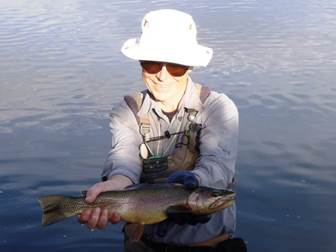
Only if you are lucky and patient……..
In 2012
Toward the end of August in 2012, I started to fish the Lower Slough in between guiding schedules. I was waiting for the traffic in the Park would be slightly slowing down. Then my biggest expectation was again to hit (or be hit by?) the swarm of flying ants. It actually happened at the same time of the day on the same date. I smirked myself. I saw many rise-rings with gulping sounds all over. I tied on my S.C.Ant Queen with confidence and started casting. However, the creek, trout, and ants were one-step ahead of me again. This time, sizes of females were 14 and 16 in light brown, almost tan, color. Trout recognized my S.C.Ant Queen (in the previous chapter) as the gigantic fake. Then again, the character of the creek never helped me hide that fact to trout. All I received was their usual “third degree inspection”. I actually caught a few but those were just lucky bites.
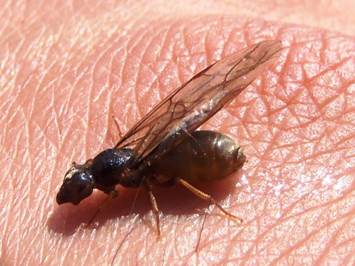
Queen 2012
Aftermath
“Well, new homework every year”, I thought. Females were flying in the air and falling on the water (along with tiny males on their butts) probably over an hour. I thought of leaving. However, just after a short period of no actions, I started to see many and constant rises again. This time, those weren’t gulping rises any more but gentle sipping rises. I thought “midges?” I noticed some cream midges were flying around me. I got off from the steep cutbank and got close to the surface. Those were tiny male flying ants. No more females around but those bachelors who couldn’t find their mates were committing desperate solo dives to the water!! Indeed they looked like midges and trout were feeding as if they were feeding on midges. Hence I performed just as I would fish for midge with tiny ant patterns such as my S.C.Ant Male.
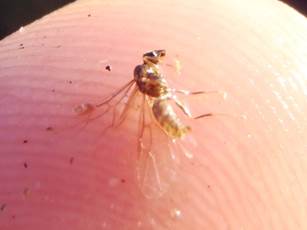
Bachelors on desperate solo dives.
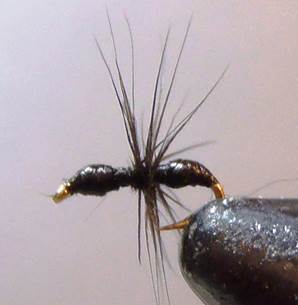
Yamamoto’s S.C.Ant – Buck
- Hook: Standard dry-fly hook size 20, 22, & 24
- Thread & Body: 8/0 Black
- Legs & Wings: hen cape hackle grizzly or black
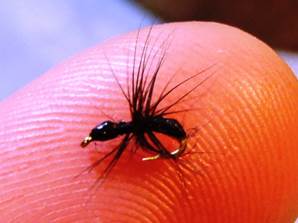
Actual S.C.Ant-Buck on my finger
I figured out what was going on but this type of fishing was not easy at all. Then again, I wouldn’t know how long actions would last. I targeted rises in a little back eddy where these tiny foods were congregating. There seemed to be a group of trout there. Situation called for 6X tippet and gentle drag-free presentations. Also I had to calculate the timing of their rises. I concentrated on each cast. I lost the sense of time or the fear of when the action would end. I finally got hooked. Big & Strong!! After breathless and intense tug-of-war, I brought him in…….
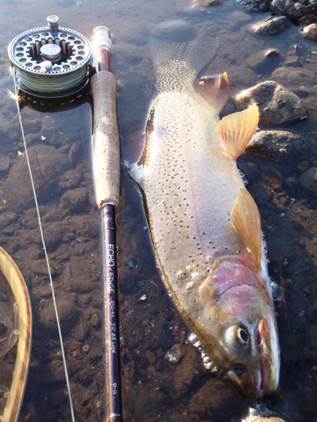
Typical Lower Slough Cutbow!
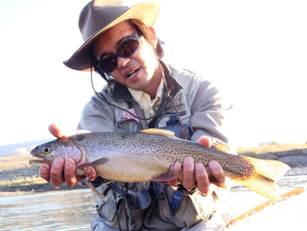
I was very satisfied and could praise myself little a bit. Actually that wasn’t the end of the day. Rises continued very long even after dark. It was very tempting to keep fishing but it could be against Park fishing regulation (fishing during daylight hours) and then I just couldn’t see or figure out what trout were feeding on any more. I left the meadow for my home at almost all 9 PM……
Satoshi Yamamoto, https://leftyangler.blogspot.com, is a guide and a professional fly-tyer in Livingston, MT.
| Sysadmin Note |
|---|
| Sysadmin Note |
|---|
Case #4: Green Drake Feeding Frenzy – Part 1
Green Drake:
Western Green Drake (Drunella grandis), like the PMD discussed before, is not a minor but super major and popular hatches for both the trout and anglers in Yellowstone Country. They are huge and gorgeous mayflies. When they are present in the air or on the water, it’s hard to miss.
| At Slough Creek | One of my stomach pump results |
Chasing and fishing for hatches, I always notice something funny with trout behavior. In my personal view and interpretation, this is the hatch when trout exaggerate themselves more than anglers do. Of course, when hatch is strong and insects are apparent trout act aggressively. But even when hatch is sparse, trout seem to compete among themselves about who is going to rise and feed. Furthermore, several days (or even longer) prior to the actual hatch, Green Drake patterns are taken by trout. Those could have been taken as attractor dry-flies but I strongly believe trout recognize them and feed as if the Green Drakes were already hatching. Information from guide books and magazine articles would help but observation and noticeability at streams are real keys to decode what trout are doing.
At the Gallatin:
The Gallatin River within Yellowstone Park (and sections in Montana along US-191) is definitely one of the most scenic rivers in the area. It’s not wrong to call it “Little sister of the Madison” as some would do. The Gallatin is one of the coldest rivers around here. Hence the season may start later than other rivers in the area. Therefore, most anglers think of the Gallatin as an attractor dry-fly and terrestrial water. However, the Gallatin does have insect hatches and does offer some decent match-the-hatch fishing. One of those insects is Western Green Drake.
I had one day scheduled to guide this section in early August. So prior to that, in late July, I went to test the water. On both days, the water was really cold in the morning. Searching pockets and pools with nymphs under an indicator was the good way to get started. Then, on both days, the real action started in the afternoon (right after lunch time) as if by clockwork. When I was on my own scouting, I actually saw rises; very subtle on tumbling surfaces of the pool, but my eyes didn’t miss those tiny movements. I did bring Green Drake patterns with me. Readers may wonder and ask “so was there actual hatch?” I’d say “Yes”. “Did you see them in the air?” “Not really”, I would answer. Then “why would you know?” readers would ask. My answer is “knowledge, experience, and observation”. But the fact is “ask trout!!”
| Very hefty 'Bow!! | Pump result |
When I took one client to fish the Gallatin it was the same scenario. This time we didn’t really see rises after lunch. No insects were really observed in the air or on the water either. Yet I encouraged my client and had him fish with Green Drake patterns.
He was totally in an awe of this clockwork like action. He kept asking me “why would they rise? How would you know?” Well, simply because I scouted several days ago. But the fact is “trout know better than I do!!”
Killer Flies:
I don’t think you will ever find these patterns at fly-shops as these are totally original.
| Master Angler’s Green Drake Soft-Hackle * Hook: Standard dry #10, 12, 14 * Thread: Olive dun 8/0 * Abdomen: Turkey biot, dark-olive (BWO) * Thorax: Superfine dun, dark-olive (BWO) * Hackle: Grouse, partridge – dark & gray feathers | Yamamoto’s UFL Green Drake * Hook: Standard dry #10, 12, 14 * Thread: Olive dun 8/0 * Rib: Yellow 6/0 * Tail: monofilament or 6X tippet, painted black and passed through the extended body * Extended body and underbody: Used fly line in dark green, olive, sage, that sort. * Body: Superfine dun, dark-olive (BWO) * Wing: EP Fiber, Widows’ Web, or other synthetic materials in white or gray * Hackle: Olive dyed grizzly |
Another Roadside Fishery
The Gallatin is just another river that runs along a major highway (US 191) from West Yellowstone to Bozeman (and beyond). There are plenty of accesses and each section has different structures and offers a different kind of fishing situation. However, it doesn’t seem crowded, compared to other roadside rivers in the area (many other waters within Yellowstone Park). In other words anglers (local and visitors) don’t seem to spend enough time (which works for me!). “Little Madison” does not imply fish there are little. Indeed regardless of body sizes, those trout thriving in this cold water are really strong once hooked. Better hang on tight to your rod and watch your steps on the rocks as you chase them downstream.
Satoshi Yamamoto, https://leftyangler.blogspot.com, is a guide and a professional fly-tyer in Livingston, MT.
| Sysadmin Note |
|---|
| Sysadmin Note |
|---|
Case #4: Green Drake Feeding Frenzy
Part 2 - NE YNP waters
First of all there are many good days when anglers encounter apparent Green Drake hatches and trout rising for them accordingly. Streams in northeast side of Yellowstone National Park such as Lamar River, Soda Butte Creek, and Slough Creek are famous for these hatches. So if you hit one of good days filled with hatches and rises you are in fisherman’s paradise. But then again, it’s interesting to note how trout behave before the hatch and even when the hatch is sparse to none. It’s the same scenarios as discussed in the previous chapter about the Gallatin River but I never believe it’s redundant. Indeed, it’s important to know if one wants to fish this breathtaking setting at least once and catch native Yellowstone Cutthroat. Before the Green Drake hatches and when the hatch is sparse to none trout in this area seem to make a Green Drake out of our well-presented dry-flies and take them with confidence. Is it because of taste, texture, silhouette, or something else? We could only guess since those factors are programmed in a trout’s brains from previous feeding experience along with the time of year. Then those experiences must have been wonderful for cutthroat.
Season:
September is the prime month for Green Drake hatches at the aforementioned streams. However I tie on Green Drake patterns for my clients from late August (even in early August). It turned out to be great for everyone (maybe not be for trout).
| Lower Slough Cutbow | Native Cutty from Soda Butte |
Flies:
This is another set of flies developed by YNP guides and proven by native cutthroat.
| Master Angler’s Green Drake Flymph * Hook: Standard dry #10, 12, 14 (Dai-Riki 280 #12 & 14 also make good flies) * Thread: Olive dun 8/0 * Tail: olive-dyed grizzly hackle fibers * Abdomen: Turkey biot, dark-olive (BWO) * Thorax: Superfine dun, dark-olive (BWO) * Hackle: Grouse, partridge – dark & gray feathers | Yamamoto’s UFL Green Drake Parachute * Hook: Standard dry #10, 12, 14 * Thread: Olive dun 8/0 * Rib: Yellow 6/0 * Tail: monofilament or 6X tippet, painted black & passed through the extended body * Extended body & underbody: Used fly line in dark green, olive, sage, that sort. * Body: Superfine dun, dark-olive (BWO) * Wing: EP Fiber, Widows’ Web, or other synthetic materials in white or gray * Hackle: Olive dyed grizzly |
| Yamamoto’s Pheasant Tail Mayfly Cripple – Green Drake * Hook: Standard dry #10, 12, 14 * Thread: Olive dun 8/0 * Tail & Abdomen: Olive dyed pheasant tail * Rib: fine gold or copper wire * Thorax: Superfine dun, dark-olive (BWO) * Wing: EP Fiber, Widows’ Web, or other synthetic materials in white or gray * Hackle: Olive dyed grizzly | Yamamoto’s Winged Victory – Green Drake * Hook: Standard dry #10, 12, 14 * Thread: Olive dun 8/0 * Tail & Abdomen: Olive dyed pheasant tail * Rib: fine gold or copper wire * Thorax: Superfine dun, dark-olive (BWO) * Hackle: Olive dyed aftershaft from any bird skins * Wing & Split wing-pad: Round rubber-leg, round & black |
Sight-Fish Tactics:
Sight-fishing during the Green Drake period is quite challenging as well as quite rewarding. Not many anglers try this because:
- They don’t know how to do it; instead they stick at one spot with one method
- Sight-fishing can be really technical.
First, one has to spot cruising trout and get as close as one can. This is the hardest part. During the late season water levels get low and trout become wary after all the summer fishing traffic. Second, one has to make a quick and accurate cast. It’s not a long demanding cast. Rather a short cast, even Bow-&-Arrow casting or Dapping, is all one needs. But this is hard to perform if one is not used to this type of fishing. Third, and the most critically, setting the hook on gently rising Yellowstone Cutthroat (or rainbow and cutbow hybrid at Lower Slough) is very technical. Often we end up pulling our flies out of their mouths because we get so excited seeing cutthroat rising with their large mouths open that we set the hook before they close their mouths. This commonly occurs whenever we are fishing for Yellowstone Cutthroat. But if one hits a right day with the right flies, one can be happy like this.
| Some of the nicest Cutty in the area! | Up close & personal |
So, don’t be discouraged when you don’t see actual hatches and rising trout or when your favorite spots are taken.
Satoshi Yamamoto, https://leftyangler.blogspot.com, is a guide and a professional fly-tyer in Livingston, MT.
| Sysadmin Note |
|---|
| Sysadmin Note |
|---|
Case #5: Midges in the River
Winter Midging:
It is true that midges will hatch during winter months (let’s define winter months as from December to February for this chapter) and trout will rise. If one hits it right, one can have superb dry-fly fishing for a short while. Conditions we wish for are: no wind and slightly warm (around freezing point 32F or 0C is warm enough for die-hard local anglers). Then some of readers may speculate that I’m fishing at Livingston’s spring creeks. Spring creeks are ice-free and water temperature is slightly higher than Yellowstone River. Yes, I fish DePuy’s Spring Creek (www.depuyspringcreek.com) with a winter pass (as I wrote in a series last year). But also, I do hit the Yellowstone River during winter months when conditions are right. Over the last couple of winters, I’ve been observing something interesting to note. I came up with a comparison.
In The Big River:
When I decide to hit the water on a non-windy and slightly warm winter day I have to choose either DePuy’s or the Yellowstone River. Since I can go and fish DePuy’s any time with the winter pass, I try to push myself to fish the Yellowstone. Besides, on a nice winter day other pass holders would hit the creek, so I could ask them about the fishing conditions later on, while I could be the only one that fishes the river.
On the Yellowstone, I have had good dry-fly fishing with midges during the winter months. Good time would be the warmest period of the day = 1 to 3 p.m. Fish may not be as big but it’s really fun. I have caught rainbows, cutthroats, and whitefish on tiny midge dry-flies.
| Midge Adult | Pupal shuck |
In The Creek:
After those good afternoons on the river I would ask other local anglers who had fished DePuy’s if they had seen midge hatches and rising trout. Or oftentimes I would go fishing on the creek in a few days. I would expect to hear and see dry-fly action on the creek. As long as I’ve been conducting this observation and survey I haven’t heard or seen good midge dry-fly actions at the creek, while I was having good time on the river. Isn’t it “supposed to be” opposite? The spring creek is warmer and holds more midges than the river, so midge hatches and trout rises are “supposed to be” more prevalent at the creek! Indeed midges are abundant and present in the air and on the water at the creek. However, do trout rise? Not really. Why? Why in on the river and not on the creek?
Think Like Fish:
If I just think like a normal human being, my answer is “I don’t know and who cares”. If I think like an average fisherman, I would answer “conundrum!” and it has been so. However, I came to a point that I could, at least try to, think like a fish. “What would I do if I were one of fish in the stream system around here?” If I were strong enough, I would swim up to the creek. In the creek, there are many food sources. Many of those are underwater organism who don’t hatch, at least during winter months (scud, sowbug, midge larvae, cranefly larvae, leech, sculpin, the list goes on). So “if I would see this many abundant underwater food sources, would I rise for tiny midges on the surface?” I wouldn’t think so. Indeed, if I catch trout with the nymph rig at the creek during winter months, they are all respectable sizes. While on the river, all I would catch are nonchalant small ones. The Yellowstone River does not hold as many scuds and sowbugs as the creek does (both of which are year-long constant food sources on the creek). Also during winter months, miscellaneous nymphs and larvae are very much dormant and not available in great numbers for river trout. So trout who are not strong enough to swim up to spring creeks (consequently they tend to be smaller) feed on any food sources available at a time. This includes rising activities on midges. This is my answer to the conundrum deduced by “thinking like a fish”. Yes, it took me a while to think like a small fish that rises on midges!!
Flies:
These flies have been working very well on both the Yellowstone River and spring creeks any time of the year when trout rise during midge hatches.
| Yamamoto’s Foam Wing Midge Emerger Type 1 * Hook: Emerger #20, 22, 24 * Thread & Abdomen: Black 16/0 * Rib: Fine silver wire * Wing: Foam, color of choice * Thorax: Peacock herl | Yamamoto’s Foam Wing Midge Emerger Type 2 * Hook: Dai-Riki 270 #20, 22, 24 * Thread & Abdomen: Black 16/0 * Rib: Fine silver wire * Wing: Foam, gray, dun, or white * Thorax: Peacock herl |
| Type 2 was gladly chewed off. |
Trout That Talks…..
This is solely my theory based on a one-man study. I simply can’t be in two places at the same time. Although I’m talking to reliable sources, not everybody fishes like I would do. I believe my observation is beyond the level of speculation, yet I never meant to conclude anything here. Till I catch a trout that talks to me.
Satoshi Yamamoto, https://leftyangler.blogspot.com, is a guide and a professional fly-tyer in Livingston, MT.
| Sysadmin Note |
|---|
| Sysadmin Note |
|---|
Case #6: Bee Swarm on B-Day
Although this story is not based in Yellowstone Country, as I wrote this series I reminisced of this experience. I believe it’s very relevant to the topic.
Surreal Experience on My Birthday:
It was probably the most surreal experience in my life, fishing and any other things included. Several years ago I lived in eastern part of Washington State. There were some good trout fisheries in the area, with Yakima River probably the most well-known. My best kept secret and favorite was the small mountain stream filled with native Westslope cutthroats and wild rainbows. The Westslope tended to be larger than the rainbow. The largest being 15 to 16-inches, any Westslope 12-inch or larger were always beautiful. This stream was suitable for one day or for one overnight camping with the mix of other streams in the area. Although fishing was consistent and always fun, I didn’t want to fish it out. It was such a lovely stream. (Though usually I’m open to discuss which streams and even spots, I’ve never mentioned the name in my blog. Now I don’t live there any more so don’t ask me!)
At that time I was already grown up too old to feel special about my birthday (early August). Yet ideally I didn’t want to work but go out fishing. Somehow fishing on my birthday has been special (even now). When I could take a week or longer leave from the job at that time, I made fishing trips to Montana (go figure where I live and what I do now). In that summer, I couldn’t take a week-long break but barely managed to take one day off on my birthday. So I decided to hit this creek. Honestly I didn’t expect much as I drove. In the previous year, my favorite and the most productive hole (5 to 6-foot deep) had been buried with rocks (I had guessed it was due to run-off). Consequently nice size cutthroats also had seemed to be gone. Yet this creek was the only one option on that day. Anyway I hiked to the hole. As I was getting closer, I noticed there were many bees flying just along and above the stream. They were not stinging kinds at all (sorry, no pictures). As I got the tail-out of the hole where I usually started fishing, I felt “BUZZ”. I’m not making jokes here. Yes, bees were buzzing in the air but also I “felt”, or probably “perceived”, “BUZZ” steaming up from the hole (I might have had some adult drinks the night before but I was sober enough to walk on rocks and in the water without collapsing). Without any hesitation, I rigged up two dry-flies: bee + attractor dry flies. As my flies fell on the water with the first cast, trout swam up to attack with ferocity!! This was the BUZZ I felt steaming up from the hole. Trout must have recognized bees flying above them but they had no way to jump at that high in the air.
| Typical appearance of Native Westslope in Eastern WA. | Another Bee-Swatter!! |
One little trout bit on the attractor dry and pulled down my leader. Then a much larger Cutt darted to the bee pattern!! For a while I literally had a “double” (lost the larger one, I recall). Also, more than once I observed larger trout were darted to the bee pattern when my leaders got dragged under water by currents.
As the pictures show I caught some nice Westslope cutthroats from the hole, all on the bee pattern. I was sincerely glad they were still there. They must have had survive, away from the buried hole, somewhere in that small stream. This feeding frenzy went on about one hour (could’ve been shorter, I don’t remember well). I started late so I was ready for lunch when the action slowed down. Now swarming bees around my lunch were slightly annoying (again they weren’t the stinging kinds). Although bees were present all afternoon, somehow the trout didn’t come up to take the bee pattern any more.
Bee Patterns
Since this experience I always carry bee patterns with me during summer months. These patterns have evolved through experiments and as my tying skills grew. Followings are two of my recent patterns. These work very well in waters I fish and guide; Yellowstone Park waters and floating rivers like Yellowstone and Madison Rivers; during summer months.
| Yamamoto’s Summer Buzz Bee * Hook: Scud or Emerger #12 & 14 * Thread: Black 8/0 * Rear Body: Cylinder foam black/yellow cut in half * Front Body: Black foam * Wing: White Zelon Windows’ Web, etc. * Legs: Small rubber-legs, choice of colors/barring. | Yamamoto’s Fountain Buzz Bee * Hook: 2XL curved #12 & 14 * Thread: Black 8/0 * Rear Body: Cylinder foam black/yellow cut in half * Front Body: Black foam * Wing: White Zelon Windows’ Web, etc., Parachute style * Hackle: Grizzly * Legs: Small rubber-legs, choice of colors/barring * Dubbing: black or yellow or both (I used yellow behind and black in front of the parachute post). |
Aftermath:
I fished this creek during the following summer for several days but didn’t see any bees at all. I had good fishing with respectable Westslope cutthroats at the same hole but nowhere close to the experience of the year before on my birthday. Even now, though I spend days the water fishing and guiding much more than then, I haven’t had days when bees were present in such abundance (without stinging us) and trout actively look up ONLY for bee patterns. I’m sure I’m not getting emotional, but the “BUZZ” I felt steaming up from the hole was something surreal and divine. It was the birthday present given to an old boy by the “Fishing god”.
Satoshi Yamamoto, https://leftyangler.blogspot.com, is a guide and a professional fly-tyer in Livingston, MT.
Originally published June 16, 2014 on Fly Anglers Online by Satoshi Yamamoto. Combined from 8 parts.