As we progress in this series, I will
assume you have mastered the steps in the
previous lesson. For instance, I won’t show
you how to start the thread, whip finish the
fly, the loose wraps needed to begin tying
down a material to the hook, or how to tie
that material down. If it’s been covered, we
won’t waste the time to cover it again. This
will allow us the time and space to progress
at a faster pace, and allow you to learn
more from this series.
This week we’ll learn how to dub a body and
attach a down-style wing. Most beginners
use too much dubbing, don’t wrap the dubbing
tight enough or use way too much hair in a wing.
The key to successful dubbing is to keep it
thin and tight around the thread. Practice makes
for a perfect fly, so practice these steps until
you have them mastered. If you need to, use a
razor blade to strip the hook and start over.
This is a building block to the rest of the
series and you must master these steps
before you can progress to the rest of the flies.
On with the series.
Midges are a significant part of the diet of
fish (especially trout) in lakes and streams.
This tiny insect hatches all year, often hatching in
the warm micro-layer of air just above the water’s
surface even in sub-freezing temperatures. Even in
the summer when many hatches occur on a daily basis,
trout and panfish will zero in on the midge as the main
source of their daily protein. For this reason it’s a
good idea to have a few midge patterns in your fly box.
Midges are usually very small, but some hatches,
especially in lakes, the midges can be as big as a
size 12, although most will be size 16 or smaller.
Start tying this pattern in a size 16 and work to
smaller hooks as your abilities grow. It’s a good
idea to have this pattern in sizes 16 to 22 if you
want to be able to match the hatch in most of the
circumstances. I tie it in colors that range from
brown and tan to cream and light yellow. It’s not
a bad micro-caddis pattern either.List of materials:
Hook: Eagle Claw L061B, Tiemco 100, Mustad 94840
or equivalent.
Dubbing: Anglers Choice pure silk, tan mink,
or any extra fine dubbing.
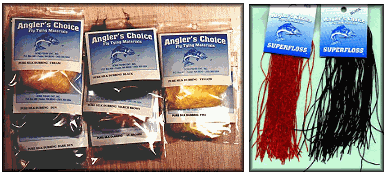
Rib: Anglers Choice Super Floss, black horse
hair, small black nylon.
Wing: Small cluster of pine squirrel tail
hairs or similar hair,antron.
Thread: Tan, brown, cream or black. I prefer
Gudebrod 8/0 or 10/0.Tying steps:
-
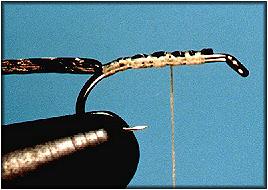
- Start the thread. Tie down ribbing material
to the hook bend.
- Start the thread. Tie down ribbing material
-
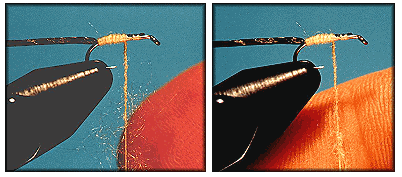
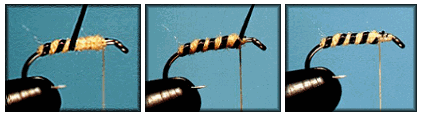
- Select a few strands of dubbing and
twist them around the thread with your thumb
and finger.
Be sure to keep the dubbing thin
or you will have a big clump of dubbing on
the hook and it won’t look natural. A few
strands at a time is all it takes. Your
dubbing should look like very fine, smooth
yarn on the thread. Make a few wraps, add
more as needed and make more wraps until you
have a body of the right proportions. I
stress this because most beginners use way
too much dubbing for the fly they are trying
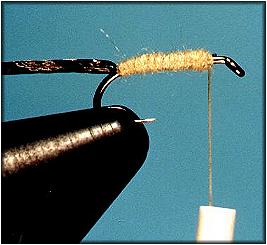
to tie. Dub the body to just behind the hook
eye, leaving enough room for the head of
the fly.
- Select a few strands of dubbing and
-
- Stretch the super floss to a thin,
thread like thickness. If using hair or
nylon, you won’t need to stretch it. Wrap
the ribbing material to the front of the body.
- Stretch the super floss to a thin,
-
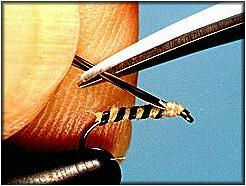
- Tie the rib off and trim.
-
- Build a thin thread base behind the
hook eye. This will help keep the
wing from twisting around the hook.
- Build a thin thread base behind the
-
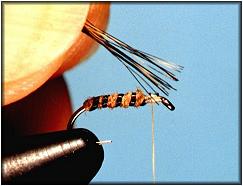
- Select a small cluster of hairs for
the wing. Don’t use too many hairs, about 12
will be enough.
- Select a small cluster of hairs for
-
- Make two loose wraps over the hair, keeping
the hair on top of the hook with your fingers.
Slide the front of the wing back to the hook eye
then tighten your first two wraps. Tie down the
wing with several more thread wraps. A slight
upward pressure will keep the wing from rotating
on the hook.
- Make two loose wraps over the hair, keeping
-
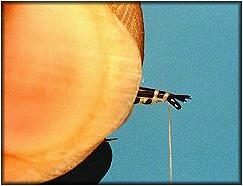
- Build the head up slightly and trim
or tie down any loose strands of hair. Whip
finish the head and cut the thread.
- Build the head up slightly and trim
-
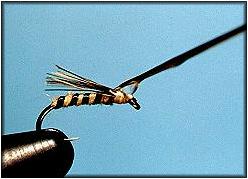
- Clip the wing above the hook bend. There
is a little room for varying wing lengths, but I
prefer a shorter wing like this one.
- Clip the wing above the hook bend. There
-
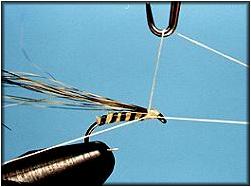
- Apply a small drop of head cement to the
head of the fly. If you get cement in the hook
eye, clean it out with a needle or bodkin.
- Apply a small drop of head cement to the
-
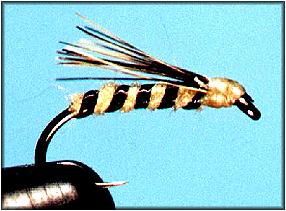
11.Your finished fly should look like this.
I use midge patterns a lot. Winter is a
great time to fish if you have a good midge pattern.
The Bighorn River and many others in the west have
huge midge hatches in the winter, spring and fall.
I’ve used this pattern to catch fish every time I’ve
been to the Bighorn. It was also a winter favorite
when I lived on and fished the Missouri river in
Montana.You can fish the fly with a dead drift or let it
swing. I usually grease it up a bit and drift it
over a fish, then let it swing at the end
of the drift. It frequently triggers a strike
just as it starts to swing across the current. A
few of my buddies fish it as a nymph with good
success too.In lakes I cast the fly in front of cruising
fish and retrieve it with small twitches. If
that doesn’t work, I use long, slow pulls on the line
to keep the fly moving slowly on or just below
the surface.Tie a few up in various sizes and colors. It will
likely become a favorite of yours too.See ya next week. ~ Al Campbell
Originally published c. May 13, 2008 on Fly Anglers Online by Al Campbell.