Lesson 3 - Spey & Dee Flies
This lesson will be the most involved lesson so far, not because
the Spey and Dee style flies are so difficult. It is involved due
to the different materials in particular, the hackles that are
used for these flies.
The Speys were introduced in the 1800’s for fishing the River
Spey In Scotland. The Dees were introduced on the River Dee
in Scotland.
Both styles are similar yet, different. The one big difference
is in the wing style. The Spey typically sports a Bronze Mallard
wing that sits low along the hook shank while the Dee wing is
split and somewhat drooping along the hook shank and, is generally
of Turkey.
Both were dressed with Heron, Eagle and other long soft barbed
hackles. One of these hackles were the side feathers on a Rooster’s
tail. The first two hackles are now illegal and the third is
somewhat scarce. Good substitutes are available though although
some come with a price. Blue Eared Pheasant is now widely used
as a Heron substitute and, makes very good hackles although
the feathers are somewhat short and have a “fast taper” (more on
this later). By that I mean the feather rachis or, shaft, is
somewhat fine near the tip but, becomes fairly large towards
the middle of the feather. Many of the feathers that are used
for Spey hackles come from various breeds of Pheasants and they
tend to share the shaft characteristics. Shlapen is widely
used for hackle and, usually has fine shafts.
The flies below are all the same pattern (The Carron) but, were
tied with a variety of different hackles to show the differences.
The fly with the dun Rooster tail hackle has much shorter barbs
than most of the others so, to make it provide a similar profile
as the long hackled flies, I started the hackle at the rear
of the fly. The others are started at the fourth rib which
is specified in TE Pryce-Tannatt’s book and several other
old references that I’ve seen.
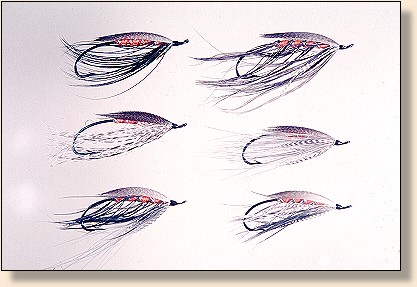
One other option for instances when you want a long trailing
hackle but, you only have fairly short ones available is to
tie on a few long fibers beard style. The fly with the black
hackle and the long grey beard is done this way.
My point in showing you all of these flies is to demonstrate
that there is always more than one way to achieve the same or,
similar end result. Try to “think outside the box” when you tie.
When you need a particular material to do a particular thing,
take stock of your available materials and think of using them
in different ways. You will hear this bit of advise frequently
throughout the upcoming lessons.
When selecting the bronze Mallard for your Spey wings, select
feathers that match perfectly in every way. The barbs can be
a little different length but, their curves must match. Also,
select feathers with good web out to the tips. If you use
feathers with wispy ends that don’t marry (cling to each other)
at the tips, it can cause problems tying them on. In use fishing
though, it isn’t too important. Really good Mallard can be difficult
to find but, when you find some, get it.
I have chosen two very old patterns for this lesson. The Spey Fly
is called the Carron and, the Dee is the Dunt. The Carron has the
typical Bronze Mallard wing, a wool yarn body and some involved
ribbing. The Dunt has the typical Turkey Dee wings and, a dubbed
tricolor body. While you may not fish either of these patterns,
once you learn to tie them, you can adapt the techniques to any
of these styles to meet your local needs. The Dunt will appear as
the next step-by-step lesson.
So, let’s get started on the Carron.
Carron
Hook: Partridge CS10/1.
Thread: Black.
Body: Orange Berlin Wool (If you can’t find Berlin Wool,
use most any yarn).Rib: Flat silver UNI-Tinsel and red UNI-Floss counter
ribbed with silver oval UNI-Tinsel.Hackle: Original calls for Heron so, we must substitute.
I used a natural Spey Hackle (A feather that I process) that has
been stripped from the quill.Wing: Bronze Mallard (You can use many other feathers for wings
on Speys. Peacock secondaries make good wings as do others.)Collar: Teal, one turn.
Head: Black.
Originally published c. December 1, 2008 on Fly Anglers Online by Ronn Lucas.