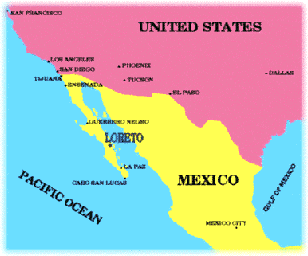
If you are a normal beer drinker, East Cape lies about four
beers north of the Cabo San Lucas Airport along the coast of
the Sea of Cortez.
Not quite half way between Cabo and Lorado is a small collection
of fishing resorts and a small village. Protected from the
Pacific swells that can raise havoc for a fly angler interested
in casting, East Cape has some unique features that make it the
mother of all fishing holes.
A good nautical map will reveal that it’s main attraction is the
100 fathom line comes to within 200 yards of the beach in several
areas. What this means for the angler is that large, and I mean
LARGE, fish used to the safety of the depths, chase schools of
sardines and mackerel up against these underwater canyons and
they have only one way to go. UP! Any salt water fly angler
worth his weight in salt will tell you if you have fish on the
surface boiling on bait you have the recipe for a dynamite
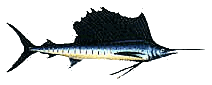
fishery. East Cape is one of the few places in the world where
anglers have actually hooked sailfish from the beach instead
of the obligatory five mile run in a boat.
Cabo’s reputation is legendary. Lorado has seen a lot of press
in the last year with an article in practically every Salt-water
magazine. Lorado has developed into the place
to go for Dorado. East Cape, on the other hand is still relatively
undiscovered.
Cabo, located on the tip of the Baja Peninsula, is more sensitive
to weather changes. Pacific swells and any wind from the south
can knock out a fly anglers day. Lorado is the most protected of
the three Baja fishing sites. Guarded from Pacific swells by the
peninsula and from southerly winds by a couple of islands, Lorado
will give you the most days with good casting conditions. East
Cape is not protected from the southerly winds but being on the
inside of the Peninsula, Pacific swells are not a problem. The
lure of East Cape is that the same large variety of fish that
frequent Cabo will also come to East Cape.
The key to fishing any of these places is a small fish called
locally as a Sardinia. These little sardines look like a fat
herring. Deeper in the body than a herring they usually are
about four inches long. Perfect size to duplicate with a Bucktail.
It is pretty simple, if the sardines are about, you will have
good fishing.
All the resorts along East Cape can furnish boats, called Pangas,
and guides. Like any place not pounded by fly fishermen there
is still an attitude that flies are as productive as bait. That
is, of course the typical prejudice found in undiscovered places.
One of the little secrets of East Cape is the fantastic shore fishing.
If a day in the Panga doesn’t fill you appetite, and you are in the
mood for more, piece together your eight-weight, string up a floater,
stuff a pocket with a half dozen clouser minnows and work the shore
right in front of any of the resorts for Ladyfish. A ladyfish looks
much like a bonefish and has the reputation of being the poor mans
Tarpon. A strong fighter that has a love of jumping. Not big by
East Cape standards these little lovelies don’t get much over 5
pounds.
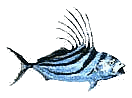
The shore will offer the same variety that you find in deeper
water with croaker, needlefish, mackerel, and an occasional
roosterfish.
Before you write off Baja as too exotic and expensive a complete
trip including round trip airfare (from Seattle) five days boat
rental, air conditioned room, and meals, as well as transportation
to and from the Cabo airport will come in at about $1500. That is
probably cheaper than five guided days in Montana would cost.
If you are interested in this region, stay tuned for my Journal
of the fishing, the flies and more
photos!
~Mike Croft
Part 2|
Part 3|
Part 4| 
Originally published c. 2004 on Fly Anglers Online by Mike Croft.
Part 2
Day One,
June 31:
El Nino has pushed the sardines up north, this means below average fishing
for the whole trip. Bummer…but thats fishing. Too windy today to cast, four
foot swells. Need to get creative and try Bill Nelson’s skip fly technique.
Met our Panga skipper, named Victor. I could tell by the look on his face
he was thinking “God a non bait fisherman.”
6:30 AM. Left the dock with Victor and Mike Hamlin headed south to Point
Arena. Nothing showing on the surface. Rigged leader to skip fly on my
12 weight. Going to have to troll. Hamlin rigging a popper.
7:30 AM. Water explodes on skipped fly. 200 yard run, 12 weight looks
like a three weight, worried it will break. Fish sounds for 20 minutes. Fight
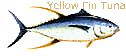
lasts 30 minutes land yellow fin tuna. All the boats are owned by the hotel
so Mike and I agree to give the skipper one fish a day for his family if we can
release the others. Skipper wants the yellow fin for tuna gravy. Tuna gravy?
9:00 AM. Find school of skipjack 8 to 10 lbs. Damn they are strong.
Good thing I checked all my loops and knots. Lost count of hooked fish.
New flies working better than expected.
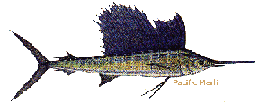
11:00 AM. Wind increasing. Two Marlin surface to sun beside the boat.
Downwind, I can cast but fish are 300 pounders…chicken out.
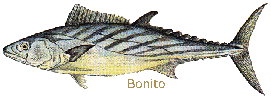
Lost school of skip jack…still hooking occasional bonita.
11:30 AM. Try and ambush a sailfish…we spook him, he is
gone…no hook up.
12:00 Fishing dead just a lumpy sea.
2:00 PM. Off load gear at dock, Mike says we landed 17 fish…wish
I could count past five. Mike and I talk over the day and Mike thinks
skip fly was hooking two to one, even over poppers. Mike is rigging
a skip fly for tomorrow in case there is more wind.
Day Two,
May 1:
3:00 AM. Can’t sleep decide to walk on beach to see what weather
is doing. I will take my 8 weight. No wind but still a small lump on
the sea.
3:30 AM. See splash in the dark. Try casting small clouser and hook
croaker on first cast.
5:00 AM. Landed 20 fish. 15 croaker and five Ladyfish. Hooked two
that I couldn’t stop…don’t know what they are???
6:00 AM. Breakfast. Guys interested in beach fishing in the dark. I
tease them about sleeping too much.
6:30 AM. Meet Victor and head south again. Water calm.
7:00 AM. Wind picking up but get into skip jack big time. 9 double
hook ups by 8:30. How can a ten pound fish put up such a fight?
10:00 AM. Lost skip jack…maybe they sounded??? Had time for a cigarette.
Propped foregrip on gunnel and stuck reel between legs to free up one hand to
get the lighter. Lone skipjack hit and did usual 100 yard run. Direct drive reel
handle hit the family jewels 500 times before I could get reel out from between
my legs. Never do that again.
11:00: AM. Wind bad. Fishing slow.
2:00: PM. Off load at ramp.
Day Three,
May 2:
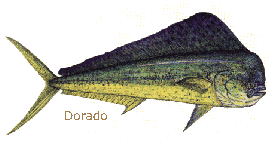
6:30 AM. Meet Victor, weather dead calm. Head to shark bouys to find Dorado.
Find fish at first bouy hit four between us all small. Like clousers. Saved one to
give to Victor.
7:30 AM. Another try at a sailfish…spooked him. Need to tease them to turn
on first.
8:00 AM. Radio says all the boats south of Point Arena are into Dorado big time.
Start run to Point Arena.
9:00 AM. Can see fleet, everyone fighting fish when we get there. Mike hooks large
fish on a popper. By the time he lands his fish the bite is over. Think fish sounded.
Damn we were too far away.
9:30 AM. Ocean is full of needlefish. Big ones fun. Teeth hard on flies and can’t keep
them off the hook.
10:00 AM. Still looking for Dorado. Find what we think is free floating shark bouy.
Victor laughs says he thinks it is a bail of marijuana. 40 kilos. We pull up and cut it
open…he was right. Barnacles on outter bail indicate it is floating for about two months.
I was impressed by how well it was sealed. Left it drifting…no Dorado.
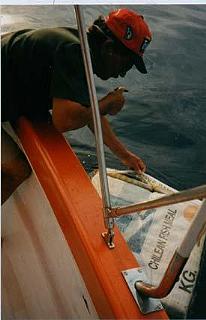
2:00 PM. Off load at dock.
5:00 PM. Weather is good for beach fishing. Tim Iverson has hot rod and hits
several Lady fish, pufferfish and trumpet fish. I lost all small clousers first day.
Bring more next time.
Day Four,
May 3:
6:30 AM. Leave dock with Victor. Buy Mullet to tease up rooster fish. Fish
shallow flats south of Point Arena for two hours. See one rooster break the
surface but can’t tease within range.
8:30 AM. Radio says all the big cruisers are into Marlin…tell Victor they are too
big for our equipment. Suggest we look for Tuna instead.
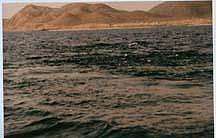
10:30 AM. 3 acre school of tuna surface beside the boat. Moving fast cast and
hook two. Land mine first, mike lands his and we run to intercept. See a half
dozen big Dorado in front of school. Victor manuvers boat to intercept. I hook
skipjack, Mike hooks Dorado about 20 lbs.
11:30 AM. Lose school. Seems that fishing drops off mid day on a pretty
regular basis.
2:00 PM. Off load at dock.
Day Five,
May 4:
6:00 AM. Damn last day, skip breakfast and get Victor 1/2 hour early.
Remember that for next trip. Went north for first time…tuna canyon.
Flat, good casting water. Sun just up Mike Hooks something big but
hook pulls out.
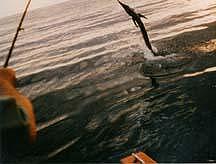
7:00 AM. Testing new flies with number two stinger hook when two sails appear, we
are into the sun from them. Like a fool I have my eight weight. What the hell, no time
to change. One sail breaks away and hits my fly. Makes a 150 yard run and jumps
7 times. Makes a short 50 yard run and jumps 6 more times. No shock tippet, 20 lb
leader means no chance. Fish swims toward the boat, I’m in shock. I give him total
slack even though hook is barbless…in the fog think it is better that he pull the hook
than I pull him. Victor starts chewing me out thinking I lost the fish. Says we use
too light a line for these. Victor shuts up when he sees I still have the fish on.
Long time we have a tug-of-war. I finally get him to the boat. Victor grabs for
bill and misses, fish dives and jumps full length behind boat about 30 feet away…
another tug-of-war. Fish comes to side of boat and Victor tries again and gets
the bill. Fish is too big to pull aboard by himself and calls for help. I grab the bill
too with no gloves and we pull him onto my lap. Three or four quick photos and
we slip him back in the water. He swims off OK. #2 hook 1/3 straightened out…
eight weight still not broken…lucky. Hand that grabbed the bill missing most of it’s
skin and bleeding…what the hell..hope it never heals.
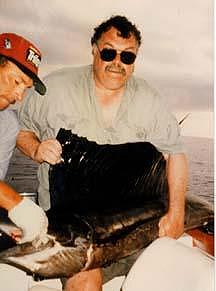
Sometime in the AM. Most of the day is a fog…still in glow from the sailfish.
Have a big bull Dorado hit both mikes and my flies at the same time. I have
had doubles but is this a 1/2…?
2:00 PM. Offloaded at the dock and we gave Victor $50 dollar tip. Don’t
think he has as bad an impression of flies as he did last week.
Flies next week! Stay tuned!
~Mike Croft
Originally published c. 2004 on Fly Anglers Online by Mike Croft.
Part 3
Fly selection for East Cape is really pretty simple.
Your flies should represent your tackle and how you
plan to fish. For example, under certain conditions
Dorado travel in schools. The smaller fish are found
at the top of the school, in shallower water. If you
want to target the larger fish then you will have more
luck if you fish your flies deep. You can do this
with a shooting head system or by using clouser Minnows
or weighted flies. You can, of course, use both.
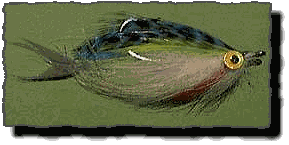
Clousers.
Another good beach fly and good for casting into
schools of dorado. This is a must have fly. 2-inch
to 5-inch in length.
There are two physical states that you will find the
fish. The normal state, in which the fish are simply
moving around, and a state in which they are “lit up”.
You will see this “lit up” referred to in a lot of
articles about billfish. However, billfish are not
the only fish you can light up. Dorado, and roosterfish
will also light up for you. In this state the fish
is excited and interested in a meal. At times, when
the fish are lit up it almost seems that you could
throw a toilet seat out there and they would hit it.
They are not too discriminating during the lit up phase.
Two more generic flies tied in dorado colors.
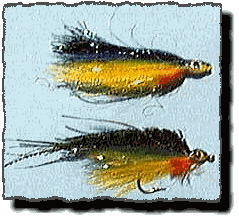
At times the dorado will prefer flies tied in there
own colors. One here is a tube fly and the other is
a streaker.
Local guides will try and light up a school of fish by
chumming. This works especially well for Dorado. In
the normal state the fish aren’t actively feeding but
will hit a target of opportunity. In this state it
helps to have a more accurate representation of the
local baitfish.
Croft’s Baby Bull Dorado.
Large flies such as this can tease a billfish into striking.
You will recognize this as a variation of Ned Grays Streaker.
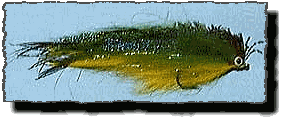
Other good color combinations on large flies are mackerel
green-backed patterns, purple and white, pink and white,
black and white, as well as the standard blue and white.
By far the most important baitfish for this area is
the Sardinia. Imagine a short 4-inch heavy set
herring and you have a Sardinia. Two things to
remember about Sardinia. Every thing eats them
so they are 90% of your fly selection. Second, if
the Sardinia are around in large numbers your trip
is guaranteed. The most common size Sardinia comes
in right at 4 inches. This is perfect for bucktail
flies. When schools of Sardinia are pushed to the
surface by dorado or tuna, then sardine poppers can
be your best choice. The poppers have the ability
to call fish from a great distance, with the added
feature of a surface strike.Croft’s Marabou Sardinia.
Shown here in the brown phase. Usually this is a blue
and white fly. Tied completely out of marabou except
for the lateral line. This fly is impossible to
foul as it is set so far back on the shank of the
hook. Nothing here to
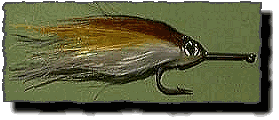
interfere with the gape of the hook. Like all other
marabou flies it swims with great action.
Croft’s East Cape Sardinia.
This fly has caught everything from sailfish to tuna.
It is a good fly for times when the fish are not lit
up and they like something more natural.
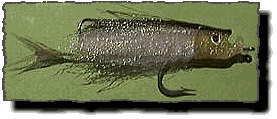
…And yes those are fish lips on this fly.
Two generic blue and white Sardinia patterns.
These two flies will give you 90% of your action.
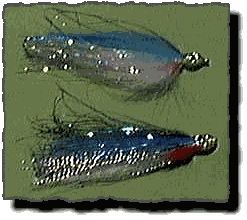
Tied here tube style and traditionally with a stinger hook.
Of lesser importance in descending order are mackerel,
mullet and flying fish. Mullet and flying fish can
be duplicated with dark blue or black back over a white
or cream body. The mackerel has characteristic black
stripes down his body, so look for green dyed grizzly
for patterned striped backs on these flies. Mackerel
and flying fish are used mostly for sailfish, while
mullet are a favorite food of the roosterfish.
Unless you just can’t stand them, tube flies are a
good choice. I don’t use tube flies anywhere else
in the world except here. But the ability of the
fly to slide up and out of the fishes mouth is a
great feature of these flies. When fishing is hot,
some fish can chew up a whole lot of standard flies
in a day.
Smaller 2 and 3-inch clousers, or weighted flies
work well from the shore. Poppers cast from the
shore will also pick up the occasional rooster
fish. These patterns can simply be scaled down
versions of Sardinia.
Poppers.
Good beach flies and for times when the sardines are
about and being pushed to the surface. These can be
indispensable. You want at least a half dozen.
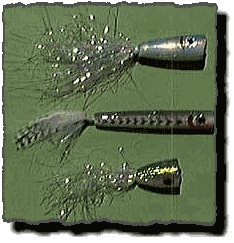
That in a nut shell is the 25 cent tour of Baja flies.
For those who are tying your own flies be aware that
no material is sacred. They all work. Color and size
are important. Most important of all is FLASH!!! Don’t
skimp on your mylar flashabou or crystal flash.
Also don’t store your flies in dark plastic boxes.
Expect temperatures close to 100 degrees. At
temperatures over 140 degrees the mylar will start to
curl. It doesn’t take much imagination to figure
what would happen to a black flybox left in the sun
unattended for a few hours.
~Mike Croft
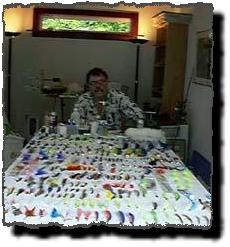
Mike and 400 Flies for Cape
Part 1|
Part 2|
Part 4|
Originally published c. 2004 on Fly Anglers Online by Mike Croft.
Part 4
There are as many opinions concerning equipment
selection For Baja as there are anglers who fish there.
A lot of what you will want depends on your fishing
style, and your pocket book. There are fish along the
shore of Baja that if hooked will never be landed. They
don’t make fly equipment, in any weight, that will
tame some of these brutes. That said, be aware that no
matter what you use you always have the chance that
one of these salt hogs will latch on to your fly.
If you could only take one rod, make it a ten weight.
A twelve weight will wear you out if you are casting it
all day, much worse than a ten weight. If it weren’t for
the fatigue, I would recommend the twelve over the ten.
Even a small yellow fin Tuna will take a twelve weight
and make it feel like a three weight.
Should finances allow outfitting your trip then I would
pick a fourteen weight for billfish. A twelve for some
of the schools of tuna, a ten weight for Dorado. And
an eight weight for beach fishing. I would also have a
back up rod for each size. Now this is a lot of
equipment and if you are buying top of the line stuff
you will be putting out a fortune. I recommend picking
up inexpensive rods for the ten, twelve and fourteen
weight rods. If they break, so what? Save your money
for the nicer rods you will use closer to home.
Your reels should be top notch. A top notch reel is one
with a cork drag system. I know a lot of new and fancy
drag systems are out there but none have been around
long enough for me to trust them. I have never fished a
bad cork drag. Unfortunately most of the reels with a cork
drag start around $400. So plan on spending some money
here.
Reaction time is very short in tropical waters. You may
only have seconds to react to a school of tuna. I find that
it is hard to change spools as conditions change, simply
because they can change so fast.
I like to have a reel for each of my rods.
Beach fishing is a ball and can be done with a six
weight as long as you know that once a day we
hooked something we couldn’t stop. I suggest
an eight weight as it will give just a bit more
penetration in the wind.
~Mike Croft
Part 1|
Part 2|
Part 3|
Originally published c. 2004 on Fly Anglers Online by Mike Croft.