In early 2003, I was searching for a watercraft
to fish the ponds and lakes here in north Texas.
I wanted a craft that was 1) portable, 2) buoyant,
3) stable, 4) durable and 5) versatile. After
trying most of the conventional fishing platforms,
I found none of them fit all the criteria for my
fishing boat. Except one. The Porta-Bote folding
boat made by Porta-Bote International in Mountain
View, California.
I have had my Porta-Bote for 15 months now and have
found it to be everything it is advertised to be and
more. I opted for the 10-½ foot model. There is
also an 8½ footer, a 12 footer and the newest member
of the family, a 14 footer. Available colors are
olive drab, Pacific Pearl (off-white) and aluminum.
All models have a 5-foot beam, 4-inch draft,
full-width bench seats, transom, floatation collar
and oars. The 8½ footer weighs 47 lbs. (hull only),
my 10 ½ Bote weighs 58 lbs., the 12 footer is 69
lbs., and the 14 footer is only 96 lbs. Maximum
outboard engine weights range from 35 lbs. to 86 lbs.
and all models can accommodate any size electric
trolling motor. The smallest model has a capacity
of 445 lbs. (persons, motors and gear) while the
biggest model can handle 807 lbs. All models fold
to a thickness of 4 inches and a width of 24 inches.
Portability:
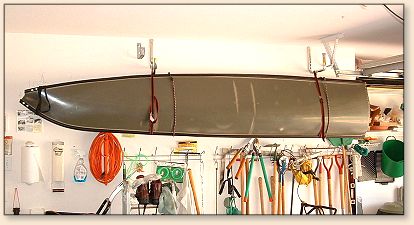
I store my 10-½ foot Porta-Bote by hanging it on the
wall of my garage. I do not have room for a
conventional boat and trailer, but I do have room
on the wall. Once you get comfortable with the
balance point of the hull, you can easily slide it
in and out of its "mooring" and transfer it directly
to the top of your vehicle in one wide sweeping motion.
I chose the 10 ½ Bote, because it is big enough for
two flyfisherpersons, yet not too big for one person
to lift safely. The 12 and 14 footer are more suited
for a two-person operation.
Buoyancy:
The Porta-Bote will float even when completely filled
with water and it can even be rowed when filled with
water. This can be attributed to the unique
floatation collar which lines the hull all the way
around under the gunwales and across the transom.
I personally have not tested this feature, but I
am confident the buoyancy is as advertised. The
collar is 2 inches thick.
Stability:
The Porta-Bote is a flexible V-hull craft. Its keel
and concave "vee" section provide exceptional
directional stability. The hull design means
the Porta-Bote is more comfortable to ride in
because the flexible polypropylene hull absorbs
shocks and the Bote does not bounce like an
inflatable or pound like a rigid boat. The
flexible hull allows for easy, stable standing.
The inside of the hull is rough-surfaced for
traction, even when wet.
When you stand up, the hull flattens against the
water's surface with a suction effect adding to
the stability. Because of the wide 5-foot beam,
the Porta-Bote is exceptionally stable even when
fully loaded and planing at full speed. The same
suction effect that allows you to stand up safely
also keeps the boat solidly on the surface. It
feels good to stand up and stretch, look out over
the water and comfortably fly cast with no worries
about the Bote tipping over.
Durability:
The Porta-Bote Company says there over 50,000 Porta-Botes
afloat around the world. Some are as old as 30 years
and still floating. Porta-Botes attribute their
durability to the unique design hinges and lightweight,
flexible polypropylene hull.
The hinges are waterproof and can take a stress of
over 90,000 lbs. per square inch. They are designed
to take a beating. I have pushed and pulled my fully
loaded Bote while launching and beaching, all the
while on the keel hinge with no noticeable adverse wear.
The hull is made of flexible polypropylene and
utilizes an ultra-violet filter and anti-oxidant
for resistance to sun and saltwater damage. This
hull material is used in Astro-Turf, car bumpers
and highway signs. Porta-Bote's "Flexi-Hull"
flexes inward and absorbs wave energy and disperses
its force. The same flexibility allows the Bote to
"give" safely when bumping against underwater
obstacles. The Porta-Bote's hull is almost ¼
inch thick, thicker than an aluminum hull.
I have watched my Bote's hull flex inward when
the Bote rubbed against a partially submerged
stump or branch and I watched it spring back.
Upon inspection on shore, no damage could be
seen on the hull, not even a scratch.
It never needs painting. All I do at the end
of the day, before I put it back on the wall,
is to sweep out any dirt from inside the hull,
make sure it is dry on the inside, and wipe down
the outside hull and hinges with a some
vinyl-protectant. That's it.
Versatility:
The Porta-Bote can be used on ponds, lakes and rivers.
It can be a fishing boat, a sailboat (with optional
sail kit), a duck-hunting boat, a ship-to-shore
dinghy or just a weekend family pleasure boat. It
can easily be transported on top of most vehicles,
RVs, seaplanes and yak. The British Royal Air Force
Climbing & Rescue Team used it on their record setting
climb up Mt. Everest. The team used the Porta-Bote at
20,000 feet to cross a glacier lake. Inflatables were
too puncture-prone and unreliable while ordinary rigid
boats were too heavy to carry up Everest. The
Porta-Bote fit perfectly on the back of a yak. I
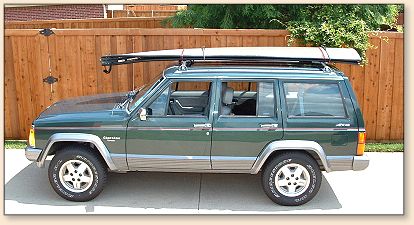
use my Bote as a flyfishing boat and transport it
on top of my Jeep Cherokee. If I ever need to put
my Porta-Bote on top of a yak someday, I am confident
it will perform as advertised!
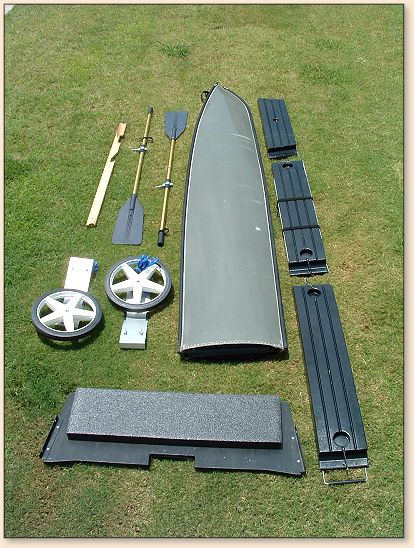
The Porta-Bote comes with the parts as seen above.
The Porta-Dolly wheels are optional if you need
to transport the Bote a good way to the water's edge.
Step 1:
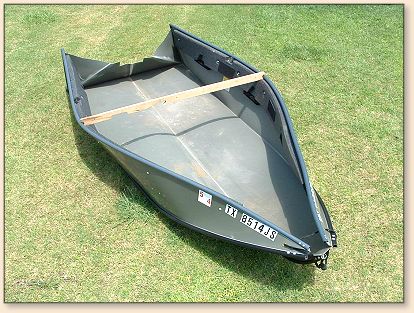
Insert the provided "hull opener" to open the Porta-Bote.
Step 2:
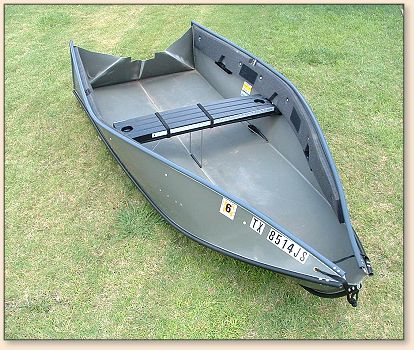
Insert the middle seat and remove the "hull opener."
The seats are held in the hull bracket by long cotter
pins on each side. I glued an aluminum yardstick on
each side of the middle seat as a convenient measuring
aid for me and my bow passenger.
Step 3:
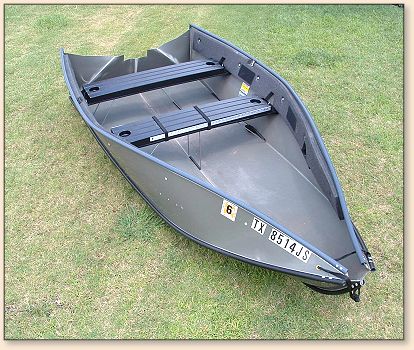
Insert the rear seat the same way as the front seat.
Step 4:
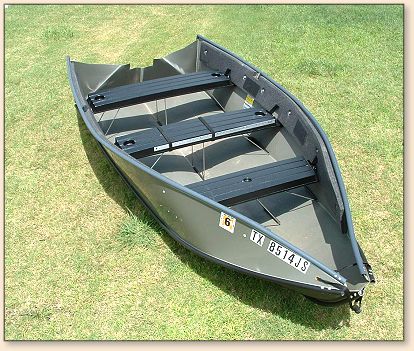
Now insert the short front seat.
Step 5:
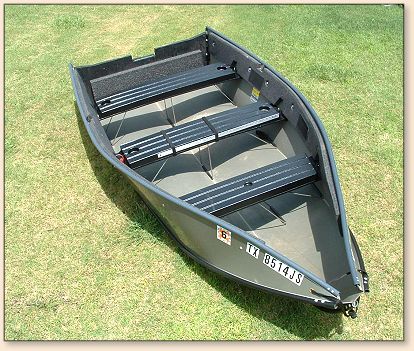
Next, insert the transom. Four wing nuts (two
gasketed) are provided to secure the transom to
the hull. The transom sits inside the hull.
Step 6:
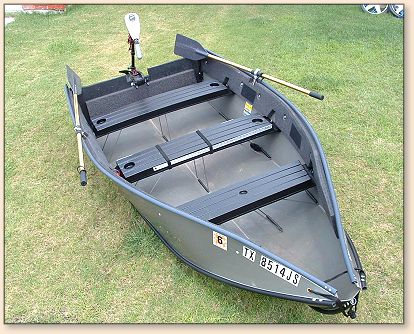
Attach your motor and oars. Here I have attached
my electric 50-lb. thrust trolling motor and show
the oars in their sockets. I normally store the
two-piece oars along one side of the hull between
the middle and rear seats. The Bote will also
handle a bow-mounted trolling motor if you decide
to use a gas outboard on the transom.
Step 7:
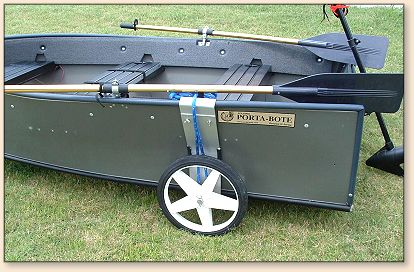
Shown are the optional Porta-Dolly wheels if the
Bote needs to be pulled a way to the water. I
added the blue towropes to aid in pulling.
Step 8:
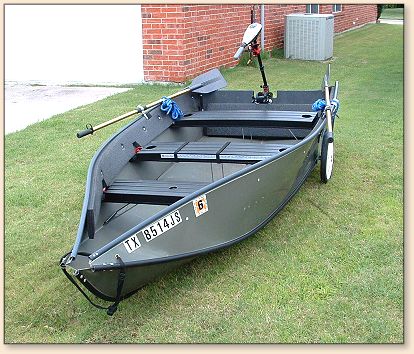
The Porta-Bote is ready to go! I usually set up
the Bote right at the water's edge and just push
it off the shore. I add the following items to
my Bote: two rod-holders, two small buckets with
mushroom anchors, a gunwale boat bag, full-size
trolling marine battery under the rear seat,
plastic accessories container behind rear seat,
long handled net and a thick nylon loop at the
bow for pulling. That's it! Everything fits
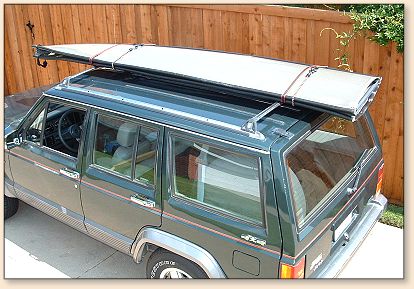
inside my Jeep and the Porta-Bote is secured to
the luggage rack with straps. It takes me about
20 minutes to set up the Porta-Bote and 10 minutes
to fold it back up at the end of the day.
For more information on the unique, folding Porta-Bote contact:
Porta-Bote International
1074 Independence Ave.
Mountain View CA 94043
(650) 961-5334
(800) 227-8882
Fax: (650) 961-3800
email: info@porta-bote.com
website: www.porta-bote.com
~ RK
|