If you own a personal pontoon boat, you know
just how heavy it can be when you want to get
it to the water or back to your vehicle. You
either have to load it while it's floating in
the water, load it on land and drag those costly
pontoons across the rocks to the water, or try
to be Superman and carry the thing. No matter
how you do it, it isn't a simple process. That
is, until now.

Last spring (I think it might have been April) the
folks who build a product called "Launching Gear"
sent me a sample of their product to evaluate and
review for you. A lot of things happened between
then and now that prevented me from trying it out,
but I finally had a morning to give it a try. Dana
and Bob, forgive me for taking so long. Those
obligations weren't fishing; and if they had been,
or if I had been able to enjoy my usual June Bighorn
River trip, I would have had this review written long
before now.

The first thing I noticed about the Launching Gear
is the weight. It is amazingly light. At 7.5 pounds,
the only noticeable weight (about half the weight) is
the rubber tire. The rest is aluminum. It appears
every consideration was made to reduce as much weight
as possible while retaining the strength and structural
integrity of the product.
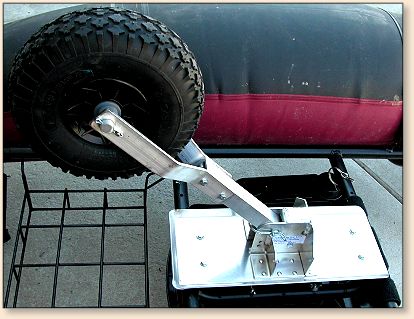
I also quickly noticed the professional craftsmanship.
The guys who make this tool are former Primex
Technologies employees who put their skills to work in
the precision sheet metal business after a series of
merger and acquisition moves. All the bends are precise,
the edges of the metal are smooth, all the metal cuts are
perfect and look like they were stamped out by a machine,
and the welding is aircraft grade perfect. To say I am
impressed by the craftsmanship would be an understatement.
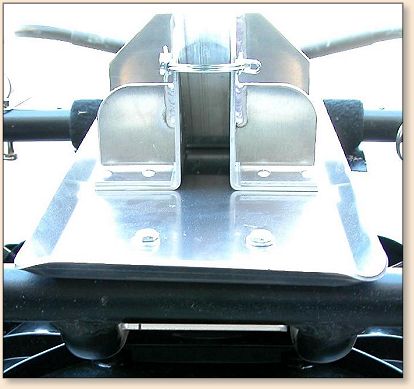
Attaching the gear to my Waterskeeter River Tamer
Deluxe pontoon boat was easy. I tipped the boat
over on its top and slid the gear into place under
the seat with the tire facing the rear. Each
Launching Gear is designed specifically for your
boat, so the fit is perfect. All I had to do was
position the gear on the frame and tighten the bolts
so that the built-in clamping mechanism would clamp
down on the frame. The mechanism is designed to clamp
around the frame without damaging the finish, and it
did just that. If they had used U-bolts or if the
aluminum edges would have been sharp, the frame of
my pontoon or the finish would have been damaged, but
they designed this thing to prevent any damage at all.
It took maybe five minutes to attach it to my pontoon
boat's frame, including the time it took me to get my
ratchet and wrench.
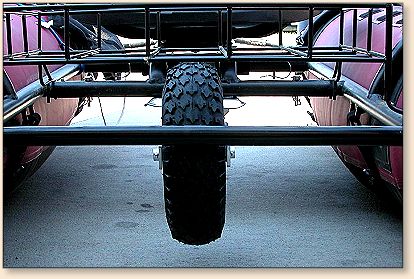
In the stowed position, the wheel is about four to
six inches off the ground when on dry land. Depending
on how you load your boat, how much stuff you have on
the cargo rack, and how much you weigh, the tire should
ride a few inches into the water, about the center of
the wheel. They thought about that, and everything
including the wheel's bearings are waterproof. Water
can't hurt the Launching Gear.
When the wheel is down, it lifts the pontoon boat about
a foot off the ground. I loaded my River Tamer with
about 100 pounds of gear, including a 12-pound anchor,
and tried to roll it around on my driveway and in some
gravel. At first I tried using the pontoons as handles,
but they flex too much. Then I grabbed the foot pegs
and rolled it around like a wheelbarrow. That was the
ticket. I can roll it fully loaded over gravel, down
my driveway and even over the rocks on the shore of a
local trout lake. I didn't tip it once.
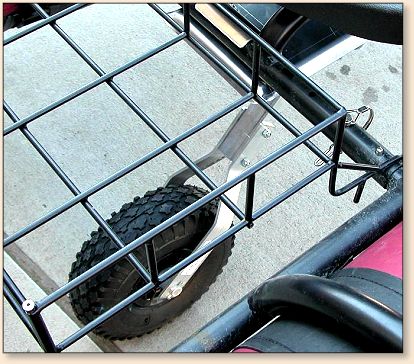
There is one thing I don't like about the Launching Gear,
and I don't see how they can change it. When I got the
pontoon boat in the water, I had to reach under the seat
to remove the pin so I could stow the wheel. It was a
bit like stumbling around blind trying to remove the
pin and re-insert it in the other hole to stow the wheel.
I think that task would be better done on dry land where
a dropped pin could be easily retrieved. They tell you
to lift the end of the boat to do this, but I had it
fully loaded for my test, so reaching under the seat
was easier than lifting. One nice thing was that the
wheel floats, so I didn't have to lift the wheel and
insert the pin at the same time. Coming out of the
water I drug the boat up on land and tipped it on its
side to lower the wheel. No way I'm going to lift a
hundred pounds of stuff to lower or raise the wheel.
With the wheel lowered, it rolled up the bank a lot
easier than I thought it would. It cleaned up pretty
easy after I got home too. All I had to do was hose
it off. The pontoons on my River Tamer don't clean
up that easy.

These pictures were taken on my driveway before I loaded
the cargo rack. I needed all the light I could get, and
the coolers and such would have been in the way of that.
I loaded it with all the gear I would have taken with me
on a float trip down the Bighorn River so I could see if
there was anything I didn't like about the Launching Gear.
Except for the pin for stowing and lowering the wheel,
everything else was flawless and performed better than
I expected it to. From now on, I'll just lower or stow
the wheel on dry land next to the water where I can kneel
down next to the boat and tip it on its side. I like the
idea of loading my cargo at the vehicle, so I'll continue
to load it before I roll it to the water.
These photos are of the LG5 model for Waterskeeter,
and retails around $129.00. ~ AC
DaBob Precision Sheetmetal
P.O. box 453
Indianola, WA 98342
Phone: 360-297-4316
Email: dado17@centurytel.net
Website: www.launchinggear.com
|