Mirage: (mi-räzh') n. [from the Latin mirari, to wonder at.] Something illusionary.
Since the days of Theodore Gordon's recommendation of the use of
epaulet threads - and probably before then - to the mylars and metals
that grace fly shop walls today, that ever-unsatisfied beast known as
the fly tier has been putting flashy fibers on flies to present
fish with "something illusionary." We use wires pulled from electrical
cords, salvage shiny plastics from gift wrap, and pay a goodly amount
of coinage at a time for spools, hanks, and sheets of all manner of brilliance.
All this for fish. Strange creatures, we.
What is the purpose in all this shine which has our obsession? I think it
breaks down into two basic reasons. Aside from ribbing, which can be
accomplished with non-reflective materials and is another issue, flashy
material provides us with translucence and attraction. Almost all minute
aquatic life has an attribute of translucence to some extent. This is part
of their natural camouflage, but is impossible to replicate with opacity.
Nymphs, minnows, and other creatures blend in very well with their
environs not only because their colouring is similar, but because their
pigmentation is such as to allow light to pass through them. Attraction
(in this context) is simply what happens when something out-of-the-ordinary
catches the eye of the fish. Sometimes fish will strike a fly in anger, and
reflective materials seem to trigger that response.
The recent history of the flashy materials has seen us go in a relatively
short time from metal tinsels to mylar tinsels. This was a great leap
because it made the material cheaper, easier to use, and more durable.
(There are no rust issues with Mylar.) People started using the new
materials in winging, and we soon started seeing flash products being
sold as wing materials. At the forefront of this was Hedron,
Inc. who brought us Flashabou and Krystal Flash. Starting with the
standard gold and silver, soon to our eyes and on our flies was brought
more colours, then something called "pearlescence" - materials that
started essentially clear, then dyed in numerous shades. Most recently,
holographic materials have made our fly boxes even more garish.
These materials are all good fly tying implements! The standard
"solid" mylars and metals are reflective. Light bounces off them,
allowing none through. Pearlescents are refractive. Light bounces
off them as well, but is also allowed to shine through, giving a glimpse of
materials or environs on the other side. In the most general of terms, the
reflective products tend to give us their best use as attractors, and the
translucent materials tend to be more imitative. (Again, this is a gross
generalization, but more accurate than not.) No product has really
combined the best of both phenomenae, though. None until now.
Hedron, the same folks who brought us the original Flashabou and
Krystal Flash, have taken their mylar to new heights with 'MIRAGE,'
a new material that is both reflective, having a given colour, and refractive,
allowing colour through, all the while assimilating the hues around it!
My initial response to Mirage was almost of disbelief. The shine was such
that I had never seen before, and I was truly stunned by it. The element
that sets Mirage apart from other products is that even though they come
in various shades of gold, silver, opal, pink, chartreuse, and other colours
that shine more brashly than any other materials, they assimilate the shades
of the objects around them. Immediately after coming into possession of a
few packages of Mirage Flashabou, Saltwater Flashabou and Krinkle Sheeting,
I set off to the vise to see what they could do.
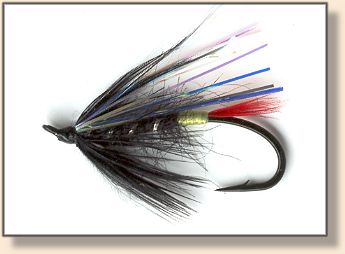
As a Salmon/Steelhead tier headed into the summer season, I had big
ideas. Summer Steelhead are notoriously spooky, and this looked like
just the ticket for getting their eye without offending them too greatly.
My first task was to replace the winging on a Green Butt Skunk with
silver and opal Mirage combined. It worked perfectly, giving the fly a
defined wing with movement and sheen, but not one that would alarm
wary Steelhead as the bright calf tail sometimes does. (Don't get me
wrong, the original fly is great, but not always under all conditions.)
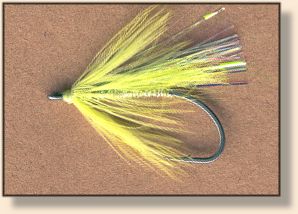 Keeping the wing sparse made it very subtly attractive which worked on
this fly, but might have created a problem. I had to use this on
a Karluk Flash Fly for wintertime, but would it deny the pattern of its best
use - blazing light through the depths to give the best visibility? This time I
used chartreuse Mirage Flashabou, twisting it around 3/0 thread to make
an "oval tinsel" body, and lying it in large amounts over sparse chartreuse
kid goat. It worked fantastically because with the greater amount of Mirage,
you actually see it shining through itself. Yes, it picks up colour around it,
but that only gives it added life aside from the naturally seductive movement
of the Flashabou.
Keeping the wing sparse made it very subtly attractive which worked on
this fly, but might have created a problem. I had to use this on
a Karluk Flash Fly for wintertime, but would it deny the pattern of its best
use - blazing light through the depths to give the best visibility? This time I
used chartreuse Mirage Flashabou, twisting it around 3/0 thread to make
an "oval tinsel" body, and lying it in large amounts over sparse chartreuse
kid goat. It worked fantastically because with the greater amount of Mirage,
you actually see it shining through itself. Yes, it picks up colour around it,
but that only gives it added life aside from the naturally seductive movement
of the Flashabou.
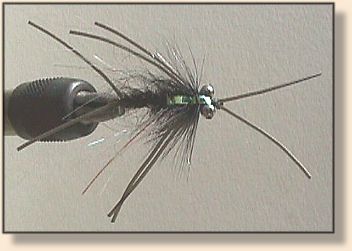
Satisfied that it works either way, I turned back to my summer patterns.
Steelhead nymphing has become very popular lately because it catches
a lot of fish under conditions that might be considered less than ideal.
Stonefly nymphs are among the favourites here in Northern California,
but with a problem: sometimes the standard Stoneflies are snubbed,
being too mundane to be noticed. The remedy has been to add some
Flashabou to the legs, giving a little interest to the potentially unseen
pattern. Unfortunately, this is sometimes either a little too garish to be
taken seriously as a nymph, or too nymph-y to be exciting. The solution?
A few fibres of Opal Mirage Flashabou mixed in with the Perfect Rubber
Legs makes it attractive and buggy.
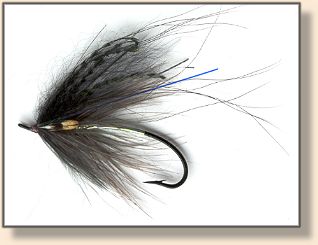 My specialty, though, is spey flies. They are my favourite of all
Salmon/Steelhead flies, and in subtle shades, my favourite summer-run
flies. My theory on summer speys is, the most visible and the less
conspicuous, the better. This is not always an easy combination to incur,
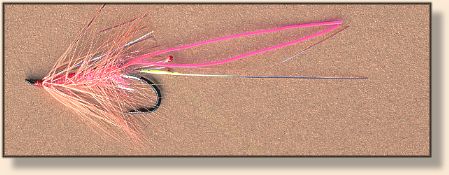
but using a single Mirage saltwater stand (1/16" wide) as a "tinsel" body
and thorax, and adding some standard Mirage Flashabou to the wing,
a lovely and efficient fly is created that picks up the colours that are present
in the stream, all the time moving and giving the illusion of life. My summer
box now sports many of these, and they have taken nice fish under overcast
skies. (Tying hint: Saltwater Mirage makes a very alluring tinsel replacement
on flies like Comets, Muddler Minnows, and other patterns that call for
standard tinsel bodies.)
My specialty, though, is spey flies. They are my favourite of all
Salmon/Steelhead flies, and in subtle shades, my favourite summer-run
flies. My theory on summer speys is, the most visible and the less
conspicuous, the better. This is not always an easy combination to incur,
but using a single Mirage saltwater stand (1/16" wide) as a "tinsel" body
and thorax, and adding some standard Mirage Flashabou to the wing,
a lovely and efficient fly is created that picks up the colours that are present
in the stream, all the time moving and giving the illusion of life. My summer
box now sports many of these, and they have taken nice fish under overcast
skies. (Tying hint: Saltwater Mirage makes a very alluring tinsel replacement
on flies like Comets, Muddler Minnows, and other patterns that call for
standard tinsel bodies.)
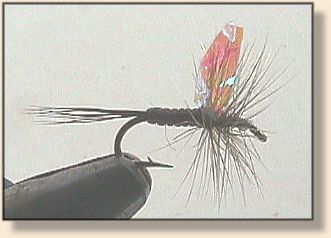
Mirage also comes in a sheeting, either smooth or crinkled, which can be
used for shellbacks, mayfly wings, nymph flashbacks, and who knows what
else. This material will surely spur on the imagination of any fly tier.
An excellent companion to this remarkable product is Hedron's other new item,
Perfect Rubber. Hedron claims that it has the best qualities of both rubber and
silicone. Not being sure at what point rubber would reach perfection, I'll leave
alone claims of infallibility and instead judge what I know.
The benefits of wiggly leg material in general are patently obvious. Most
long legged aquatic creatures have a high degree of mobility in those legs.
Hackle is great in most cases, but for excitable fish like Bass, Panfish,
Steelhead, and others, as well as on larger naturals such as Stonefly
and Dragonfly nymphs, and Crayfish, a little extra degree of purported
mobility can trigger a take more effectively. Standard rubber-strand
material is good, but has limitations, the primary one being its short life.
You can only keep them for so long in warm weather before you have
a sticky mess in your fly box and your flies are missing a leg or two.
Even in cooler weather, there is no guarantee that the rubber strands
will not disintegrate to any extent. Newer silicone legs last longer and
do not melt as does rubber, but can be brittle, and often break during
the tying process. More than a few times I've been snapped on the finger
while trying to adjust or even out silicone legs - very frustrating. Additionally,
while both materials look like they should make a nice, segmented body,
neither works well when wound as such, unraveling with remarkable
predictability under various conditions. Not that either is a poor material,
they just have their limitations.
Perfect Rubber has surpassed some of these limitations making rubber-strand
material that is useful for a wider variety of purposes. It looks and acts like
standard rubber both in the package and in the water, but has two main
elements which set it apart from the rest of the products available now.
The first is that the diametre of the individual strands can be made
permanently thinner by stretching them. This may not seem overly
important, but is quite useful because from the same package
(literally from the same strand,) you can tie all manner
of patterns, from #1/0 Bass flies to tiny #18 trout flies. You can
also tie "tapered" legs if you feel compelled to do so. Somehow,
(I do not know how,) the strands start nice and plump,
can be pulled to look rather anorexic, and do not return to original size.
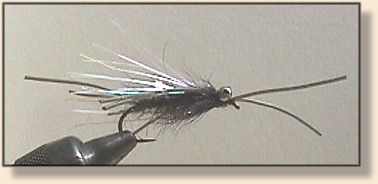 These aspects also lends themselves to the wrapped-body application
in a multitude of sizes. Even on dry flies, from a #10 Green Drake to a
#18 BWO, you can stretch and wrap the material, and due to its strength,
it will both retain its size, and from all apparent reasoning, not snap. I tied
a few nymphs using this technique, and they are still holding up after
several fish each.
These aspects also lends themselves to the wrapped-body application
in a multitude of sizes. Even on dry flies, from a #10 Green Drake to a
#18 BWO, you can stretch and wrap the material, and due to its strength,
it will both retain its size, and from all apparent reasoning, not snap. I tied
a few nymphs using this technique, and they are still holding up after
several fish each.
An added benefit of the Perfect Rubber is some of the unique colours
and colour combinations available like Pearl, Avocado, Smoke, and
others. All the colours are extremely clean, from the naturally smooth
Brown/Olive to the vivid, ocularly demanding Fluorescent Chartruese.
Even when stretched, the material retains its original colour without
losing sheen or shade.
Together, these new Hedron products present the tier with a whole new
spectrum of tying opportunities, and should provide for sparks of ingenuity
to light new torches in design. From stillwater to bluewater, and everything
in between, these will help us to create "something illusionary" with new
creativity.
I don't know what the future in fly-tying materials holds, but I do know that
I'm going to keep my eye on Hedron Inc. to get an idea. Based on their past
innovations and their current presentations, I'm sure their future holds great
things. Meanwhile, I'm going back to my bench.
Mirage Products and Perfect Rubber are available at your local fly shop.
For more about Hedron products see the information on the Hedron
Sponsor page here on FAOL. ~ Thomas C. Duncan, Sr.
Hedron, Inc.
402 North Main Street
Stillwater, Minnesota 55082
Phone: 651-430-9606
Email link: dm@hedroninc.com
|
