 Everyone's heard of 'you-know-who' and his hackle.
However, not everyone has heard of Dennis Conrad
and his hackle. My intent is not to compare hackle brands or pass
judgement on what is 'the best.' Such determinations
cannot possibly be made in any sort of subjective way, because
every tyer has their own opinion on what is important in hackle.
With some, it is the number of hackles that will wrap tiny tiny
flies. With others, it is the color of the hackles. Still others
will go with barb density, or number of feathers per patch, or
the length of the average 'sweet spot.' What I will
not do is try to gauge these hackles based on number of
flies tied per patch. That's an interesting number, but
not one that I care much about. Value is something that needs
to be determined by each buyer.
Everyone's heard of 'you-know-who' and his hackle.
However, not everyone has heard of Dennis Conrad
and his hackle. My intent is not to compare hackle brands or pass
judgement on what is 'the best.' Such determinations
cannot possibly be made in any sort of subjective way, because
every tyer has their own opinion on what is important in hackle.
With some, it is the number of hackles that will wrap tiny tiny
flies. With others, it is the color of the hackles. Still others
will go with barb density, or number of feathers per patch, or
the length of the average 'sweet spot.' What I will
not do is try to gauge these hackles based on number of
flies tied per patch. That's an interesting number, but
not one that I care much about. Value is something that needs
to be determined by each buyer.
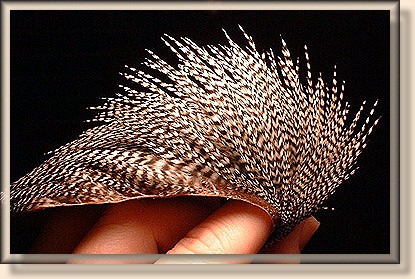
What I will talk about is the quality of the hackles. The way they
tie. I will discuss the range of sizes found on necks and saddles.
I will talk about how the hackles behave when palmer wrapped,
parachute wrapped, and wrapped in a traditional 'Catskill'
fashion. I will talk about the colors, the barb density,
the 'sweet spot,' and all the other attributes
that fly tyer's will consider when choosing hackle. When
all is said and done, you might be surprised with what
such a small-scale hackle breeder can produce.
 |
|
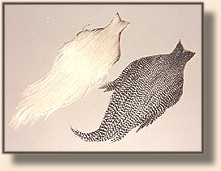
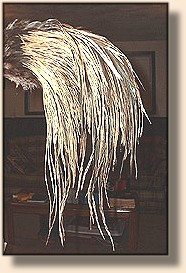
A pair of Conranch dry fly necks. |
|
|
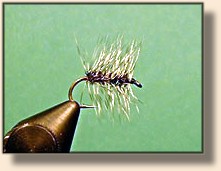
Griffith's
Gnat
|
 |
|
California
Mosquito |
 |
|
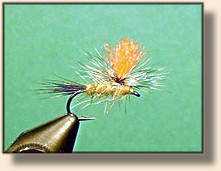
Parachute Hare's Ear |
 |
|
Conranch Dry Fly Saddle |
 |
|
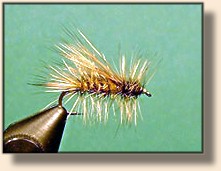
Stimulator |
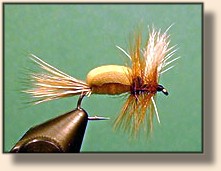 |
| Foam Humpy |
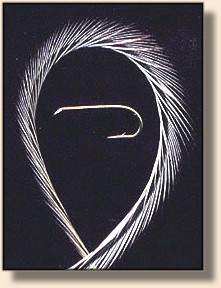 |
| Conranch saddle hackle and size 18 Tiemco TMC100 |
 |
| Medium Dun JV Hen Skin |
Dennis has been raising birds for over
40 years. What started out as a project to earn him a
merit badge in Scouts has become a business that
he and his daughter Liz run together, just the two of them. His ranch
produces upwards of a thousand products per year with a near-term
goal of about 1500, which is just where he wants it. Any more
and he would have to hire out for help, which he would like to
avoid. He enjoys it being just Liz and him.
The Conranch line of hackle is from a flock of birds
that has been bred for their dry fly hackle for almost
a half a century. The colors are all natural - from
rich blacks through cream and gingers, to bright
grizzlies. In addition to dry fly necks, his birds also produce
excellent dry fly saddles. He also has brought onto the market
a line of hen products specifically targeted toward hackle tip
dry fly wings.
Dry Fly Necks
Conranch sells hackles and necks separately. The necks have a good range
of hackle sizes from smaller than I will ever use (in the 20's)
to a useable size 8. The meat of the neck is in the 12-20 range,
which is perfect for most applications. To learn more about these
hackles, I chose three flies that I thought represented typical
uses of dry fly neck hackles - a parachute, a conventionally hackled
fly, and a palmered. Using his grizzly hackle, I tied a parachute
Hare's Ear, a California Mosquito, and a Griffith's Gnat.
The mosquito was a good test, because what I've found in using other genetic
dry fly hackle is that good tailing materials has been sacrificed
for longer and thinner hackles. I have some old necks that have
wonderful wide hackles that would be found on the throat of the
rooster. These have long, shiny, stiff barbs that produce excellent
tails on a conventionally wrapped fly. I was pleased to discover
some nice tail hackles on the Conranch hackle.
I was able to easily tie the three standard fly styles with no problems.
The stems of the hackles were thin and flexible and did not show
any desire to twist while the hackle was wrapped. The parachute
hackle was nice and flat, and the double wrap of hackle on the
Mosquito fell into place very nicely. There was plenty of length
to palmer the Griffith's Gnat. In short, I found the neck to do
exactly what I would expect it to do.
Dry Fly Saddles
Everyone is going nuts for dry fly saddles these days. As far as I knew,
there was only one breeder producing what I would consider true
dry fly hackle on a consistent basis. The Conranch hackles I was
able to review provided a good mix of true dry fly quality hackle
as well as some very webby 'schlappen' style hackles.
From the same patch, I could pluck a ten inch long feather that
was a perfect size 18 dry fly hackle, and I could put a seven
inch long feather that was solid dense web in a beautiful irridescent
black that will produce fantastic wooly buggers or other wet flies.
I'm not one to worry about how many flies I can tie from a single feather.
What I care more about is being able to tie good flies with the
feathers I have to work with. The type of flies I would tie with
a dry fly saddle would mostly be palmer bodied dry flies like
an Elk Hair Caddis or a Stimulator. Since the stems of dry fly
saddle hackles are so thin, you can wrap an extraordinarly dense
hackle collar, which is great for 'western'- style dry
flies such as a Humpy or a big Wulff-style fly. With these flies,
meant to be fished on the surface of very turbulent water, the
more wraps of hackle you can pack into the space available, the
better. As such, you are better off using saddle hackle. The barb
density on a good dry fly saddle hackle usually is higher than
an equivalent neck hackle, and since the stems are thinner, you
can usually make the wraps tighter and closer together. For the
purposes of this review, I tied a Stimulator and a Foam Humpy,
to test the qualities of the Conranch saddles.
What I found was impressive. As I expected, I was easily
able to tie a Stimulator. I mean, with a ten inch long
hackle, if you can't palmer a stimulator body, something
is wrong. The hackle palmered well, did not want
to twist, and projected nicely from the dubbed body. I had plenty
of hackle to spare. The Humpy went equally well. I was easily
able to pack a ton of hackle around the wings. I figure this fly
will float forever.
J V Hen Skins
Dennis is rightly proud of these hen skins. They are
bred to serve as dry fly wings on traditional dry flies.
Each skin comes with a complete neck and saddle patch.
These are called 'J V' because they are not
yet mature birds. Taken early in their growth, the
neck hackles especially are nicely shaped for wings, with rounded
points and a nice web line. The saddles show feathers with solid
web that will produce excellent soft hackle wet flies or even
can be used to make cut wings for more realistic dry flies. You
can't find these hackles elsewhere. Most hen necks have hackles
that are long and thin, with pointed tips and relatively little
web, another by-product of breeding for dry fly hackle. Dennis
understands what fly tyers want, and he produces hackles to satisfy
those needs.
For more information on Conranch Hackle you can visit
Dennis on the web at
https://www.conranch.com
Conranch Hackle
35926 North Conklin Rd.
Elk, Wa. 99009
Ph. (509)292-2141
|
