I've played with a lot of fly rods in my lifetime. Most of the rods
had something, usually something little, that I would improve if I
was building the rod. I guess I had pretty much settled my thoughts
and desires to Sage and G. Loomis because in my opinion, they
offered the most performance for the dollar. I recently had the
opportunity to build a fly rod on a Gatti blank. Keep in mind, I
rarely fish with anything that isn't labeled Sage or G. Loomis on
the rod blank. I'm a fanatic for high modulus and performance,
so I looked at the Gatti with a cautious eye.
The first thing I was skeptical about was the
claim that there would be very little if any spine (or spline) to the
rod blank. How could a fly rod blank have no spine? The process
that creates a rod blank guarantees a spine of some sort. I was sure
I'd find a noticeable spine.
Then there is the claim that Gatti blanks have
a uniform wall thickness. In my experience, this is as unlikely as
winning the lottery. It's true that the best rods (Sage, Loomis,
T&T, Winston, etc.) have a fairly uniform wall thicknes
s, but the process of creating a graphite rod blank assures some
lack of uniformity in the wall thickness of the rod blank. Buy a
cheap rod, and the lack of uniformity will be very noticeable.
The next thing I had doubts about was the
claim by some that the rod would be a smooth power house with
a fast action. I like fast actions, but most of the time fast and smooth
don't share the same space. Smooth as in Sage SP is accomplished
by giving the blank a progressive action. In the case of the SP+, the
smooth feeling is replaced by a rifle fast action. The SP+ is a high
performance rod for sure, but in my opinion, not as smooth as the
regular SP.
How about the claim that Gatti rods are as light
in physical weight as you can buy? Everyone knows that title belongs
to G. Loomis. How could a finished rod blank be as light as an
unfinished blank? Let's get real, I suspected a little bit of creative
advertising was behind that claim. After all, they all claim to make
the best fly rods in the world.
Finally, there's the claim of a smooth flow
of power between the rod sections. In fact, the claim is that it is
as close as you can get to a one piece blank in feel and power flow.
The only way to achieve that flow is to use a thin ferrule, and thin
ferrules break. I suspected a little bit of creative advertising here too.
Obviously, I was skeptical of the claims.
After all, any rod with all of the above listed characteristics would
have to be able to jump into a phone booth and emerge seconds
later with a big "S" on its chest. People kept telling me to try one,
but I was sure I didn't need another rod and my budget didn't need
another one either. So when J. Castwell and Ladyfisher arranged for
me to get my hands on a blank, my answer was; "OK." Getting me
to try a new fly rod is about as hard as getting a fish to swim in a river.
A shiny new Gatti two piece fly rod blank in
an 8 1/2 foot four weight (FR864TA) arrived just in time for me to build it and
take it to the Bighorn River on my annual fishing vacation. If anything
can test a fly rod, the Bighorn will. In fact, if the rod has flaws, they
will show their faces on that river as soon as a big fish grabs your fly
in heavy current.
So, how did it perform? Let me tell you how
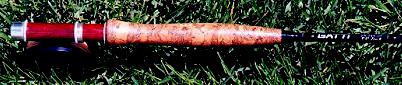
I built it first. I used a burl cork handle because I like the look and
feel of burl cork. I used single foot strippers and snakes to keep the
weight down and free the action up. A down locking, slip ring reel
seat finished off the components. Hmmm, it looks nice, but how
did it perform? I'll address each claim separately.
The blank does have a spine. It only took my
trained hands two tries to find it and six checks to confirm its existence.
Most people wouldn't notice the spine, but if you can find it, place the
guides according to the spine. If not, don't worry about it, with this
rod it won't matter much if at all.
I used magnification to check the blank for the
uniform wall thickness that was claimed. As far as I can tell, it is
uniform throughout its length, and definitely in the areas I could see.
That would explain the lack of a spine.
Well, how about weight, power and speed?
The finished rod weighs less than my Loomis 8 foot, four weight IMX.
In fact, the reel I use on my Loomis is the one I used on the Gatti, but
the balance point moved closer to the reel on the Gatti handle. It casts
as smooth as my nine foot, four weight Sage SP, but will outcast the
SP by about ten feet. I let eight guides on the Bighorn cast it to see
what they thought about its performance. Without exception, they all
liked the smooth power and the light weight of the rod. I overheard
one guide telling another guide that he wished he hadn't bought four
Sage rods this year because he wanted a Gatti after trying mine. That
was the same guide who cast all of the line and five feet of backing with
a double haul. Not bad for a four weight. It doesn't have a noticeable
spine, but it has plenty of backbone.
As I suspected, the ferrule is thin. I expected
the rod to break on the first big fish. One guide asked if it was a one
piece blank because he didn't see or feel the connection between the
sections. I landed a rainbow over twenty two inches and was broke
off by bigger fish in heavy current without a problem. If you build
a rod on one of these blanks, be sure to wrap the ferrule with thread
so it won't have a chance to split. A little candle wax on the ferrule
is a good idea to keep it snug without the tendency to stick. By the
way, I no longer expect the rod to break.
I'm not getting rid of my Sage and G. Loomis
rods. They make outstanding fly rods and blanks worth every penny
it costs to own one. Compared to other rods, I think Sage and Loomis
are kings of the hill. But, there's a new kid on the performance block
named Gatti, and this one will give Sage and Loomis a run for their
performance money. In fact, the performance contest just moved to
a higher level with Gatti uniform thickness blanks.
Finally, the Gatti is a performance blank. That
means it's built with very high modulus graphite and is prone to fracture
if you abuse it. The same is true with other performance rods like Loomis
and Sage. The higher the modulus, the easier it is to fracture the graphite
fibers with impact like you would get with a beadhead or an epoxy head
fly. If you want to abuse your fly rod, buy a broom stick. But, if you
want sports car performance, make your next rod a Gatti. I didn't notice
the "S" on its chest, but it met the advertised claims very well. In fact, I
believe my next rod will be another Gatti. I wonder, will a nine foot, two
weight Gatti cast a whole line?
~Al Campbell
|