Photography is all about being at the right place
and the right time with the right gear. Sound
suspiciously like fly fishing? Combining the two
can be a major challenge. But for most fly fisherman,
the photograph is the only tangible trophy we have of
our adventure since many of us catch and release. So
next to catching that trophy fish (however you want
to define trophy) it's the photograph that matters.
While you might not have thought of it, but fish biology
has links with photography. Photography is all about light,
so is fish coloration and a lot of their feeding habitats.
We need to know both and use both to capture on film our
great catch. But how do you do that? Here's some simple
tips that you can use to improve your fish photography.
Camera
The camera is really important. You need a camera I feel
that has certain attributes. The first is small and compact.
I prefer a pocket camera or small SLR and now days, digital.
Next is the lens. You need a range that is wide angle to
short telephoto. Last feature is built-in flash.
When it comes to camera bodies, I personally have the Nikon
Coolpix 5700 and D2H, but that's not normally what I take
fly fishing. I've come to depend the Coolpix 3100 and D100.
Both of these cameras are small and compact. Both deliver
excellent quality in a small package.
These two cameras have lenses, or the ability to accept
lenses, that are perfect for fly fisherman. The 3100 has
a range of 38-115mm which is perfect (and the whole camera
fits in your pocket). The D100 can accept hundreds of
lenses, I prefer Nikon 24-120VR. This combination of
small body and lens provides the flexibility plus the
VR technology makes getting sharp images when I'm in a
boat or float tube really easy.
These two cameras more importantly have a built-in flash.
It's that light thing and as you'll see, it can make or
break your photo. Whatever camera you get, keep in mind
it doesn't like water. No matter the camera, keep it
dry. The easiest way of doing this is a Ziplock bag.
Just keep the camera inside and you'll have no problems.
When you do use the camera, try to have a dry hand.
Moisture on your shutter release finger can force water
into places it shouldn't go. And if you have any fish
slim on your hands, don't touch a camera because it will
do it in!
Whatever camera you use, it is important it not get in
the way of your fishing but does the job.
The Background
Making the subject 'pop' is one of the keys to a
great photograph. While the beauty around you
should not be forgotten or left out of your
photograph, the subject, typically the fisherman,
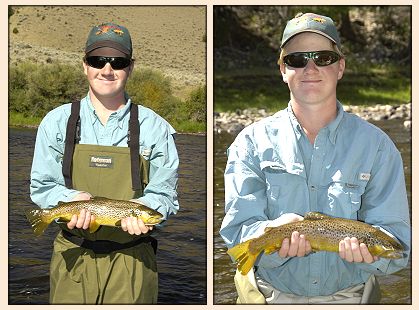
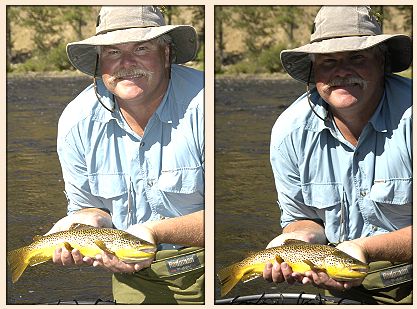
should visually pop out. If you look at the two
photos above, can you tell the difference between
them even though it's the same subject? What is it
about the image on the right that makes the subject
visually pop? It's the background!
Look at the background. The one on the left, the
background has the same light falling on it as on
the subject. The photo on the right, the background
is dark making the subject that is in the sun visually
pop. More importantly, the Brown is in front of shade
as well, so both the fisherman (my youngest son) and
the fish visually pop. This is a very simple principle
that can radically improve your images. It also ties
in with what makes it all work, light.
Light
Light is what makes or breaks great photographs. Let's
start with the two images above. Why is the photo on
the left better than the right, light. In this case
we've used the built-in flash on the camera to light
up the fisherman (me) and his catch. The technique
is flash fill and with current cameras is an easy
technique to learn. Basically, we're filling in the
shadow with light so we can see what the shadow was
hiding. If you want to master flash fill, you might
want to check out the flash How To on my website
www.moose395.net.
There's nothing wrong with direct sunlight, but...It's
like trying to fish with a size 8 when you know size 22
would nail that big fish. Too much sun is not a good
thing. I'm sure you've heard that the best photography
is at dawn or dusk. The truth of the matter is, the light
levels during these hours are typically the mellow light
you want for photography. They can occur anytime of the
day, you just need to recognize it (and of course, catch
the fish when that light is happening).
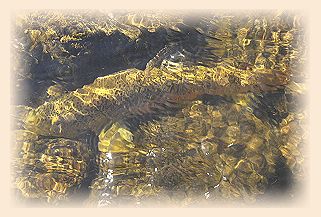
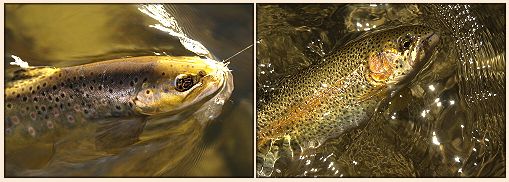
The two photos above were both taken during those mellow
light hours. But if you look at the Brookie and compare
it to the Rainbow, you'd see one big difference in the
light. The Brookie is backlit and the Rainbow is frontlit.
The Brookie has flash fill bringing up the detail in the
spots where the Rainbow doesn't need the extra light to
see its spots. It's all about light.
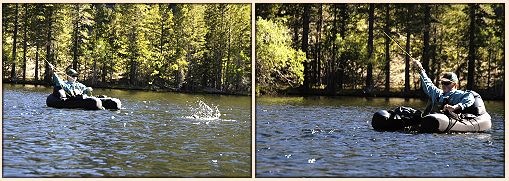
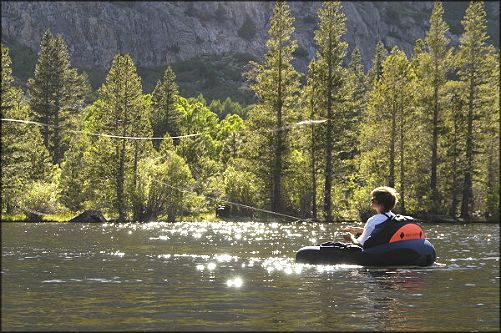
Once you have the right camera and you start thinking
about backgrounds and light, you can bring drama into
your photos. The two images above illustrate my point.
Both images were taken minutes apart (two different fish),
but I changed my position (I'm in a float tube). The
lighting on my son remained the same as far as quality
but instead of front lighting like you see in the photo
on the right, the lighting is now backlighting in the
photo on the left. Coupled with the backlighting is a
darker background giving the whole photograph a totally
different feel.
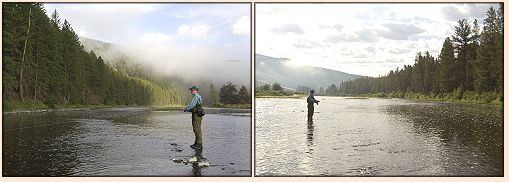
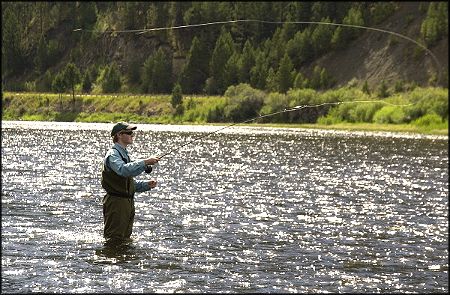
This brings us to the images I see most fly fisherman not
capturing and that's the grandeur we fish in. This is when
that wide angle comes in. When you combine the wide angle
with background, light and gorgeous surroundings, you've
got a great image. You can shoot frontlit or backlit,
subject big or small, flash fill or natural light and
be a winner when you just think about all of these
elements. It can be a challenge when you're also fishing
because typically as soon as you see that great image,
that great fish also grabs your attention. I don't know
of a way around that problem yet.
These are the bare bone basics of catching the great
shot of that great catch. There is obviously a lot more
to it than what is here just like there's more than just
tying on a fly and casting it. Just as it takes more
knowledge than fly and cast to catch that beautiful
fish, it takes more than owning a camera to capture
that great image. There are lots of resources out there
you can read to further your photography. Practicing when
you're not fishing is a great first step. Photograph people
in different light and backgrounds. Place a soda pop can
in water and practice shooting it to learn light. Personally,
I have a hard time between fly fishing and photography,
photography and fly fishing and hopefully I've helped you
get into photography for fly fishing! ~ Moose
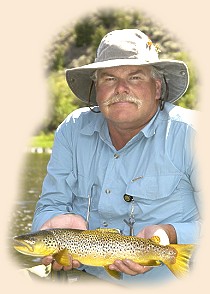
About Moose:
Moose Peterson is a professional wildlife photographer,
fly fisher and fly tyer, (you will find several of his
flies in the Fly of the Week section) who lives in
Mammoth Lakes, CA. He has an extensive website to
furnish wildlife photographers with information to
make the most of their photographic pursuits. You will
find it at: www.moose395.net/
|